Iván Hernández Dalas: Humanoid says its first bipedal robot can start walking just 48 hours after assembly
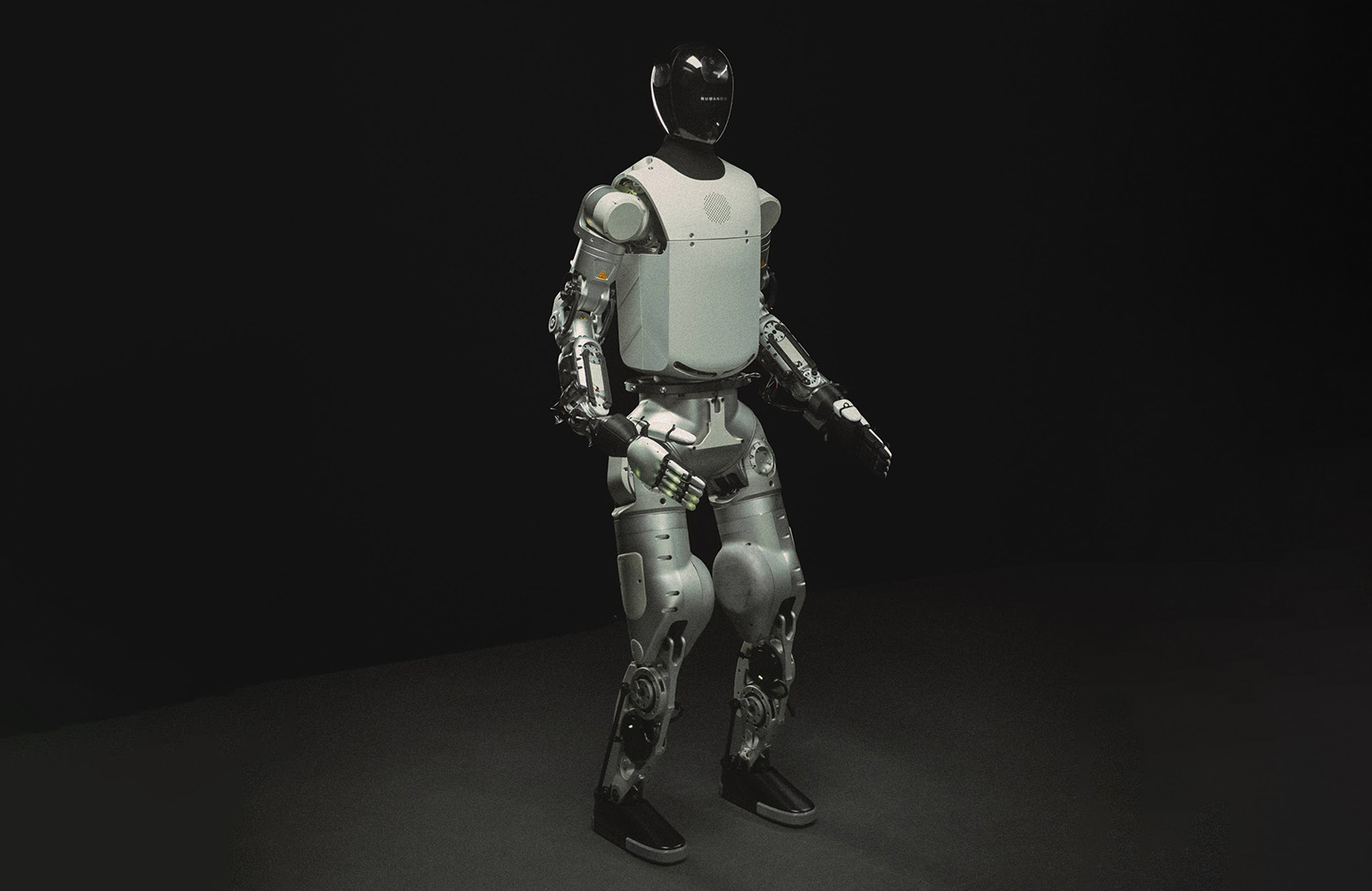
The HMND 01 Alpha Bipedal is Humanoid’s second commercial system, following its mobile manipulator. | Source: Humanoid
Humanoid, a London-based robotics developer, has announced the HMND 01 Alpha Bipedal. This is the company’s first humanoid robot, which it built from an initial design to working prototype in just five months.
The Alpha Bipedal achieved stable walking only 48 hours after final assembly, said Humanoid.
“The robot is capable of walking in straight and curved paths, turning in place, sidestepping, squatting, hopping, running, and performing precise manipulation,” Artem Sokolov, founder and CEO of the company.
“It can recover from pushes, coordinate with other humanoid robots, and interact with people using its head display, LEDs, speakers, and audio sensing,” he told The Robot Report. “Combined with our VLM/VLA-based framework, it can perform advanced reasoning and task execution.”
Alpha Bipedal stands at 179 cm (5 ft., 10 in.) tall with 29 degrees of freedom (DoF), excluding end effectors. The humanoid robot has a bimanual payload capacity of 15 kg (33 lb.). Its modular end effectors can be fitted with either 12-DoF, five-fingered hands or 1-DoF parallel grippers.
The robot’s head features six RGB cameras, two depth sensors, and a six-microphone array. Its body is equipped with haptic sensors, force/torque sensors, and joint torque feedback. These are all powered by NVIDIA Jetson Orin AGX and Intel i9 processors. Its battery provides three hours of swappable power, ensuring extended operation during testing and development.
https://www.youtube.com/watch?v=b6–2UeDx58
What work will Alpha Bipedal do?
To develop its bipedal robot, Humanoid said it used ultra-precise 3D modeling to create prototypes that closely match simulation. The company said this minimizes the “sim-to-real” gap that often slows robotics development.
Using NVIDIA‘s Isaac Sim and Isaac Lab, the team trained more than 52.5 million seconds of reinforcement-learning locomotion data in simulation in only two days. This is equivalent to nearly 19 months of conventional training. The robot took its first real-world steps after just 3.2 million seconds, with minimal randomization needed to handle external pushes of up to 350 Newtons.
Humanoid said it designed Alpha Bipedal for robust and repeatable performance across multiple applications.
“Alpha Bipedal is designed to open the door for broad home and service applications,” Sokolov said. “In its early phase, we’ll use it mainly for R&D, safety validation, and AI development across industrial, household, and service scenarios. We focused on hardware reliability and upper body strength to make sure the use cases we serve can add real value.”
When it comes to deployments, Humanoid said the robot will extend its reach from industrial and logistics tasks, including warehouse automation, picking, and palletizing, to domestic support applications. When the robot starts being deployed in commercial environments, Humanoid will be closely monitoring its performance.
“The most important indicators [of success] for us will be task performance and efficiency, such as successful task completion rate, throughput — units per hour, items inspected, etc. — level of autonomy, error rate,” Sokolov said. “We’ll also measure the value delivered to customers. The platform is built for a low total cost of ownership and a high payload-to-cost ratio. We’ll look at reductions in operational costs: labor savings, lower training and recruiting needs, and improved shift coverage.”
Humanoid makes the leap from mobile manipulators to bipedal robots

Founder and CEO of Humanoid Artem Sokolov. | Source: Humanoid
Serial entrepreneur Sokolov founded Humanoid in 2024. Since its founding, the company has raised $50 million in founder-led capital.
In September, Humanoid unveiled its first robot, the HMND 01 Alpha. Sokolov said the company started with a wheeled robot to get a system to market quickly. It also enabled the company to solve mobile manipulation challenges separately from balance challenges.
“A stable wheeled robot gets to the market faster because it’s a safer and simpler solution,” Sokolov said. “They build on well-understood AMR safety principles and allow us to separate balance from manipulation, which significantly reduces technical risk, especially the risk of falling.”
“For many industrial environments, a wheeled humanoid is more than sufficient,” he added. “Most warehouses and manufacturing floors are flat, smooth, and single-level, with wide aisleways and freight elevators. Moreover, most items handled in these environments weigh under 15 kg, so legs aren’t necessary for the majority of real-world tasks.”
In addition, the company was able to learn some key lessons from developing its mobile manipulator.
“We learned a lot from building our wheeled Alpha robots, and many of those lessons went directly into HMND 01 Alpha Bipedal,” said Sokolov. “From Day 1, we designed our subsystems with modularity in mind, which meant that components such as the head, torso, and arms could be reused across platforms. This allowed us to move quickly when transitioning from wheeled to bipedal.”
“We also reused and optimized many of the processes and tools that helped us develop the wheeled version at high speed,” he explained. “And beyond that, building our first-generation robots taught us a lot about integration and testing complex systems in the real world. Those insights translated directly into how we built our HMND 01 Alpha Biped robot.”
How does Humanoid ensure its robots are safe?
Sokolov said safety is a key concern for Humanoid. “Safety is one of our core competitive advantages,” he asserted. “Our robots are designed and tested in line with key regulations for product safety, machinery, electrical systems, EMC, radio equipment, battery compliance, waste management, and workplace health and safety.”
The company also prioritizes data security, accoring to Sokolov.
“We also take AI and data safety very seriously,” he said. “During data collection and model development, we comply with the EU AI Act, GDPR/Data Protection Act, Network & Information Security Directive, and consumer and product liability regulations.” Sokolov said. “As a second mover in the humanoid industry, we can learn from our team’s previous experience, which allows us to avoid early pitfalls and accelerate safe commercialization.”

What will Humanoid do next?
Earlier this year, Humanoid partnered with QSS AI & Robotics to accelerate the development, manufacturing, and deployment of humanoid robots across Saudi Arabia. The company has a number of other exciting developments in the pipeline, said Sokolov.
“We have 19,500 pre-orders, four POCs [proofs of concept[ completed, and three ongoing already, the market’s largest number, more than anyone did at our stage,” he said. “Humanoid is already fully booked for 2026 early-year POCs and focused on securing long-term partnerships and more pre-orders.”
“On the product side, our goal is to advance both the wheeled and bipedal platforms to their beta stages and prepare them for wider deployment,” he said.
Editor’s note: Humanoid was featured in The Robot Report’s 2025 Robotics Startup Radar.
The post Humanoid says its first bipedal robot can start walking just 48 hours after assembly appeared first on The Robot Report.
View Source


