Iván Hernández Dalas: EY rolls out physical AI platform, opens EY.ai Lab, and names global robotics lead
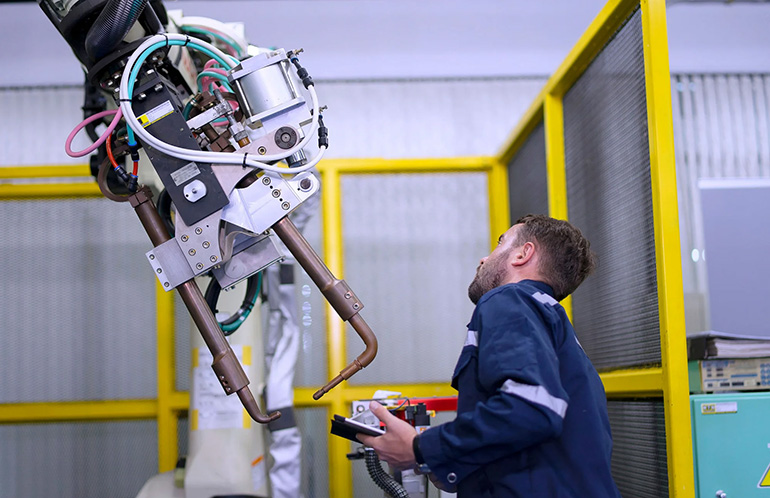
EY is collaborating with NVIDIA and other partners on physical AI. Source: EY
EY, the collection of firms under Ernst & Young Global Ltd., is known as a consultancy, and it is moving into physical AI and robotics. The company today said it is adding a focus on the potential of artificial intelligence with a new platform and solutions, a leadership appointment, and a new laboratory.
Before robotics and AI can advance together, organizations must have the right data, said Joe Depa, EY global chief innovation officer.
“A tremendous amount of data is required to simulate physical AI in an environment before a robot is launched,” he told The Robot Report. “And there are several common challenges when using data for physical AI: data quality, accessibility, and data scarcity. If you don’t address these data challenges, your robots won’t work.”
“There is no physical AI without AI-ready data. A meal is only as good as its ingredients,” said Depa. “AI-ready data must be reliable, accessible, and scalable. It should be visible with proper context and consistency. The data must be trusted and secure, so it’s important for organizations to prime their data for effective physical AI use at scale, including data management and AI governance.”
“Data remains both the lifeblood and a bottleneck for organizations,” he added. “Data is a topic we know well. EY processes more than 1 trillion lines of financial data annually, including 50% of Fortune 500 data sets. And it has a 1.6TB+ weekly volume of AI-ready data products for client use.”

Physical AI platform to cover entire application lifecycle
EY said its new physical AI platform was developed with NVIDIA Omniverse libraries, NVIDIA Isaac, and NVIDIA AI Enterprise software. It is intended to provide a structured approach to implementing and managing AI systems executed by robots, drones, smart edge devices, and more.
The London-based company also plans to integrate NVIDIA Isaac’s open models, simulation, and learning frameworks to help clients to develop and validate AI-driven robots in realistic 3D environments. “NVIDIA AI Enterprise provides a secure, scalable, and high-performance foundation for employing advanced AI workloads,” it noted.
The platform will focus on three foundational elements, according to EY:
- AI-ready data: It will generate synthetic data to simulate the multitude of scenarios for physical AI.
- Digital twin creation and robotics simulation and training with Omniverse: The platform will use NVIDIA technologies to bridge the digital and physical worlds, providing real-time insights, monitoring performance, and facilitating operational continuity.
- Responsible physical AI: EY said it will implement robust “guardrails” for safety, ethics, and resilience across operations.
What does “responsible physical AI” mean?
“First, let’s be clear: EY is not in the business of manufacturing robots,” Depa replied. “For us, it’s about how we use data in a responsible way to enable physical AI. This includes simulation of the physical AI to ensure they are tested appropriately as well as enabling attestation services for the compliance and regulatory components that are required for many physical AI solutions.”
“To help advance responsibility, we’re developing digital twins for modeling, testing, and optimizing physical systems before deploying them into the real world,” he added. “We’re reducing risk and accelerating time to value for our clients. We also established the EY.ai Global AI Advisory Council to guide our responsible AI strategy and adapt to the rapidly evolving physical AI landscape.”
“Our recent ‘Responsible AI Survey‘ found that almost every company surveyed — 99% — reported financial losses from AI-related risks, and 64% experienced losses exceeding $1 million,” noted Depa. “At the same time, only 12% of C-suite executives were able to correctly match the appropriate control to specific AI risks, and organizations with fewer responsible AI controls in place reported even higher financial losses.”
EY said its offering will use components to encompass the entire lifecycle of physical AI applications, from strategy and safety to design, implementation, and maintenance.
“Physical AI is transforming how businesses across sectors operate and help create value, from enhanced automation and greater efficiency to significantly helping reduce operational costs,” said Raj Sharma, EY global managing partner for growth and innovation.
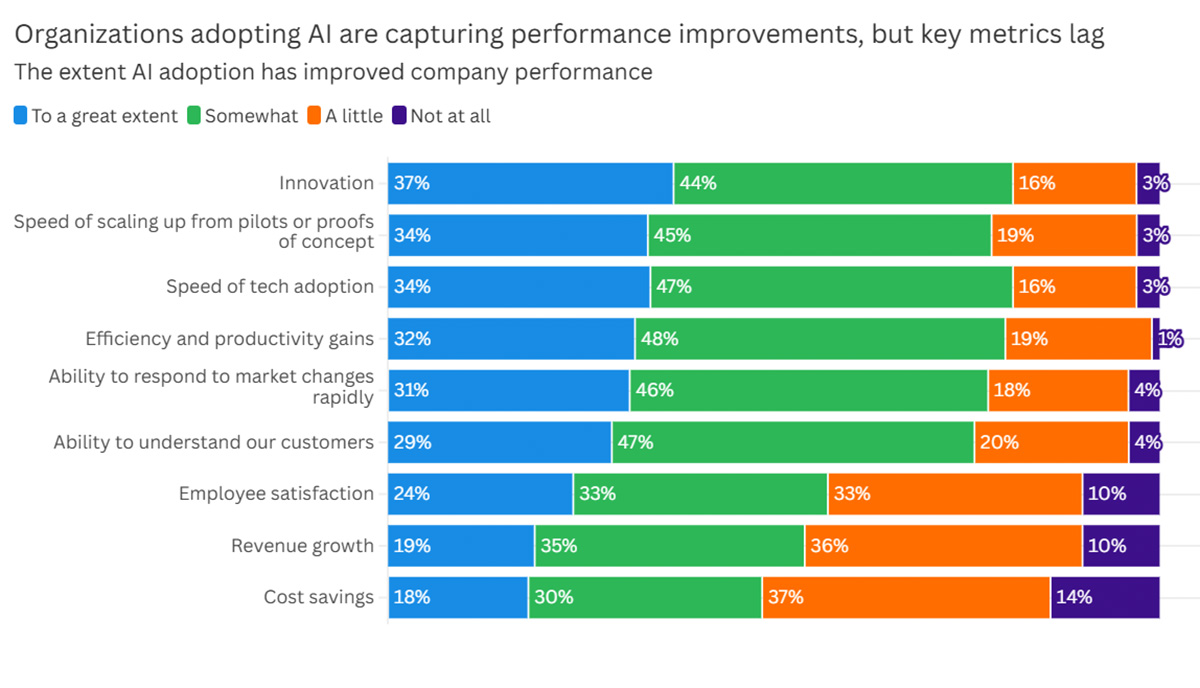
EY found that companies adopting AI are starting to reap benefits. Source: EY
Research veteran appointed global physical AI leader
Dr. Youngjun Choi is the new EY global physical AI leader, effective immediately. The company said he will oversee the next-generation robotics and physical AI workstream and position EY as a trusted advisor in this field.
“Choi brings nearly two decades of experience working closely with executives and industry leaders to advance new solutions, foster strategic partnerships and help accelerate growth,” said EY.

Youngjun Choi, EY. Source: LinkedIn
He previously led the UPS Robotics AI Lab, where he oversaw pioneering projects to transform the organization’s legacy network through adopting advanced robotics, digital twins, and AI.
Choi has also served as a research faculty member in aerospace engineering at the Georgia Institute of Technology, where he contributed to advancements in aerial robotics and autonomous systems.
Choi will lead the newly opened EY.ai Lab, which can help clients smoothly integrate AI into physical environments.
“We’re developing the next generation of EY talent through a hands-on physical AI sandbox where our people can experiment with cutting-edge robotics and AI technologies,” said Depa. “Dr. Choi’s priority is to accelerate the entire physical AI journey for our clients — from early education and immersive demonstrations to building digital twins, generating synthetic data, and driving real industry use cases.”
EY.ai Lab builds on NVIDIA collaboration
The new EY.ai Lab is in in the U.S. technology hub of Alpharetta, Ga. While it is part of a growing global network of EY sites featuring work with physical AI, the company claimed that it is the first one that is fully dedicated to this emerging technology.
EY said its lab is equipped with leading-edge robotics, sensors, and simulation capabilities, providing organizations an environment to rapidly prototype, test, and deploy scalable physical AI systems. The research and development facility allows partners and clients to:
- Design and simulate physical AI systems in a virtual testbed to validate financial viability and operational feasibility through comprehensive “What if?” simulations
- Develop robots across diverse form factors including humanoids, quadrupeds, and other next-generation platforms
- Improve logistics, manufacturing, and maintenance workflows through digital twins
This expansion builds upon ongoing EY and NVIDIA collaborations, including the agentic AI platform launched earlier this year. The partners will look to further expand physical AI offerings to provide capabilities for new industries such as consumer, energy, healthcare, mobility, and smart cities. They also said they hope to drive sustainability through intelligent automation that reduces waste and environmental impact.
“Enterprises are bringing robotics and automation into the real world to adapt to shifting demographics and boost safety for people working in factories and other industrial facilities,” said John Fanelli, vice president for enterprise AI software at NVIDIA. “The EY.ai Lab accelerated by NVIDIA AI infrastructure and software helps organizations simulate, optimize, and safely deploy robotics applications at enterprise scale, accelerating the next phase of the AI industrial revolution.”
The post EY rolls out physical AI platform, opens EY.ai Lab, and names global robotics lead appeared first on The Robot Report.
View Source


