Iván Hernández Dalas: Otis shares the secrets to controlling elevators for robots
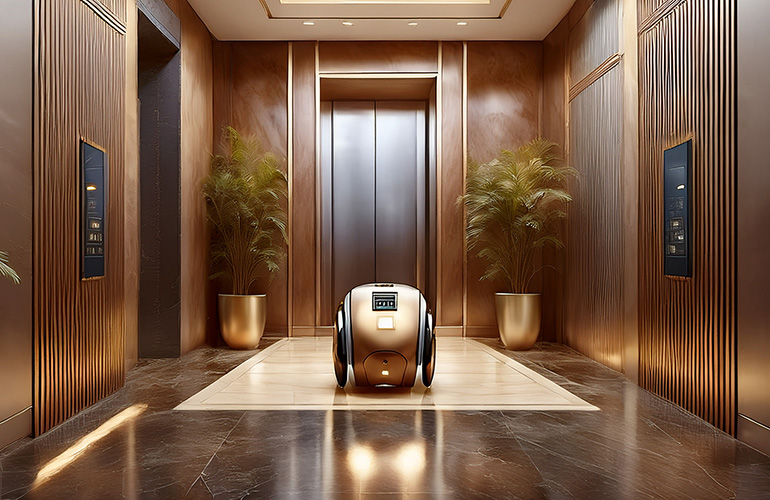
Image of a mobile robot waiting for an elevator, generated by Adobe Firefly. | Credit: The Robot Report
Farmington, Conn.-based Otis Worldwide Corp. is a global leader in vertical transportation, a legacy built on Elisha Otis’s 1852 invention of the safety elevator that continues today through the manufacturing and servicing of elevators, escalators, and moving walkways worldwide.
Mobile robots and elevators didn’t mix
A decade ago, integrating autonomous mobile robots (AMRs) with elevators was extremely challenging, mainly due to local elevator permitting restrictions and the lack of digital, standardized interfaces for controlling the elevators.
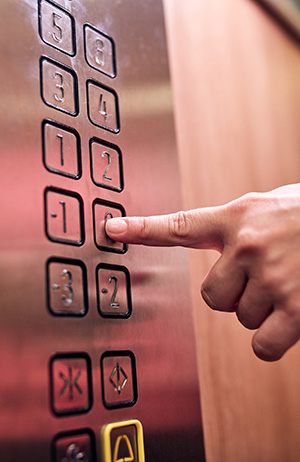
Interfacing with the controls on the elevator was difficult for robots, until digital APIs were supported. | Credit: Adobe Stock
Around 2018 to 2019, Otis recognized the growing demand and adoption of robots, especially driven by China. The company built on existing elevator technology while focusing on creating cloud-based, digital application programming interfaces (APIs).
Otis subsequently released Otis Integrated Dispatch, a cloud-based system for efficient, group-level integration of elevators with robot systems. This approach supports multiple robots in commercial settings such as hotels, hospitals, and warehouses. It can also increase scalability compared with the older, one-elevator/one-robot discrete wiring model, according to the company.
Otis relies on two-way communication. Not only can robots call elevators, but they can also receive real-time status information — such as in emergencies or service modes — to adapt their behaviors.
The company’s support now includes extensive documentation, a developer portal, a sandbox environment for testing, and ongoing support for robot software teams.
The platform is backward-compatible with most Otis equipment going back 30 years, allowing for significant retrofitting opportunities.
There is a move toward industry standards such as Singapore’s SS 713 and exploration of middleware technologies, but proprietary elements remain for now. The regulatory landscape is improving, reducing the historical risk for startups.
Otis harmonizes elevators and mobile robots
Otis said it treats mobile robots as building occupants, and its system operates to maximize overall productivity and the user experience. The integration process has shifted from heavy hardware installations to safe, certified, digitally managed connections supported by manufacturer supply chains, making deployment easier and inspections smoother.
The Robot Report recently spoke with Nick Cope, senior director of design strategy at Otis, to learn more about the state of the art in robot-to-elevator interfaces.
Tell us about how a mobile robot developer can interface to an Otis elevator in a building
Cope: Otis now supports a digital interface and APIs by nature, and these APIs are generally concerned with connecting our elevator systems to third-party systems, like a robot system, for example. The design strategy is the principle of putting human-centered design into business processes, business models, service design, and intervention.
Whenever we introduce a new piece of technology, we’ll work with the API user and the robot software team, to make sure that they have everything they need to fully understand the API. We can review their sequences and their retry logic and make recommendations based on our past experience.
Also, on the other side, we’re working closely with the local Otis teams, where there’s some installation involved. We also work with the property customers themselves, who will obviously have a lot of questions that they would like to have answered.
Because we’re a service company, our customer is also the robot provider’s customer, and we want to make sure that everyone’s goals are aligned.

How did the evolution happen to create the digital interface and establish a supported interface for the robotics companies?
Cope: Around 2018 or 2019, we saw a lot of adoption happening in China, so we investigated that. We knew that we had existing technologies that could be leveraged.
There are ways to get data out of an elevator controller and ways to control them. The real desire was to put them in the cloud, and then from the cloud get them out to the other third-party systems.
We were seeing robotic systems moving out of the industrial space, moving out of warehouses. We knew that AGVs were being deployed into hospitals. But the real big opportunity was to take that robotic technology and put it in more commercial spaces like hotels.
And then with the emergence of robotics-as-a-service (RaaS), the robot provider takes care of all the infrastructure, bringing a whole host of challenges for them. They have to bring their own interfaces, and interfacing with the elevator was an issue.
So we created a cloud-based API called Otis Integrated Dispatch, because it integrates the dispatching capability. Today, five years later, we’ve engaged with over 60 different robot companies. We have a developer portal that contains the documentation. We also have a sandbox environment that they can use for their testing.
We also encourage the robot companies to consider implementing emergency sequences as well, because we can pass that data on to the robot system so that it will know if the building is in trouble. For example, if the elevator is moved into fire service mode, or the elevator has been taken over by a medical team, the robot can be informed of these situations and react accordingly.
Have any standards emerged that will enable any robot to talk to any elevator in any building?
Cope: Yes. For example, the Building Construction Authority in Singapore just recently published something called SS 713, which is sort of an interoperability standard for systems in a building. And if you read through that, you’ll see they are encouraging the idea of multiple robots in the building.
There’s always going to be proprietary information between all the different elevator systems. That’s not going to go away, but ways to make it easier for everybody to get along are obviously the goal of the standard.
Also, ASME A17.1-2019/CSA B44-19 Section 8.17.1 outlined requirements for the maintenance, repair, replacement, and testing of elevators, escalators, and related equipment. It dictated that all such work must adhere to the Safety Code for Elevators and Escalators [now A17.1-2022], ensuring continued safety and compliance during operation.
The other trend we see happening is this concept of middleware. All of the different parties, including elevators, automatic doors, and robot OEMs, can benefit from a common interaction.
Is there a middleware that can abstract all of that language away to make it very simple for everybody, just to place their commands and then let the adapters that connect between the middleware and the different OEMs take their instructions from the middleware?
Is there a certain generation of Otis elevators, and probably across the industry as well, that is digital now?
Cope: Otis started installing elevators with digital controls about 30 years, around the 1990’s. We were very careful to design a system that can work with equipment that’s out there for retrofit.
Our technology, obviously, only works with Otis equipment, but we can retrofit it for backward compatibility with controllers around the 30-year mark.
To learn more about interfacing mobile robots with Otis elevators, contact sales-oid@otis.com
The post Otis shares the secrets to controlling elevators for robots appeared first on The Robot Report.
View Source


