Iván Hernández Dalas: Robotics industry reacts to iRobot’s bankruptcy
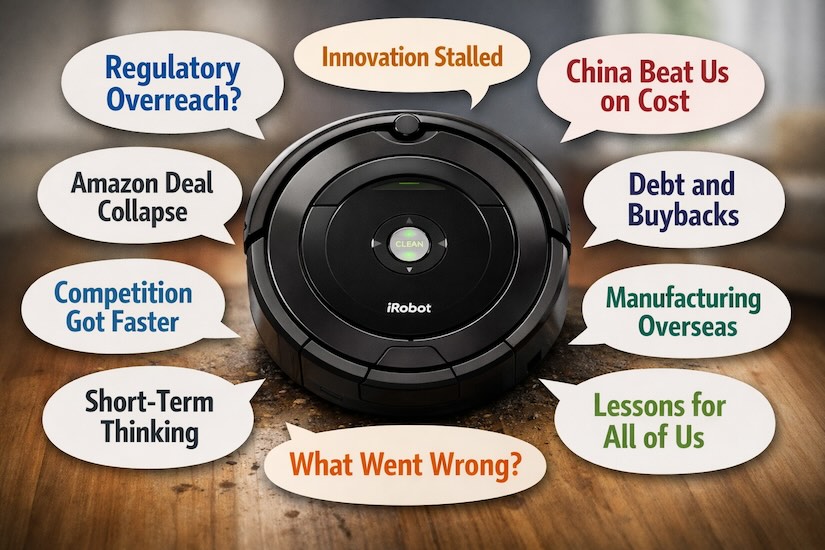
Image created using ChatGPT. | Credit: The Robot Report
While many in robotics saw this outcome coming, iRobot filing Chapter 11 bankruptcy has nonetheless sent shockwaves through the industry. Founded in 1990, iRobot is an iconic brand and a true category creator. It has defined consumer robotics since the launch of the first Roomba robot vacuum in September 2002.
The reaction has been deeply polarized. Some point to tariffs and regulatory intervention that led to the collapse of the proposed Amazon acquisition as the decisive blow. Others argue that longer-running issues played a larger role, including slowing innovation, structural challenges around scale and manufacturing, financial decisions, and intensifying global competition.
Regardless of where responsibility ultimately lies, iRobot’s decision to enter Chapter 11 and transfer control to its Chinese contract manufacturer marks a sobering moment for the robotics industry. In recent days, we’ve heard reactions from across the ecosystem, including former iRobot co-founders Colin Angle and Helen Greiner; co-founder Rodney Brooks has not commented publicly.
We’ve compiled a small sampling of responses from robotics leaders, engineers, and executives. Check your social media platform of choice for much more reaction. Some read as a postmortem of a pioneering company, while others serve as hard-earned warnings for anyone attempting to scale robots in today’s market.
What is your reaction to iRobot’s Chapter 11 filing? Share your perspective in the comments.
Editor’s Note: These comments were taken from social media platforms and have not been edited.
Colin Angle, CEO of Familiar Machines & Magic; co-founder and former CEO, iRobot
Today is a hard day. iRobot has filed for bankruptcy.
For more than 35 years, extraordinarily talented people poured their creativity, intelligence, and heart into building something entirely new: consumer robotics. Together, we brought robots into millions of homes and helped define what this industry could become.
I’m profoundly grateful to every customer, engineer, designer, operator, partner, and leader who made that possible. What you built mattered—and it still does.
I stepped down in early 2024, but that doesn’t make today any less painful.
What gives me pause is this: innovation doesn’t fail only when ideas are wrong—it can fail when the path to scale is removed. When companies that create categories are denied viable ways to grow, everyone pays the price: consumers, employees, and the broader innovation economy.
Despite this news, I remain hopeful. Robotics and AI are entering a new era, and the ideas, technologies, and people behind iRobot—and others like it—will continue to shape what comes next.
My hope is that moments like this force a serious conversation—not just about companies, but about how we, as a country, support innovation at scale.
For those building or investing in the next generation of technology: what lessons should we be taking from this moment—and how do we avoid repeating it?
Helen Greiner, co-founder and former chairman & president, iRobot
What went wrong with iRobot:
Regulatory overreach – Lina Khan, EU, stopping Amazon acquisition.
Tariffs – China, now Vietnam. Manufacturing highly complex, low cost consumer goods in the USA is impossible, sorry we would have loved to have done it.
Chinese innovation – low-cost LiDAR sensor
Taking on debt – crazy. Cut costs, debt just delays action compounding problems
Stock buy backs – financial games for short term price increases, use $ for innovation or diversification
Worst outcome is Chinese ownership of iRobot for U.S. lead in robots. In a sane world, U.S. gov would buy the iRobot stock, make debt long term, and keep the U.S. ahead in a market it built. iRobot does over $500M in sales, numbers that current robot companies being hyped would love.
Ira Renfrew, co-founder & chief people & product officer, Familiar Machines & Magic (previously worked 6.5 years at iRobot)
I’m deeply saddened this morning to see the news of iRobot’s bankruptcy. I owe my practical education in robotics and some of the best times of my career to the company, which was both the pioneering leader in consumer robotics and an active supporter of the robotics ecosystem in Boston and beyond.
I will always remember the stranger who, noticing my iRobot jacket, turned to me and said, “Your products have changed my life!” So many of my colleagues felt the same way about working at iRobot. Thank you to Colin Angle, Rodney Brooks, and Helen Greiner, plus so many others, for Changing The World. We can all be proud of that legacy as we go forward.
Bob Little, chief of robotics strategy, Novanta
What are the lessons learned from the iRobot bankruptcy? iRobot didn’t fail overnight. It took decades to get here — which makes the lessons worth paying attention to.
Being a public company didn’t help
Short-term investor pressure outweighed long-term product focus. Over its life, iRobot spent $400M+ on stock buybacks, capital that could have gone into engineering, manufacturing, and product advancement. Robotics is not a quarterly business.
Patents bought time, not safety
As competitors iterated faster, iRobot relied too heavily on historical advantages instead of continuous innovation.
Engineering was too lean
Treating engineering as a cost rather than an investment slowed iteration and made recovery difficult once product gaps appeared.
Distance from manufacturing mattered
Robotics improves fastest when engineering and manufacturing are tightly connected. Heavy reliance on overseas production weakened that feedback loop and slowed product cadence.
The Amazon deal became a crutch
iRobot should never have depended on one acquisition for survival. When it collapsed, there was no fallback.
A policy lesson for the U.S. and EU
Blocking the Amazon deal may have led to a worse outcome: a U.S. robotics pioneer now controlled by a Chinese contract manufacturer. Economic and manufacturing security must factor into these decisions.
iRobot wasn’t just a consumer company. It was a robotics pioneer.

Anthony Nunez, Founder & CEO, INF-Care
Unfortunate but not surprised, many of us OG roboticists saw this coming-it is in large part due to their unwillingness or inability to diversify their offerings (deliver other robots into adjacent or new spaces) They started to with their military division and then sold that off prematurely.
Gary Shapiro, CEO and Vice Chair, Consumer Technology Association
This week marked a sad chapter for iRobot, maker of the Roomba. This company pioneered the concept of robot vacuums and paved the way for a product that makes life better for millions of people. iRobot knew they faced intense competition from China. What they didn’t factor in was U.S. federal regulators kneecapping an American company in service of a “big is bad” agenda.
iRobot is a classic story of American innovation. Launched in 1990 by three MIT graduates, they initially set their sights on lunar exploration, producing products designed for use by NASA. After a few years, they pivoted to something a little close to home – mobile cleaners known as Roombas.
In recent years, the company faced off against Chinese competitors, who benefitted from government support, low-cost capital, and limited intellectual property enforcement. That helped them take the product concept and design and produce it cheaper. So they tried to pivot again, looking to find a larger buyer as a way to tap into new resources and scale their growth.
They found that company in Amazon, which was eager to wade into a growing sector and could provide market scale that was nearly impossible for the small Massachusetts company. It looked like a match made in heaven, until European regulators swooped in at the explicit request of the Lina Khan-led U.S. Federal Trade Commission. In my view, the FTC regulators knew they couldn’t make a compelling case in U.S. Courts. The acquisition was clearly legal under U.S. law! So instead, they convinced European regulators to block one American company buying another. As the deal fell apart in 2023, iRobot was forced to lay off hundreds of American employees.
Amazon CEO Andy Jassy called the outcome a “sad story” of regulatory failure, suggesting that regulators “trust…Chinese companies with maps of the inside of U.S. consumers’ homes more than they do Amazon.” I call it an abomination, and economic malfeasance!
CTA was vocal in opposing this regulatory overreach. At the time, I published an op-ed calling the collapse of the Amazon-iRobot deal a “blow to U.S. tech leadership.” While it doesn’t make up for what I saw as our government’s huge mistake, at CTA’s 2023 Digital Patriots Dinner we recognized the iRobot founder Colin Angle with one of our highest awards.
Sadly, the ultimate result of FTC interference was the bankruptcy of iRobot, a great American company. It will now be taken over by a Chinese supplier. I ask the FTC, and anyone reading this: are American consumers better off?
My view of life is that we all make mistakes, but we should use those mistakes as learning opportunities. Our American government should help and defend American companies, not hamstring them. American officials shouldn’t get legal cover if they seek to use Europe’s regulatory overreach to block American innovators.
This should be illegal, and it’s certainly not right. This must never happen again.
Matt Schruers, president & CEO, Computer & Communications Industry Association
This bankruptcy was foreseeable when regulators denied it a financial lifeline that would have saved U.S. jobs and boosted competition with Chinese companies. Unfortunately, this market is now almost entirely foreign-owned – an outcome that regulators should be avoiding, not causing. Policymakers and activists who celebrated when a deal to save iRobot was thwarted have cost American jobs and impaired U.S. standing in home robotics. The takeaway should be a cautionary tale for competition agencies reviewing low-risk mergers. Competition policy should protect competition, not competitors.

iRobot’s products over the years. | Credit: iRobot
Josh Orenstein, CTO, Lindeman & Associates
The company that helped NASA explore Mars just filed for bankruptcy and handed control to its Chinese supplier.
iRobot didn’t fail because they lacked technical expertise. They built the PackBot that cleared IEDs in Fallujah and surveyed Fukushima’s radioactive ruins. Their team designed rovers that informed Spirit and Opportunity on Mars.
They failed because organizational velocity beats technical excellence in consumer hardware.
While iRobot spent 10 years developing a lawnmower that never shipped, Chinese competitors went from concept to market in 6 months. While regulators blocked Amazon’s acquisition to “protect competition,” those same Chinese manufacturers captured 70% of the global market.
The robot vacuum wars ended with American robotics innovation answering to Shenzhen supply chains.
This isn’t a story about a failed product. It’s about what happens when strategic paralysis meets 3-4x faster product cycles, and when regulatory asymmetry determines which companies survive.
Andrea Okerholm Huttlin, staff robotics software engineer, Stack AV
iRobot’s bankruptcy hits hard; it’s a place where I spent so much of my career and made so many friends. Its legacy is not (just) Roomba and Packbot though. iRobot’s legacy is also the thriving robotics community that alumni have created and contributed to. Thousands of people learned real, practical consumer robotics on the job at iRobot.
I am so grateful for all of you iRoboteers.
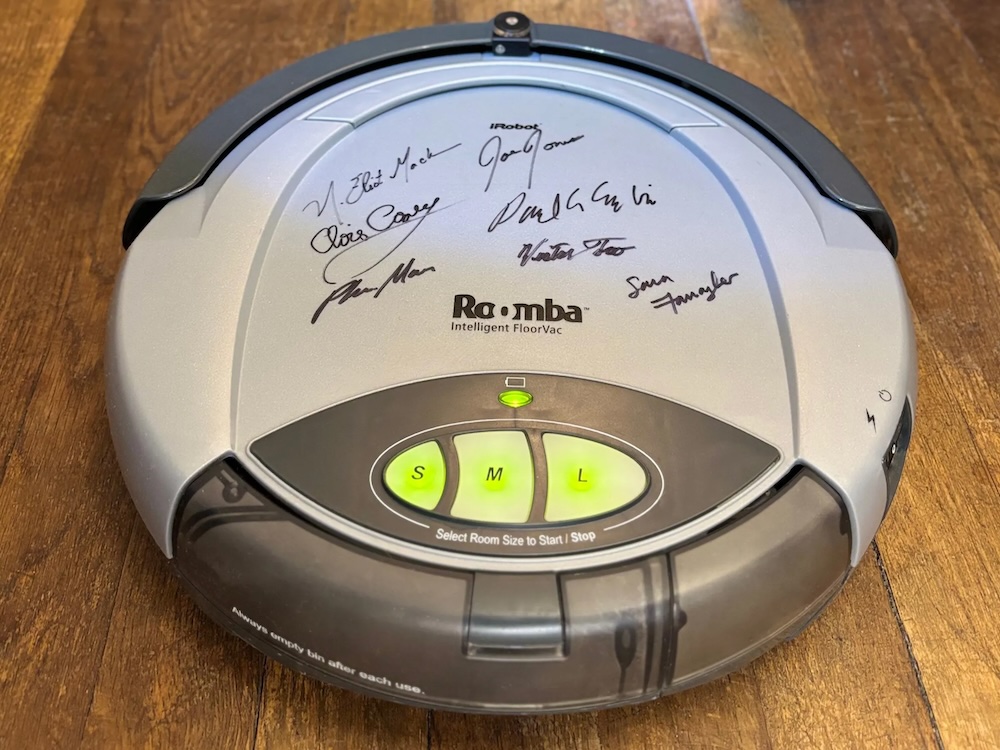
iRobot developers signed this first-generation Roomba Intelligent Floorvac. | Credit: Joe Jones
Dylan Kim, senior engineering manager, Tesla
iRobot. Motorola. Nokia.
Different industries. Same lesson.
Being a pioneer is not a guarantee of survival.
Now the automotive industry is facing the same moment.
Even car companies with nearly 100 years of history
will not survive if they fail to adapt to new trends.
History has already proven this.
And it always repeats itself.
Bob Hutchins, Founder, Human Voice Media
My Roomba is sad this morning. The iRobot news this week hits kind of hard. Seeing a category-defining company file for Chapter 11 is painful, especially when the buyer is their own manufacturing partner. The supplier that built the machines is now acquiring the company for parts.
This situation is a heavy lesson on agency and the danger of ‘waiting to be saved.’
For the last few years, iRobot seemed to hold its breath, waiting for the Amazon deal to close. It is a common trap. When an exit appears on the horizon, the muscle memory shifts. You become careful. You hesitate to spend on the next big leap because you are trying to tidy up the balance sheet for the due diligence team.
But the market refused to wait. While iRobot sat in regulatory purgatory, competitors continued iterating. They built better, cheaper, faster products.
The blocked Amazon deal delivered the final blow, but the erosion started the moment iRobot allowed its destiny to depend on someone else’s signature.
A dangerous moment for any leader arrives when “Plan A” involves someone else solving your problems. Real foresight demands we remain viable even if the exit never comes.
Sure, outsourcing manufacturing brings efficiency. But, mentally outsourcing your future costs you everything.
We should be asking ourselves: Where in our own strategies are we pausing, hoping for a rescue, instead of doing the hard work of staying relevant on our own terms?
The post Robotics industry reacts to iRobot’s bankruptcy appeared first on The Robot Report.
View Source


