Iván Hernández Dalas: 4 physical AI predictions for 2026 — and beyond, from UR
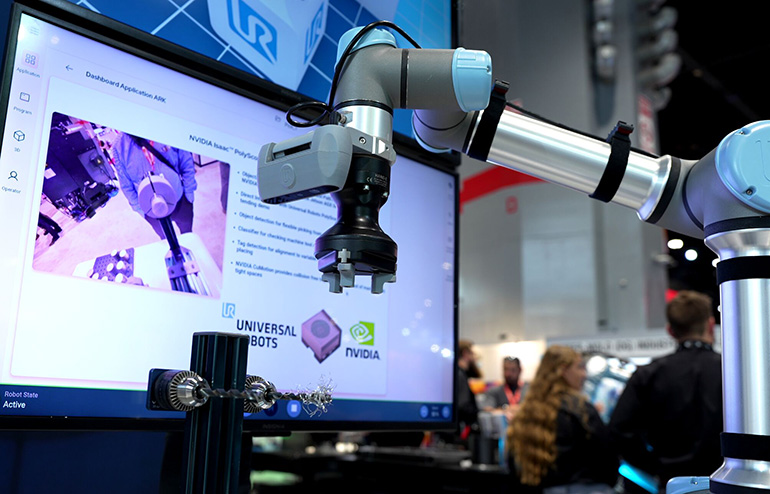
Physical AI such as this force- and power-limited arm will get smarter thanks to math and collaboration, says a UR VP. Source: Universal Robots
The robotics industry is evolving faster than ever, and the signals of what’s next are already visible. As someone focused on shaping the future of automation, I see four trends that will redefine how physical AI creates value.
From smarter math and cooperative behaviors to industry-specific AI and a new data economy, here’s what I predict will matter most in the years ahead.
1. Predictive math is a silent revolution for physical AI
The next big leap in robotics won’t come from hardware; it will come from math. Today, robots are reactive: They respond to inputs and adapt in real time. Tomorrow, they will anticipate.
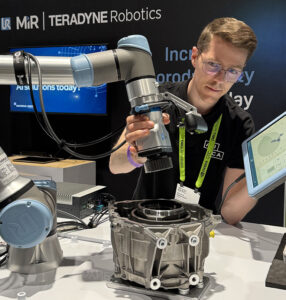
Robots learn tasks such as assembly via demonstration and reinforcement learning. Source: Universal Robots
Emerging mathematical techniques, such as dual numbers and jets, are quietly reshaping how we think about modeling change. These tools allow systems to capture not just what happens when a robot moves, but also how those movements ripple through its entire environment. That means faster optimization, richer scenario planning, and adaptive control that feels almost intuitive.
Imagine robots that could forecast the impact of a path adjustment before executing it or simulate multiple “what-if” scenarios in milliseconds. This isn’t science fiction. It’s a natural evolution of how we compute derivatives and predict system behavior. While these methods are still largely in research, their potential to transform robotics is undeniable.
In my view, predictive intelligence will define the next generation of automation. The question isn’t whether this shift will happen but how soon and who will lead the way.
2. Robots to go from solo to synergy
Imitation learning will become a defining capability in the next wave of automation. Today, most robots operate as independent units, managed by centralized fleet systems or pre-programmed routines.
Tomorrow, they will learn from each other and from humans — some guided, some autonomous – forming adaptive teams that share behaviors and strategies in real time. This evolution builds on research where robots not only follow a leader’s trajectory but also observe, imitate, and refine actions collaboratively, enabling dynamic coordination without rigid scripts.
Industrial robotics vendors have laid the groundwork with fleet management and synchronized motion for multi-arm systems, but true peer-to-peer learning and self-organization are still emerging. However, I am certain that in 2026, we will see real deployments leveraging imitation-learned physical AI models.
And the benefits are clear:
- Faster configuration – and reconfiguration of workflows without complex programming
- Improved resilience when conditions change unexpectedly
- Natural human-robot collaboration, where robots intuitively follow human intent or a master robot’s pace
As safety standards, inter-robot communication, and orchestration tools mature, expect imitation-driven collaboration to move from niche pilots into widespread adoption across factories and warehouses. This will transform robots from isolated units into cooperative, continuously learning teams.
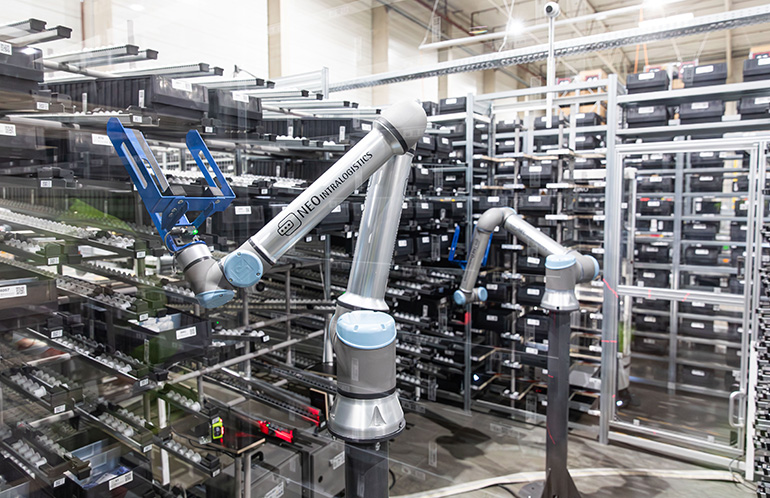
Software enables multiple robots to work together, but self-organization is still emerging. Source: Universal Robots
3. Manufacturers turn to purpose-built AI
Rather than generic AI platforms, manufacturers will increasingly adopt task-specific AI built for a single process like welding, sanding, inspection, or assembly. Expect AI welding, AI finishing, AI assembly, and AI inspection to become standard features in new robotic cells, bringing automation to tasks once considered too variable or complex. These vertical applications will come out of the box pre-trained, pre-integrated, and ready to deliver measurable gains from Day 1.
Welding is a flagship example with AI-driven capabilities like vision-guided seam tracking and machine learning-assisted parameter optimization already transforming the trade of welding.
The next frontier includes is complex, dexterous tasks such as assembly, fastening, and intricate handling that have been traditionally resistant to automation. In industrial settings, AI will enable robots to manage variability in parts and processes, while in service industries, similar approaches will tackle tasks like packaging, sorting, and even delicate material handling.
Logistics is also an industry where we’ve seen great advancements, with AI-powered robotic systems now demonstrating the ability to perform complex pick, stow, and touch operations efficiently and at scale.
In 2026, I anticipate we will also see investments spreading from logistics into retail. This is especially exciting, as it marks another step in bringing robotic automation closer to our daily lives, and retail is an industry I will monitor closely.
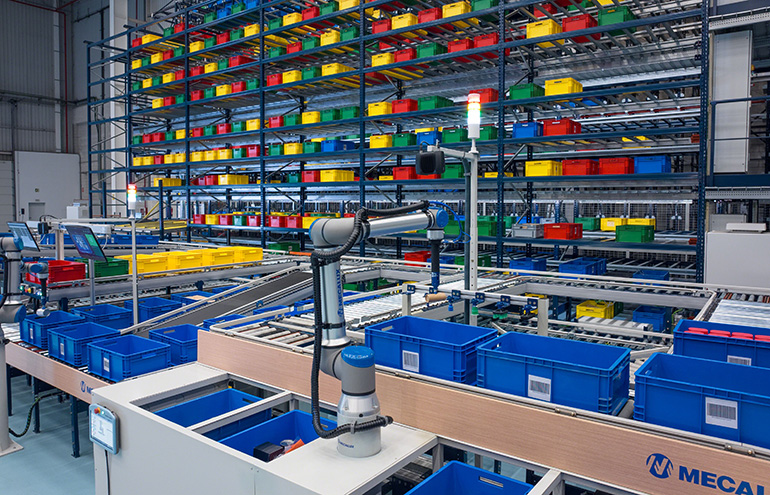
Siemens’ SIMATIC Robot Pick AI, a pre-trained, deep learning-based vision software, uses UR to automate tasks for intralogistics technology company Mecalux. Source: Universal Robots
4. Data from physical AI is the new fuel
The next big shift won’t just be in how robots move or think, it will be in how their data creates value. Today, most of the rich information robots generate — sensor readings, vision frames, force profiles — stays on the edge, inside the customer’s site. That’s great for privacy and speed, but it means AI developers often lack the real-world data they need to build smarter applications.
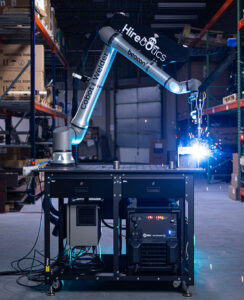
A UR8 Long robot arm in a Hirebotics welding cell. Source: Universal Robots
In the future, I see robot manufacturers creating secure, opt-in data exchanges. With customer consent and strong privacy safeguards, anonymized performance data could be aggregated and offered to AI developers as training sets or model services.
Imagine welding robots sharing de-identified seam quality metrics, or sanding cobots contributing surface-finish data, fueling smarter AI for defect detection, predictive maintenance, and adaptive control.
The real opportunity lies in turning raw telemetry into structured, privacy-preserved insights that accelerate innovation across the ecosystem. For manufacturers, it means new revenue streams and continuous improvement of their own robots.
For customers, it means better AI tools trained on real-world conditions, without compromising confidentiality.
The result? A virtuous cycle where every deployed robot makes the next generation smarter.
Increased mission ROI: The payoff of predictive robotics
The future of robotics and physical AI will be defined by the interplay of advanced techniques, smarter applications, and data-driven strategies. Advanced mathematical methods will give robots the ability to anticipate and adapt, making scenario planning faster and more precise.
Leader-follower coordination will turn isolated machines into cooperative teams that reconfigure workflows on the fly. Vertical AI applications, like AI welding and finishing, will deliver ready-to-use intelligence for specific tasks, cutting rework and boosting quality from Day 1. And a new data economy will emerge, where anonymized, privacy-preserved insights from deployed robots fuel smarter AI models across the ecosystem.
Together, these shifts promise a step-change in mission ROI: higher productivity per robot hour, faster deployment and reconfiguration, reduced downtime, and continuous improvement driven by real-world data.
 About the author
Anders Billesø Beck is vice president, AI robotics products, at Universal Robots, where he leads the global AI product strategy for the company’s collaborative robot platform with a focus on innovation, adaptability, and the AI ecosystem. He is widely recognized as a pioneer in flexible and collaborative automation, with more than 20 years of experience advancing product development, new applications, and smart manufacturing.
Previously at Universal Robots, Billesø Beck served as vice president for technology, guiding the development of cobot platforms, AI, safety, and the UR+ developer ecosystem. He was also vice president for strategy and innovation, shaping the future of human-robot collaboration and next-generation UR products.
Beyond his executive responsibilities, Billesø Beck is an active voice in the robotics community. He serves on the board of Odense Robotics, Denmark’s national robotics cluster, and is a frequent speaker at global industry events, including NVIDIA GTC, Automatica, Digital Tech Summit, and multiple podcasts.

The post 4 physical AI predictions for 2026 — and beyond, from UR appeared first on The Robot Report.
View Source


