Iván Hernández Dalas: Buildroid AI expands simulation-first robotics platform to U.S. sites
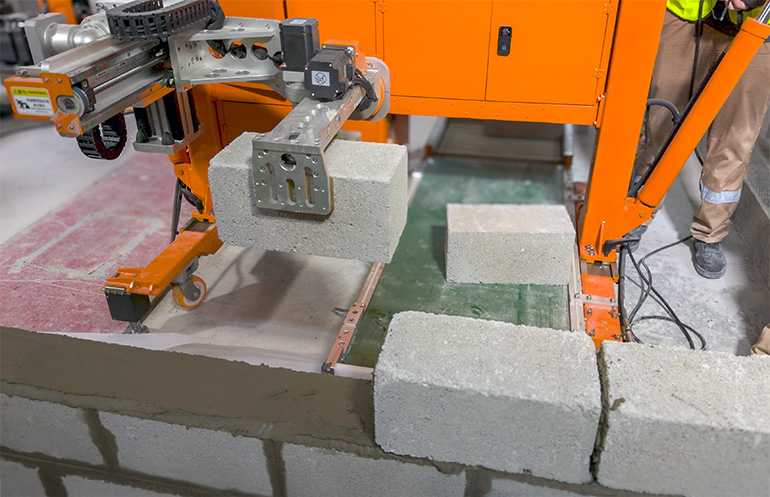
A Buildroid block-laying robot at a demonstration construction site. Source: Buildroid
One reason why the construction industry has not adopted more robots is because many systems automate only isolated tasks, according to Buildroid Inc. The company said its platform can increase utilization and throughput by linking multiple robots into coordinated workflows that address a full trade sequence.
“America’s construction industry faces many of the same pressures seen worldwide—labor shortages, rising costs, and increasing demand for speed and precision,” stated Slava Solonitsyn, co-founder and CEO of Buildroid AI.
The San Francisco-based company said its platform uses NVIDIA Omniverse-based modeling to evaluate workflows on job sites, and it is compatible with more than 40 robot types. Buildroid offers its proprietary technology through a robotics-as-a-service (RaaS) model.
“By running thousands of NVIDIA Omniverse-powered digital twin simulations before ever sending a robot to a job site, we can identify the workflows that deliver the highest impact and ensure viable economics from Day 1,” said Solonitsyn. “Our early pilots show how simulation-first planning turns robotics from a high-risk trial into a predictable, scalable advantage for U.S. builders.”
Buildroid to begin U.S. deployments in Q1
After pilot deployments in the United Arab Emirates, Buildroid emerged from stealth and entered the U.S. market in November 2025. It also raised $2 million in pre-seed funding led by venture capitalist Tim Draper.
“Unlike single-robot solutions, Buildroid’s platform combines the best robotic technologies validated through BIM [building information modeling]-based simulations,” said Draper, founding partner of Draper Associates. “Such an approach empowers builders with scalable, flexible, vendor-agnostic automation that maintains the critical role of skilled human operators. I’m excited to back a team that’s transforming how buildings are made, improving efficiency while empowering workers.”
In the first quarter of 2026, Buildroid plans to begin commercial implementations with general contractors focusing on blockwork and partition-wall installation, a $13 billion segment within the $17 trillion global construction industry. The startup said it will use a a shared-savings model in which it receives 50% of net efficiency gains while committing to specific performance metrics.
Companies working on bricklaying robots include Construction Robotics, FBR (Fastbrick Robotics), and Monumental.

Startup shares plan to aid the trades
Anton Glance, co-founder and chief technology officer of Buildroid, replied to the following questions from The Robot Report about Buildroid’s approach to construction automation:
Can you give examples of the robots that Buildroid can simulate?
Glance: Our primary use case is automating blockwork on construction sites. Right now, our platform supports one block-laying robot (BLR) model, and we’re adding two more in the coming months:
- A more compact block-laying robot (BLRc) that can work alongside the current one and in residential layouts
- An autonomous mobile robot (AMR) that delivers materials, bringing blocks to the BLRs and dry-mix mortar to the mixing station, removing the need for a human helper
After blockwork, our next focus is bringing in robots for other construction trades. The next trade we’re adding is plastering, and we’ve already selected the robot partner and started integrating its system into our platform.
How does the system coordinate workflows among different systems — does it have APIs (application programming interfaces) into their control software to provide interoperability?
Glance: Yes. For the current block-laying robot, we use an edge computer that serves as a bridge between the robot and our platform. It also gives the robot real-time, context-aware guidance based on data from onboard sensors and spatial scanners.
To control the robot’s movements, we work closely with the manufacturer to ensure we have the right APIs, allowing us to send commands to the robot and receive data back. This creates a smooth, interoperable workflow between different systems.
Since the company is providing robots through a RaaS model, does it send engineers onsite for setup, or does it work with the hardware providers?
Glance: In our early deployments, our engineers will be on-site to supervise the robots, prevent issues, and handle any urgent situations.
In the long run, we aim to have one supervisor overseeing an entire fleet of robots, while our AI orchestrator handles most coordination and decision-making. Supervisors will only step in if a robot needs help continuing to work or if there’s a safety concern.
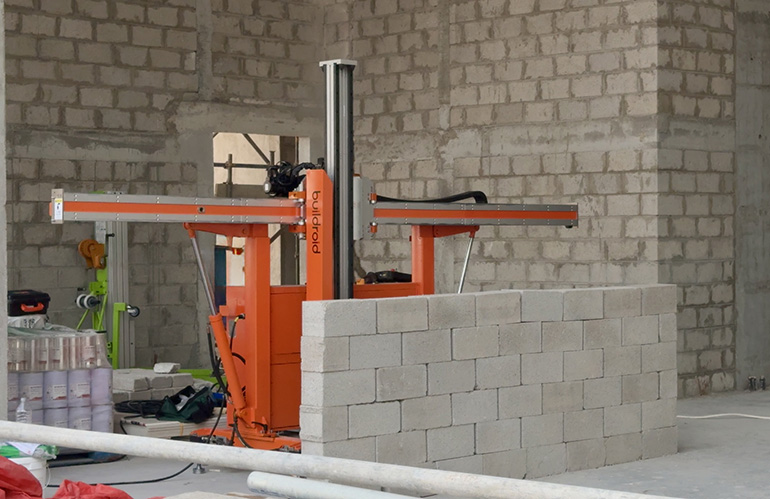
The BLR uses digital twins for autonomous construction. Source: Buildroid
Do the digital twins run onsite, or are they used for planning only? How often or easily can workflows change?
Glance: Our digital twin is designed to do both: initial planning and real-time replanning.
- The digital twin manages high-level planning, such as deciding which wall to build next.
- The on-site edge computer handles detailed execution, such as deciding exactly where each block should be placed.
If a robot goes offline or conditions on the job site change, the digital twin automatically updates the plan and redistributes tasks to keep the project moving with minimal downtime.
Is Buildroid working with specific construction robotics providers?
Glance: We partner with the best robots on the market, regardless of the country or manufacturer. One of our key criteria is the robot’s level of autonomy. More autonomous robots integrate into our platform much more easily.
For promising but not yet advanced robots, we collaborate with their manufacturers to boost robots’ performance, leveraging our expertise in AI and construction automation.
What are Buildroid’s plans for scaling up with the funding? Will it be staffing up in the U.S.?
Glance: Expanding into the U.S. is one of our top priorities. Since we deliver a full end-to-end solution that includes robots operating on job sites, having local teams will be essential.
Before global rollout, though, we’re focused on completing our BIM-to-BUILD platform and validating everything through real-world reference projects using our selected robots.
The post Buildroid AI expands simulation-first robotics platform to U.S. sites appeared first on The Robot Report.
View Source


