Iván Hernández Dalas: CES 2026: Hesai to showcase next-gen lidar for physical AI
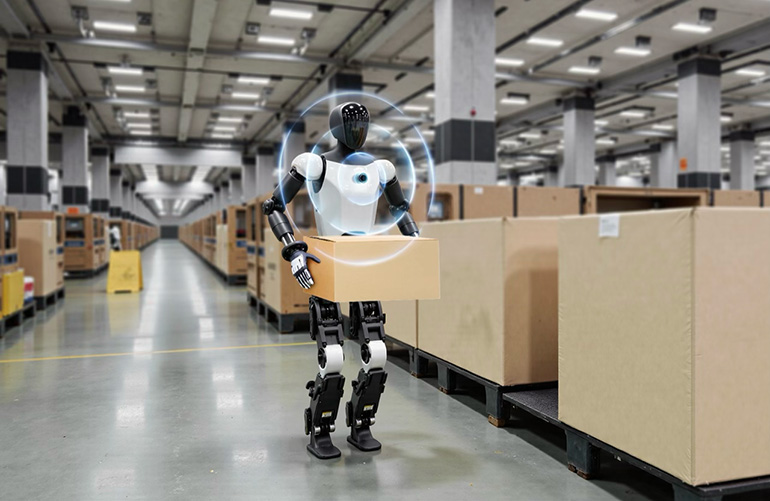
Hesai’s lidar delivers high-fidelity sensing to enable robots to perceive, localize, and operate safely at scale. | Credit: Hesai
Hesai Technology develops and manufactures lidar sensors for 3D perception. The Shanghai-based company provides a range of hardware, including long-range, ultra-wide view, solid-state, and mini 3D sensors.
In 2025, Hesai surpassed 2 million cumulative deliveries. To meet rising demand, the company is expanding its annual production capacity to more than 4 million units in 2026, which it said sets a new benchmark for the industry.
These products are used in advanced driver-assistance systems (ADAS), autonomous mobility, and robotics applications. Hesai integrates research and development with in-house manufacturing to supply its sensors to automotive manufacturers and robotics companies in various international markets.
Next-generation L3 automotive suite to enhance safety
Hesai has identified the automotive sector, specifically ADAS, as the primary driver of the current lidar market share. According to co-founder and CEO David Li, the high-volume production required for automotive applications has been a catalyst for the robotics industry, making lidar a significantly more affordable and accessible option for mobile robotics.
Acting as an “invisible seatbelt,” lidar plays a critical role in preventing accidents before they occur. Lidar-equipped vehicles reduce fatal highway accidents by 90% and lower regular traffic accidents by 30% compared with camera-only systems according to Li Auto‘s official data.
Furthermore, the rigorous operating demands of the automotive world have enhanced sensor robustness. This “automotive-grade” reliability is already a cornerstone of Hesai’s partnerships with leading robotaxi developers like Zoox and Aurora.

China EV demand drives lidar production
Li said he believes that the Chinese electric vehicle (EV) market is way ahead of the rest of the world in terms of the volume of lidar units required. This is one of the reasons why his company is manufacturing in China.
In addition, Li cited many Chinese EV manufacturers as partners. Hesai has spent more than $100 million to build an “all-in-one” factory to do testing, validation, design, everything under one roof.
To date, Hesai has secured design wins from 24 automotive OEMs for mass-production programs. Key partners include a top European manufacturer and a leading global automaker in new energy vehicle (NEV) sales. Others are Li Auto, Xiaomi, Changan, Geely, Great Wall Motor, Chery, Zeekr, Leapmotor, SAIC Audi, SAIC-GM, a Toyota joint venture.
Hesai’s new ATX long-range lidar has already secured orders exceeding 4 million units from multiple leading OEMs, with mass production and delivery starting in April 2026.
“Our customers are scaling faster than ever, and we are scaling with them,” stated Li. “By expanding our annual capacity to over 4 million units and adding our new Thailand facility, we’re building a global manufacturing footprint that can reliably support mass production.”
“Our commitment is simple: Deliver world-class lidar, at scale, with the consistency and trust that the automotive industry demands,” he added.
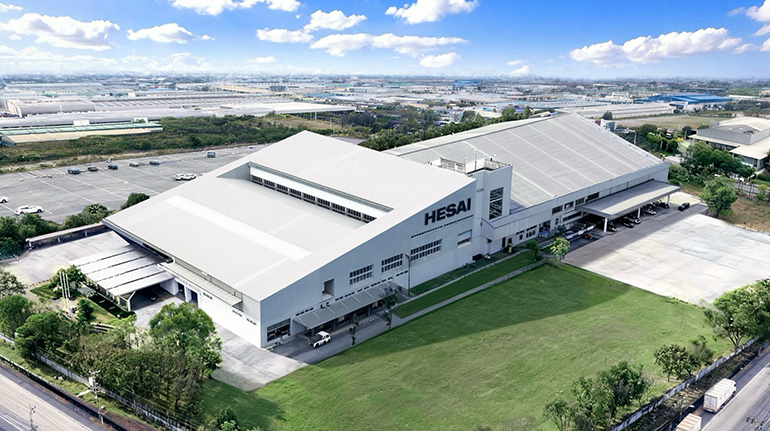
Hesai’s Galileo factory in Thailand. | Credit: Hesai
Solid-state lidar is the next innovation
Hesai is also a leader in developing solid-state lidar sensors, which is helping to reduce the cost of lidar. While spinning mirror lidar units used to cost $5,000 to $10,000 per unit, solid-state lidar is now available for $400 to $500 per unit.
Hesai’s solid-state lidar can be software-defined, enabling the user, through software, to modify the scanning pattern and resolution. In addition, some perception functions can be performed onboard the sensor silicon, reducing off-board processing and speeding up detection algorithms for vehicle, farm implement, or robot control.
Hesai watches humanoid robot market
Li said he is paying careful attention to the developments in the humanoid market. Research at his alma mater, Stanford University, has produced interesting research with the Universal Manipulation Interface (UMI) and Mobile Aloha projects.
Li promotes the idea that “tactile-less is the new blindness.” Cars should never touch one another, so that is a no-contact environment.
For robots, the meaningful work only really starts when the robots touch something, and there’s a deformation and interaction with friction, Li explained. All of that information is non-visual, but important to the success of manipulation.
Today, lidar sensors produce a point cloud of visual information, but in the future, new sensors might produce point-cloud-like information from tactile sensors.
Hesai is very interested in working with robotics companies that need to integrate visual sensing, tactile sensing, and manipulation. Li said he believes that new sensing technologies are just around the corner and that his company has built the design team and production capacity to develop and manufacture the next generation of robotics sensors.
Hesai cites adoption of JT lidars
In the robotics and industrial sectors, Hesai said its JT series mini 360° hyper-hemispherical 3D lidars have a documented track record of adoption. Designed with a small form factor and low power consumption, the series offers a wide field of view and easy integration into various mobile robots and industrial platforms. To date, the JT series has reached over 200,000 cumulative deliveries.
At CES next week, Hesai will demonstrate its next-generation L3 automotive lidar suite, featuring the long-range ETX and short-range FTX. Innovators including lawnmowing robot maker MOVA, robot vacuum provider DREAME, companion robot developer Vbot, and 3D spatial digitalization company Realsee are already integrating the JT lidars into their products.
Hesai has also partnered with Meituan to provide solid-state sensors for the Keeta Drone food-delivery unit.
In Las Vegas, Hesai said visitors will be able to explore these applications firsthand and see how it is helping power the next wave of autonomy in robotics and physical AI. The company will be exhibiting at Booth 5601 in the West Hall of the Las Vegas Convention Center.
The post CES 2026: Hesai to showcase next-gen lidar for physical AI appeared first on The Robot Report.
View Source


