Iván Hernández Dalas: The hidden technology behind fluid robot motion
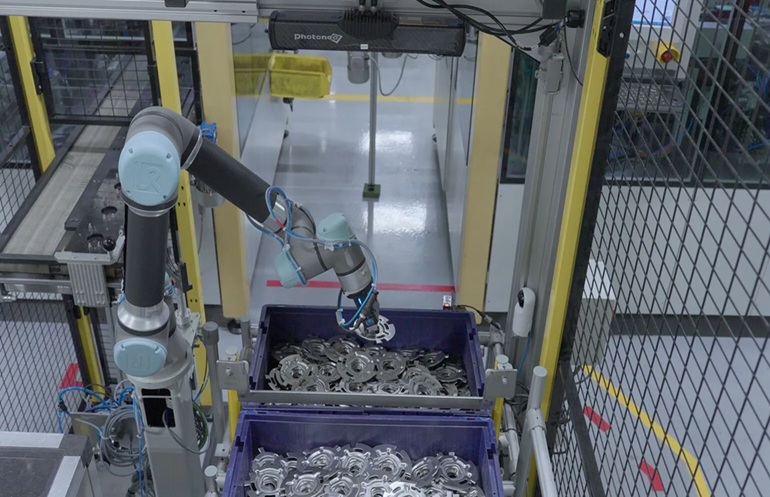
A UR5 cobot uses strain wave gearing for smooth motions in material handling. Source: Universal Robots
Long gone are the days of rigid robotics, where arms jerk and clank in the most unintuitive ways. These movements have hindered production and industry for years, requiring massive spaces to operate and maintain the machinery. Fluid robot motion has revolutionized the game, enabling machinery to operate in tighter spaces with greater mobility.
Behind these innovations are several crucial components and technologies that are often overlooked.
The importance of fluid robot motion
Conventional robotic locomotion is restrictive, especially in fields that require a more delicate approach. Industries such as surgical science and emergency response require more flexible tools to support workers in hazardous and fragile environments. Historical machinery would be cumbersome in these applications, hindering efficacy.
Soft robotics more reliably accomplishes complex assignments, enhancing human-robot collaboration with increased dependability and utility.
Additionally, fluid motion makes it easier for tech to move in tight spaces or mimic more biologically intuitive movement. The advantage makes the equipment adaptable and scalable across various industries.
A robot could handle more tasks, especially if they require precision or finesse. Due to their wider range of programming potential and motion, robots can achieve results in fewer steps, thereby reducing energy consumption. Many mechanisms contribute to these enhancements.
5 essential components in fluid robotics
Although it is a constantly evolving field with numerous innovations on the horizon, the following are several examples of the most influential mechanisms in soft robots to date.
1. Pneumatic artificial muscles
Compared with a structured motor, pneumatic artificial muscles or PAMs offer a softer alternative. The mechanism expands and contracts like a lung, manipulating itself with air based on its needs for movement.
Because the part can constantly adjust its air capacity, its movements are less forceful and more intuitive. PAMs remove a robot’s structural limitations by crafting a body more akin to a human’s.
One example is the E-Trunk robot from Festo, whose innovations have inspired further research in biomimetic models and designs. The arm features many PAMs that use air pressure to bend and twist in a manner that a standard robotic arm could never achieve. Its materials have inherent give, whereas older models would hit literal barriers by rubbing up against their own metal joints.
2. Strain wave gears
Strain wave gears are flexible alternatives to traditional motors. They enable robots to move more smoothly by using teeth and a wave generator to enable elliptical mobility.
The mechanism creates a backlash-free design, as the flexspline teeth manipulate the circular spline with a preloaded connection. There is always some tension — without jitter — due to the teeth, but equal mobility is achieved because of its design.
A prominent example of this is the UR5 series from Universal Robots (see image above).
Strain wave gears are critical components for boosting joint elasticity, though more research is needed to uncover how to lower the friction that strain wave gears can cause. However, reducers can mitigate some of these concerns.
3. Central pattern generators
Central pattern generators (CPGs) are an integral part of the robot’s control hub, manifesting as software or hardware, typically as a neural network in modern applications. They automate movement programming by replicating how a spine works, producing more natural locomotive patterns. Engineers issue wave-based commands to CPGs, and they respond smoothly.
A key example of this is an amphibious creation called the Salamandra Robotica II. EPFL researchers demonstrated how its CPGs allowed it to smoothly switch between swimming and walking.
4. Electroactive polymers
Electroactive polymers (EAPs) are a pivotal material in robot fluid motion, rather than a distinct part. They are considered smart materials because they can replicate muscle movement without mechanical influence, eliminating common pain points such as stilted movement or the need for excessive lubrication.
EAPs react to electrical stimuli instead, altering their shape to fit the use case. NASA developed a robotic gripping machine with fingers made from EAPs as early as 1999.

5. Shape memory alloys
Shape memory alloys (SMAs) are metals that are like phase-change materials in that they can change shape when subjected to heat or electrical triggers. Once the stimulus is applied, it can remain in a specific form until instructed to revert to its original shape. This could reduce the number of parts flexible robots need, as SMAs can adapt to the task in real time.
SMAs make motion smoother by adjusting components on a molecular level, making the robot the most dynamic version of itself. Harvard researchers are proposing these tools for wearable robotics, assisting humans with elbow and forearm flexion that could help with daily life or industrial applications.
Recognize the technologies behind fluid robot motion
These examples are only a few of the foundational innovations behind this generation’s imagining of robotic movement. Many other technical marvels contribute to these flexible and adaptable machines, which permanently change the way industries operate.
Knowing the hidden players behind these advancements can help robotics developers and integrators discover ways to continue improving the blueprints for the robots of the future, making them even more mobile and capable.
 About the author
Lou Farrell, a senior editor at Revolutionized, has written on the topics of robotics, computing, and technology for years. He has a great passion for the stories he covers and for writing in general.
This article is posted with permission.
The post The hidden technology behind fluid robot motion appeared first on The Robot Report.
View Source


