Iván Hernández Dalas: Bills introduced to strengthen U.S. robotics competitiveness, humanoid security
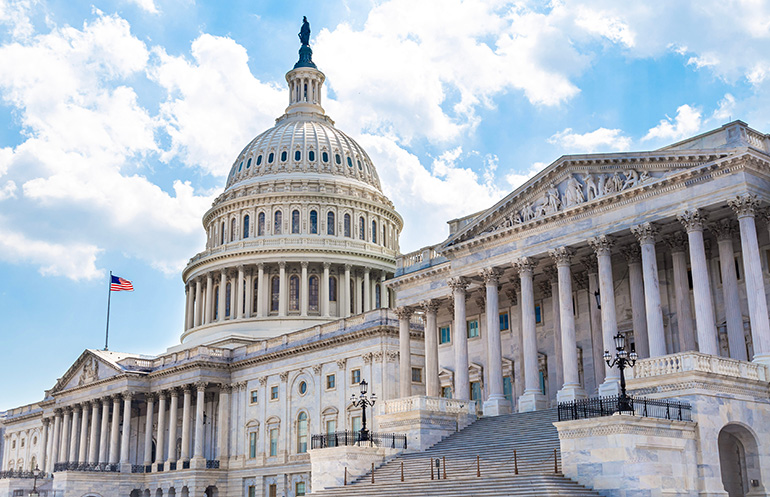
Robotics legislation was proposed on Capitol Hill this week. Credit: Sheik, via Adobe Stock
Robotics has not been a top legislative priority in Washington, D.C., but that could be changing. Two bills introduced in Congress focus on different ways of promoting U.S. competitiveness in robotics.
The National Commission on Robotics Act (H.R. 7334) proposes to establish a national commission to evaluate U.S. competitiveness in robotics and provide policy recommendations. Representatives Jay Obernolte (R-CA), Jennifer McClellan (D-VA), and Bob Latta (R-OH), who are members of the recently revived Congressional Robotics Caucus, introduced the bill this week.
The Humanoid Robotics Oversight and Blocking of Obtainment from Totalitarians Act of 2025 or “Humanoid ROBOT Act of 2025” (S. 3275) would prohibit the federal government from acquiring humanoid robots with integrated artificial intelligence from foreign entities, including military suppliers to China, Iran, North Korea, and Russia. Senators Bill Cassidy (R-LA) and Chris Coons (D-DE) introduced the bill.
Experts would make competitiveness recommendations
Under H.R. 7334, the U.S. Department of Commerce would establish an independent commission composed for 18 recognized robotics experts. They would be appointed and approved by members of both parties and the president, and the commission would submit an interim report within one year and a final report including actionable recommendations for Congress and the administration in two years.
“As robotics continue to reshape our economy, manufacturing base, and national security, it is essential that the United States remain the global leader in robotics innovation,” stated Rep. Obernolte. “This legislation brings together experts from industry, academia, and the public sector to help Congress develop smart, forward-looking policies that strengthen our workforce, secure our supply chains, and keep America competitive.”
The commission would examine domestic and international developments in robotics, workforce and talent challenges, supply chain risks, manufacturing competitiveness, and the role of robotics in economic growth and national security. The Congressional Robotics Caucus and others have advocated for a more unified federal approach to the robotics industry.
“As our global community adapts to a constantly growing and evolving digital world, robotics will become more critically important to meet the demands of the 21st century,” Rep. McClellan said. “The National Commission on Robotics Act helps ensure that the U.S. remains competitive on the global stage and a leader in technological development and innovation. Only by better understanding the economic impacts of robotics can we continue to work on the cutting edge of research that drastically improves and enriches people’s lives.”
“The United States must lead when it comes to robotics and autonomous systems,” said Rep. Latta. “Creating a commission to evaluate how robotics pertain to commerce, economic competitiveness, and national security will allow the U.S. to continue making important advancements in robotics. Further, evaluating how robotics can enhance workforce opportunities will spur future programs to attract and recruit leading talent in the field.”
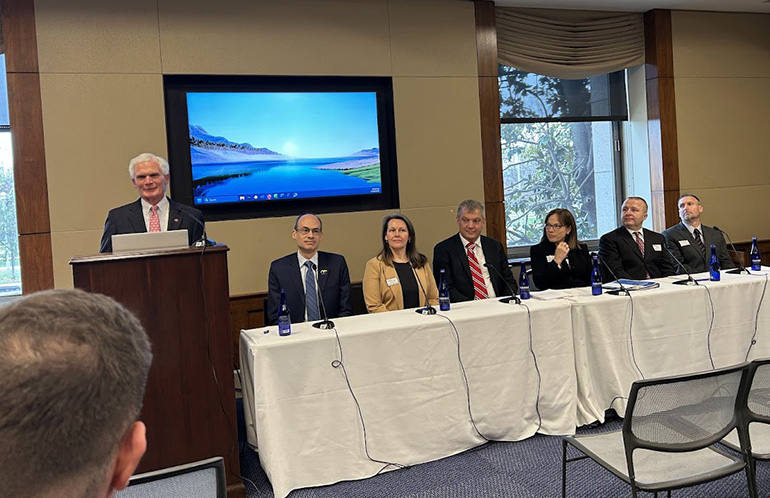
Rep. Latta addressed a meeting with the Congressional Robotics Caucus in December 2025. Credit: Eugene Demaitre
Industry leaders welcome proposed legislation
“This is a major development towards strengthening U.S. leadership in robotics and automation,” Jeff Burnstein, president of the Association for Advancing Automation (A3), posted on LinkedIn. A3 has been a major proponent of a national robotics strategy.
The National Commission on Robotics Act is the first piece of federal legislation in support of the robotics industry in the U.S., asserted Brendan Schulman, vice president of policy and government relations at Boston Dynamics.
“The proposed establishment of a national commission is especially timely, as AI dramatically accelerates the capabilities of robots, and as foreign competition intensifies,” he added. “Robots will not only transform core industries, help reshore critical manufacturing, and elevate job safety and efficiency — they will also redefine America’s economic and industrial future.”
“Robotics and automation are not optional tools—they are foundational infrastructure,” wrote Robert Little, chief of robotics strategy at Novanta. “Without them, reshoring at scale is not feasible. Manufacturing competitiveness, supply-chain security, and economic resilience all depend on advanced automation.”
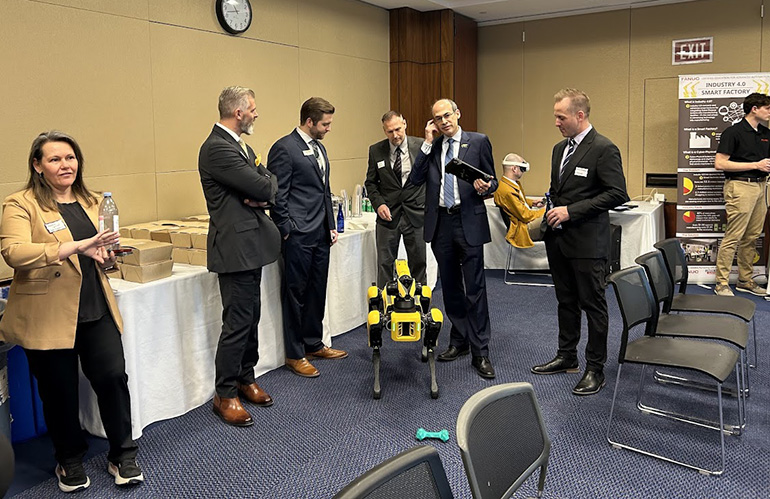
Boston Dynamics’ Brendan Schulman demonstrated the Spot quadruped at the December Congressional Robotics Caucus meeting. Credit: Eugene Demaitre
AUVSI launches Partnership for Robotics Competitiveness
“The age of autonomy and advanced robotics is here, and dominance in this industry will determine who leads the next industrial revolution,” said Michael Robbins, president and CEO of the Association for Uncrewed Vehicle Systems International (AUVSI).
Members of Congress including Obernolte and McLellan also met with industry executives organized by AUVSI to launch the Partnership for Robotics Competitiveness (PfRC). The partnership’s goal is to create policies and target investments to “reduce reliance on foreign suppliers, scale domestic manufacturing, and create high-quality jobs in communities across the country,” said the AUVSI. It released a whitepaper of recommendations for treating robots as critical to U.S. military and economic leadership.
“If we want to stay competitive on the global stage, we need a coordinated national robotics strategy that aligns innovation, workforce development, and federal policy,” said Jeff Cardenas, CEO of Apptronik.
Wendy Tan White, CEO of Intrinsic, stated: “The strategic importance of physical AI for the coming decades cannot be overstated. How we advance modern manufacturing through intelligent robotics, and create more flexible and adaptive systems, will have a direct impact on economic growth and society at large.”

Humanoids raise national security concerns
“Americans win when we lead in technology,” said Dr. Cassidy about the Humanoid ROBOT Act. “We’re keeping that lead by blocking countries like China from putting their robots in our workplaces and homes.”
The senator noted that humanoid robots could be “increasingly integral for industrial, household, and defense applications.” While U.S. investment and research leads the world, many companies overseas are also working on developing humanoids, often with government support, Cassidy said.
Just this week, LimX Dynamics Inc. raised $200 million in Series B funding, the latest multimillion-dollar investment in a company developing humanoids and AI. Many U.S. laboratories use Chinese hardware, such as Unitree legged robots, and U.S. manufacturers such as Tesla currently rely on Chinese components for their humanoids.
Tesla last week announced that it was converting a California factory for its Model S and X vehicles to U.S. production for Optimus humanoid robots.
The post Bills introduced to strengthen U.S. robotics competitiveness, humanoid security appeared first on The Robot Report.
View Source


