Iván Hernández Dalas: Fictiv and MISUMI report on the state of manufacturing, supply chain digitalization
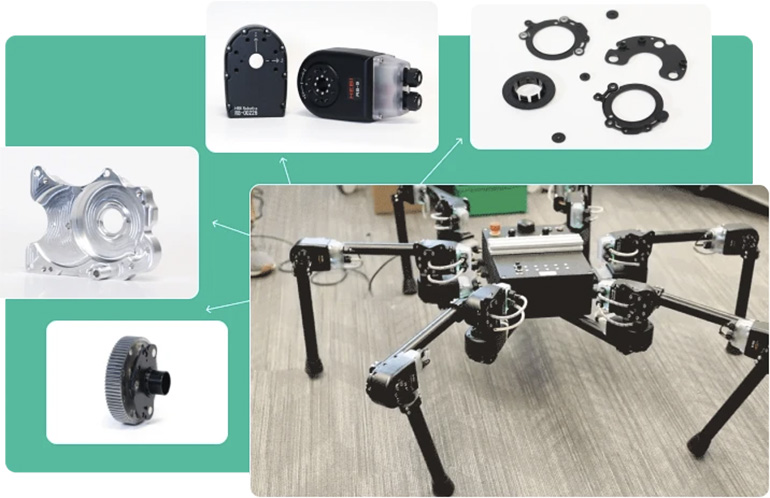
Simpler design and more use of AI for management can boost manufacturing, said survey respondents. Source: MISUMI Americas
Artificial intelligence and digitalization are transforming global industry in response to persistent volatility, according to a the “11th Annual State of Manufacturing & Supply Chain Report” by Fictiv and MISUMI Global. The companies surveyed more than 300 senior supply chain and manufacturing leaders.
“Global manufacturing has entered a new phase, where quality, compliance, and transparency are non-negotiable,” stated Ryusei Ono, representative director and president of MISUMI. “This research reflects what we see across our customer base: a growing expectation for consistent performance at scale amid increasing regional, regulatory, and technological complexity.”
Fictiv said businesses use its manufacturing centers in India, Mexico, China, and the U.S. to access high-quality production, optimize logistics, and mitigate supply chain risk. The San Francisco-based company has delivered more than 39 million prototype and commercial parts and assemblies for early-stage companies and large enterprises alike, helping them innovate faster, free up resources, and grow profits.

MISUMI Americas brings scale to machine parts, automation
In April 2025, MISUMI Group Inc. acquired Fictiv for $350 million. MISUMI Americas provides configurable components, standard parts, and custom manufacturing for automation, robotics, medical, automotive, electronics, aerospace, and industrial equipment markets across the U.S. and Mexico.
The combined company said it delivers a unified digital manufacturing platform that connects design, engineering, and production with precision, speed, and reliability.
“MISUMI is a 70-year-old public Japanese company and has been in the U.S. market for over 20 years,” said said Dave Evans, CEO of Fictiv and now president and CEO of MISUMI Americas. “It is differentiated from other standard components providers in simplifying the bull of materials by [also] providing configurable and custom components.”
“We ship 200,000 boxes a day — there’s a 747 that flies from Japan to Chicago every day,” he told The Robot Report. “We get to plug in this amazing technology supply chain with everything that Fictiv has done over the past 10-plus years.”
“I’ve toured centers where shelving, pick and place, and bundling of orders were being automated,” he added. “You can’t get to high levels of quality, cost, and time without automation, and I’ve seen firsthand how robots don’t replace jobs but drive productivity.”
AI is becoming essential to industry, leaders tell MISUMI
Dimensional Research conducted the survey of qualified individuals at the director level or higher who work in engineering, supply chain, production manufacturing, research and development, or digital innovation roles. Most of the companies involved produce goods in clean energy, electric vehicles, robotics, or medtech industries.
The 2026 “State of Manufacturing and Supply Chain Report” found that technology and supply chain expertise are now essential to staying competitive.
- AI is transforming manufacturing and supply chains: 95% off survey respondents said implementing AI into their operations is vital to their companies’ future success.
- AI addresses workforce shortages: 95% said AI and automation are helping address labor shortages, but they acknowledged that they cannot replace specialized expertise.
- Digitalization can boost production: 97% of industry leaders said digital manufacturing platforms are essential for production.
- Reshoring is a top priority: 93% said moving production back to the U.S. is a top priority.
- Supplier sourcing is challenging: 81% said supplier sourcing and manufacturing are too time-consuming and costly.
- External tariff expertise is needed: 77% said trade compliance requirements are too complex to manage without external expertise.
“This year’s data makes clear that speed, predictability, and resilience now define competitive advantage,” said Evans. “The companies that are pulling ahead are the ones leveraging AI and digital manufacturing platforms, robust global networks, and embedding quality into their operations.”
“Overseas is already heavily automated. I visited a factory in China with 450 high-precision CNC machines and maybe a dozen or two employees,” he recalled. “There are a lot of places for robots to drive innovation — from cobots in machine tending, welding, and grinding and sanding, all the way to general-purpose humanoid robots.”
“It’s critical that we don’t see robotics and AI as a competitive advantage but as table stakes,” Evans said. “We’ve seen an explosion in investment in AI, primarily around foundation models and LLMs [large language models], as market leaders recognize the need to move from the digital domain to the physical application of AI.”
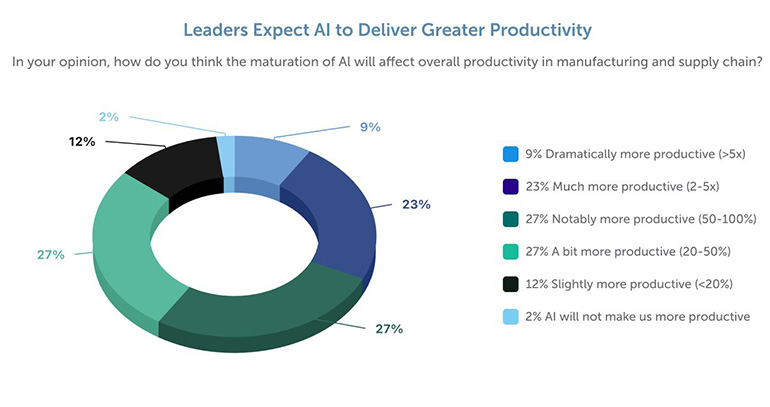
Source: “State of Manufacturing & Supply Chain Report,” MISUMI and Fictiv
Manufacturing management challenges remain
Nearly all of the 300+ manufacturing leaders surveyed, or 99%, said supplier tariff and trade expertise is now essential in partner selection, said MISUMI Americas. Ninety-eight percent reported that rising raw-material costs are actively informing strategies for more resilient sourcing.
At the same time, industry leaders are identifying the operational improvements that could deliver the greatest impact, said the company. Today, 83% of engineers spend four or more hours per week on procurement-related workflows, while 93% of leaders said productivity improves when administrative tasks are offloaded. Fictiv offers tariff management assistance.
Also, rising complexity is intensifying supply chain management pressures across the production lifecycle, found the survey. Manufacturing planning was cited as the top challenge for balancing cost, quality, and time to market, followed by production, sourcing, design, and demand forecasting.
MISUMI noted that 81% of leaders said that supplier sourcing and management is too time-consuming and costly, up from 73% in 2025. The company said this points to a growing need for more integrated operating models.
AI adoption has also moved from experimentation to execution. AI is already embedded across core manufacturing and supply chain workflows, said 97% of respondents.
In addition, 95% of the leaders said they consider AI a requirement rather than an option. Many of them anticipate AI-driven productivity gains of 50% or more, with some projecting improvements of two to five times as workflows are redesigned around automation and intelligence.
“Our belief at Fictiv is in humans plus machines,” Evans said. “As we simplify sourcing for complex mechanical products, speeding time to revenue, we’ll see more innovation. Small and midsize businesses [SMBs] and manufacturers have been struggling for years — not with lights-out automation, but how to make local production more economically viable.”
“I was talking with a manager at an SMB a few weeks ago, and he put a pedometer on his operators,” noted Evans. “When it passed three to four miles, he said, ‘You’re a robot.’ I thought about it, and in factories, we should think about time wasted moving rather than operating. In Asia, we’ve tackled that with vendor-managed inventory machines.”
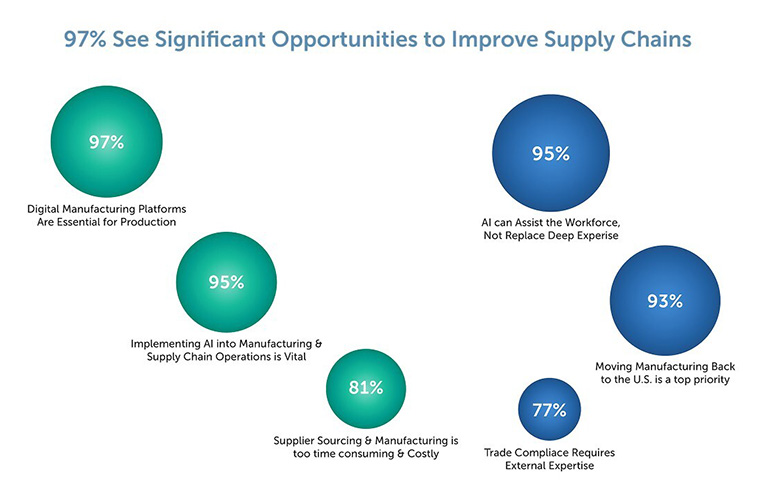
The majority of industry leaders surveyed said they expect AI and reshoring to improve their supply chains. Source: MISUMI Americas
The future of manufacturing is digital
An increasing number of industry leaders are focused on digital manufacturing platforms, with 97% saying they are essential, up from 86% in 2024. They are also prioritizing services that reduce handoffs and compress cycle times, according to MISUMI Americas.
Ninety-three percent reported that engineering productivity would significantly or moderately improve through managed manufacturing or supply chain services, the company added. Ninety-eight percent saw clear optimization opportunities— particularly in quality management, supply chain design support, design for manufacturability (DFM), costing, and engineering services.
“Over the past few years, supplier sourcing and management have become significantly more complex and resource‑intensive,” said a senior sourcing manager at a global automation integrator. “Increased volatility, along with the need for greater visibility and resilience, has made managing suppliers much more challenging.”
The full 11th “Annual State of Manufacturing & Supply Chain Report” is available from Fictiv and MISUMI Americas.
The post Fictiv and MISUMI report on the state of manufacturing, supply chain digitalization appeared first on The Robot Report.
View Source


