Iván Hernández Dalas: Flipping the script: How ‘upside-down’ AutoPallet robots solve palletizing density
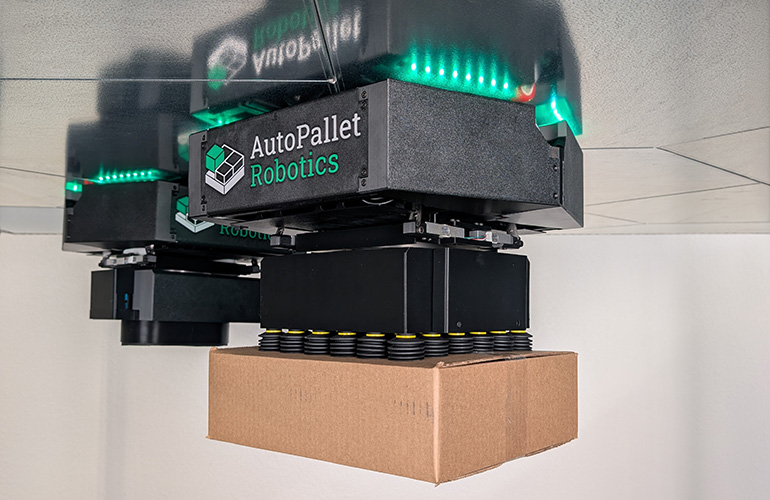
The AutoPallet system uses magnets to drive on steel panels mounted overhead and to pick and place cases on pallets and conveyors below. | Credit: AutoPallet
AutoPallet Robotics is focused on solving palletizing challenges with a novel warehouse robot. The startup made the first public demonstration of its palletizing/depalletizing system at Manifest 2026 today. Its founders got their start at Y Combinator in 2024.
The AutoPallet robots are small autonomous mobile robots (AMRs) that drive upside down, magnetically affixed to a steel plate positioned over the target workspace. The robots lower a vacuum gripper down to a pallet or conveyor to acquire a box, then lift the box up and carry it to the target drop location.
The freestanding modular superstructure bolts into the warehouse floor, allowing operators to drop high-density automation into existing buildings without redesigning their entire material flow.
“We started from the question, ‘What would a purpose-built, modern robotic architecture for case handling look like if you didn’t assume a robot arm on a pedestal?’” said Eric Miller, co-founder of AutoPallet Robotics. “By putting small, efficient robots on the ceiling, we can give operators dense, flexible sortation and palletizing in places where traditional automation solutions just don’t fit.”
The company‘s architecture is designed for flexible case sortation and palletizing in a variety of roles. AutoPallet robots can receive mixed streams of diverse cases, sort them across many pallet positions, and directly build dense pallets in the same zone.
Because all of the complexity lives in the ceiling of the workcell, pallets and conveyors can be packed tightly under the panels, delivering a level of floorspace density that is impossible to achieve with traditional loop sorters, tilt-trays, or arm-based cells.
AutoPallet builds self-contained robot pods
The AutoPallet robots are completely self-contained, battery-powered units. The mobile base has an onboard battery for the drive propulsion, and the gripper has its own battery to power the vacuum pump.
The base and gripper communicate wirelessly, simplifying the mechanical winch drive that lowers the gripper assembly to acquire a box. Each robot communicates with the other robots in the swarm through a wireless mesh network, enabling them to share instructions and avoid collisions.
The lithium-phosphate batteries can be quickly swapped, minimizing downtime, explained AutoPallet. The robots can also move to a charging station to recharge when not in operation.
Contained within the gripper are the downward-looking cameras and sensors for perception. These sensors enable the robot to locate the target items to acquire and locate the placement positions. The base contains the drive motor and primary compute for the individual robot.
The company is developing the simulation and orchestration software to manage the operations.
“We’re marrying two worlds of AI, the AI used for robot arms and the AI used for AMRs,” explained Miller. “But we’re combining them in the opposite way that people normally do. We’re not putting the robot arm on the AMR; we’re putting an AMR as a robot, as a gantry, and very much can build on the advances in the industry. In both of those spaces.”

A new take on an old concept
AutoPallet said its innovbation enables multiple overhead robots to operate within the same workspace, unlike overhead gantries, which allow only a single gripper to operate in the work environment.
There have been other attempts in the past to create an overhead mobile gripper concept, most notably in the mid-1980’s to ‘90’s with RobotWorld, designed by Victor Sheinman and commercialized by Automatix (later acquired by Yaskawa); Megamation; and Cimflex Teknowledge. Those prior approaches were limited because the movable heads needed a path plan, they had to occasionally “untangle” with power and air cables, and they ultimately didn’t deliver the throughput of robotic arms.
The onboard battery power and vacuum generation of the AutoPallet robots address the design flaws of three decades ago.
AutoPallet will show its system in Booth 2371 at Manifest this week in Las Vegas.
The post Flipping the script: How ‘upside-down’ AutoPallet robots solve palletizing density appeared first on The Robot Report.
View Source


