Iván Hernández Dalas: High-precision robots: What to do when absolute accuracy is poor?
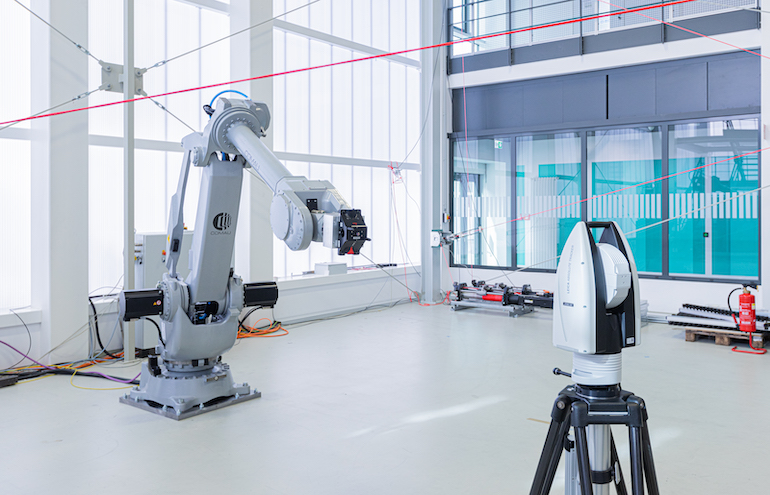
With top equipment and years of experience, Fraunhofer IPA gets to the root causes of inaccurate robot operation. Source: Rainer Bez, Fraunhofer IPA
Robots are almost always highly repeatable. Absolute accuracy, on the other hand, often leaves something to be desired. A team at the Fraunhofer Institute for Manufacturing Engineering and Automation IPA is uncovering the reasons for this and helping companies to achieve more efficient robot systems.
Repeatability and absolute accuracy are established parameters for assessing the quality and precision with which a robot performs a specific task. If a robot performs a specific task many times with almost identical results, this demonstrates very good repeatability. Many industrial robots achieve values in the range of 0.1 mm or better.
In contrast, absolute accuracy describes how accurately a robot’s spatial coordinates are achieved in relation to its base system, regardless of previous movements. And here, there is often still room for improvement. Typically, values between 0.5 and 1.5 mm are achieved. This tendency toward inaccuracy is not a problem for some applications, but it is for others.
Disadvantages of inaccurate robots
It is difficult to use robots with low absolute accuracy in processes that are not repeated identically, such as in the production of small batch sizes. When welding an assembly, for example, it is particularly important that the wire tip is positioned precisely in the center of the weld seam. Exact positioning results in high-quality weld seams that meet industry requirements.
However, deviations of just a few tenths of a millimeter can significantly impair quality or even lead to rejections. Absolute accuracy is not only important for robot-based welding, but also for applications such as pick and place, overspray-free painting, or robot-based drilling and deburring.
Another disadvantage of inaccurate robots becomes apparent in offline programming (OLP), which is also frequently used in the processes mentioned above. Here, the robot program is created in a simulation and then transferred to the real robot. The advantage lies in the possibility of the robot maintaining operation while programming is carried out. Therefore, while the robot is processing one component, the next component can be programmed in parallel.
But if absolute accuracy is insufficient, the created program cannot be used directly. Instead, time-consuming corrections are necessary, leading to unwanted machine downtime, which in turn impairs efficiency and productivity.
The often-achieved absolute accuracy of 0.5 to 1.5 mm is therefore insufficient for complex applications and can limit or even prevent the use of robots in certain applications. It also frequently leads to additional work steps, such as the re-teaching, which reduces the efficiency of the entire production chain. In many industrial scenarios, an absolute accuracy that is similar to the repeatability is desirable or even required.

Reasons for a lack of absolute accuracy
In addition to the accuracy measurements offered in accordance with ISO 9283, companies repeatedly turn to Fraunhofer IPA with the question of how they can improve the performance of their robots in terms of precision. The causes of inaccuracies are manifold and can be divided into hardware-related, software-related, and externally related causes.
Hardware-related reasons may include the design of the robot, such as inferior encoders or gears, or insufficient rigidity, whether it is an articulated arm, a SCARA robot, or a gantry system. Poor calibration of the robot is one of the main reasons for inaccuracy on the software side, along with insufficient controller performance.
In addition, an increasing number of robotic systems are additionally equipped with “cognitive” functions, particularly those related to perception. These so-called closed-loop systems work with sensors that detect the robot’s environment, and their software processes the measured data to adjust the robot’s path accordingly. In such a system, poor sensor data, a low-performing controller, or suboptimal interaction between the components in the robotic cell usually cause problems.
Finally, external factors such as temperature and air pressure, but also process forces that occur, can have a negative impact on absolute accuracy.
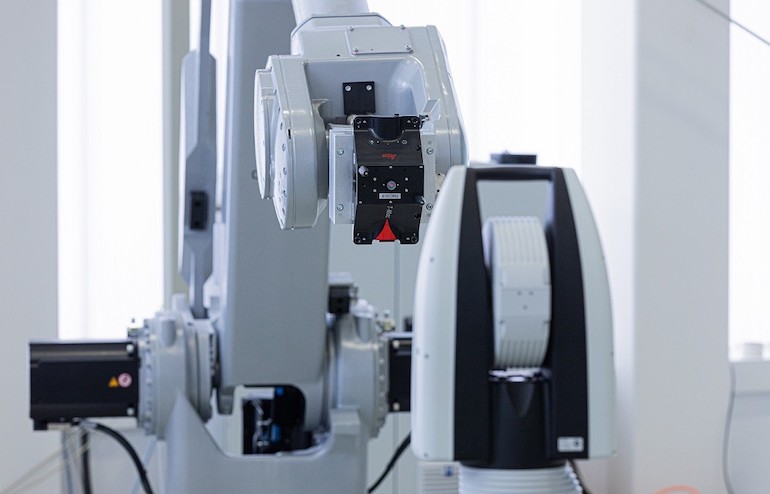
The measurements made by these devices have an accuracy of +- 40 µm anywhere in the working space. Source: Fraunhofer IPA
Comprehensive analysis with new benchmark
If companies that use robots, as well as the robot manufacturers themselves, are dissatisfied with the absolute accuracy of their systems, the entire application should be examined and analyzed. As described above, an individual investigation of the causes is necessary.
The automation team at Fraunhofer IPA is a neutral project partner that can conduct this root-cause analysis in a methodical manner based on extensive expert knowledge and experience.
In a typical project, the team first records the current situation using sensor technology such as the Leica Absolute Tracker AT960 to create a solid database. The laser tracker records the positions of the robot with submillimeter accuracy. Special performance indicators are calculated from the recorded data, which can be used to determine the performance of the robot system.
In addition, the characteristics of the robot’s movements are examined, which also provide valuable insights. In a further step, the experts investigate the cause of the undesirable behavior. To do this, they examine both the hardware and software of the robot system.
In addition, the team has developed a closed-loop benchmark specifically for the closed-loop robot systems mentioned above. The benchmark is suitable for robots from many manufacturers. In the benchmark, a reference-giving device, a “metronome,” is used to provoke the robot into certain behaviors, which allows conclusions to be drawn about its performance.
While ISO 9283 only focuses on the robot itself to measure absolute accuracy, the benchmark developed can examine everything that makes up a closed-loop controlled process or procedure. For instance, this includes the performance of the entire robotic cell, including the sensor technology and the intended process.
The benchmark procedure was presented at the 56th International Robotics Symposium (ISR 2023) and at the 21st International Conference on Automation Technology and Mechanical Engineering (CASE 2025).
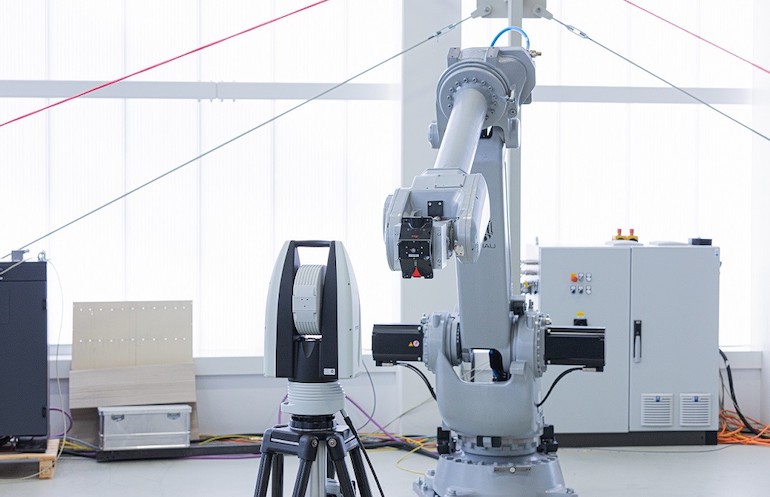
With an accurate robot, the planned path can be executed without manual interaction on the real robot. Source: Fraunhofer IPA
Added value of high absolute accuracy
A robot with sufficient absolute accuracy can not only replace more expensive equipment but also increase flexibility and minimize rework. In many applications, it therefore makes sense to investigate anomalies and improve absolute accuracy.
A robot that works precisely and reliably offers economic advantages, as well as increases a company’s competitiveness. Investing in this area is therefore a strategic decision that pays off in the long term.
About the author
Martin Finkbeiner is a project manager at the Fraunhofer Institute for Manufacturing Engineering and Automation IPA. He can be reached at martin.finkbeiner@ipa.fraunhofer.de and +49 711 9701046.
The post High-precision robots: What to do when absolute accuracy is poor? appeared first on The Robot Report.
View Source


