Iván Hernández Dalas: VDMA warns Germany is losing ground in global robotics race
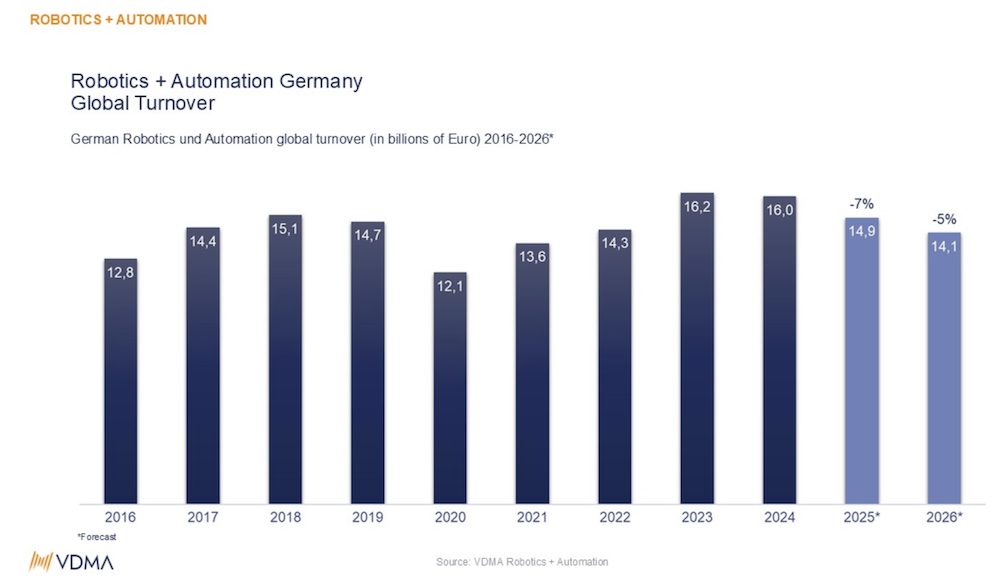
Germany’s robotics and automation industry is preparing for another tough year. The VDMA Robotics + Automation Association, a German trade group, expects revenue to fall 5% in 2026 to about €14.1 billion. That follows a 7% decline in 2025, marking the second straight year of contraction for one of the world’s leading robotics clusters.
Industry leaders say the problems go beyond a normal economic slowdown. Weak demand from key customers has hurt orders. At the same time, geopolitical tensions and broader economic uncertainty have made companies more cautious about investing in new automation equipment.
“The situation remains challenging. Our industry is simultaneously grappling with weak demand, geopolitical uncertainty, and challenging location conditions,” said Dr. Olaf Munkelt, chairman of VDMA Robotics + Automation. “This makes it all the more important that we decisively strengthen our competitiveness – our levers for this are customer centricity, innovation, and courage. At the same time, we need to pick up the pace and be faster in implementation. The task for policymakers is to significantly improve the framework conditions for entrepreneurial activity now.”
According to the association, Germany’s robotics industry is also losing ground internationally. Competitors, particularly in Asia, are expanding faster and gaining market share. The VDMA has warned that high costs, regulatory burdens, and slow decision-making in Europe are making it harder for local companies to compete.

Recent data shows the downturn has been building. Revenue fell in 2024, and order intake — especially from within Germany — dropped sharply. Domestic customers have pulled back on spending, and export markets have not been strong enough to offset the decline.
Still, Munkelt remained optimistic about the long term.
“The long-term growth drivers – digitalization, AI, smart production, and automation – remain intact,” Munkelt said. “We now need to create the conditions so that German and European robotics and automation can once again take a clear lead. We need rapid deregulation and competitive cost structures to return to a growth trajectory.”
According to the International Federation of Robotics (IFR), Germany is the largest robotics market in Europe and the fifth-largest in the world. According to the 2025 IFR World Robotics Report, robotics installations in Germany fell 5% to 26,982 units in 2024, which is the second-best result recorded after the record year of 2023. This represents a 32% market share of the annual total in Europe.
North American market rebounds in 2025
After a drop in 2024, North American robot orders rose in 2025, according to the Association for Advancing Automation (A3). The organization said this rise in orders and revenue reflects strong investment in automation across a growing range of industries. In 2025, companies across North America ordered 36,766 robots valued at $2.25 billion. Compared with 2024, this represents a 6.6% increase in units ordered and a 10.1% increase in revenue.
“The rebound in robot orders over the course of 2025 reflects renewed confidence in automation as a long-term solution to competitive pressures,” said Alex Shikany, executive vice president at A3. “We’re seeing increasing adoption across sectors, especially in general industry applications and at automotive OEMs, as manufacturers look to automation to address workforce shortages, manage reshoring initiatives, and boost productivity.”
The post VDMA warns Germany is losing ground in global robotics race appeared first on The Robot Report.
View Source


