Iván Hernández Dalas: Wayve raises $1.2B with plans to bring robotaxis to London
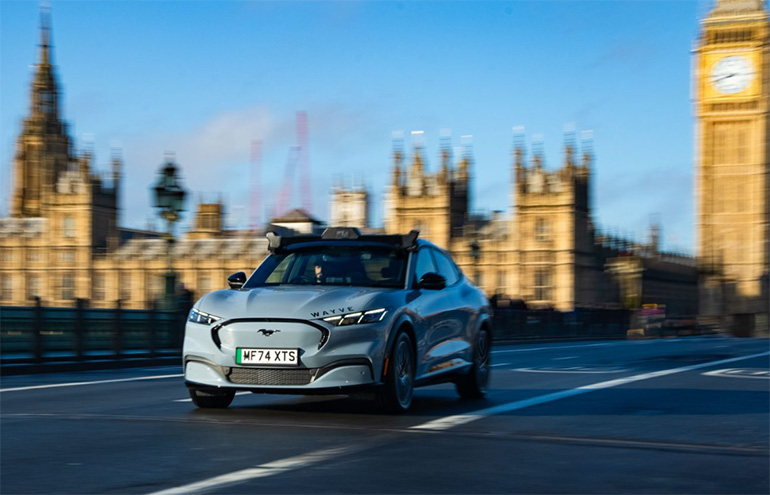
Wayve plans to launch commercial trials of robotaxis using its AI Driver this year. Source: Wayve
Wayve Technologies Ltd. today said it has closed a Series D round of $1.2 billion, bringing its post-money valuation to $8.6 billion. The London-based company said it plans to use the funding to accelerate commercialization of its “end-to-end AI platform” for autonomous driving.
“With $1.5 billion secured, we are building for a total addressable market that spans every vehicle that moves,” stated Alex Kendall, co-founder and CEO of Wayve. “Autonomy will not scale through city-by-city robotaxi deployments alone. It will scale through a trusted platform that automakers and fleets can deploy globally and improve continuously.”
“This investment accelerates our path to widespread commercial deployment and positions us to build the autonomy layer that will power any vehicle everywhere,” he added.
Wayve builds autonomy for automakers
Founded in 2017, Wayve said its AI Driver does not rely on deterministic, map-based systems and runs entirely on onboard vehicle compute. The company said its unified AI platform spans SAE Level 2 “hands-off” operations through Level 4 “eyes-off” driving across vehicles, brands, and markets.
“End-to-end AI has shifted from a research bet to the industry’s chosen path for scalable autonomy,” said Wayve. The company said its AV2.0 foundation model replaces the “sense-plan-act” architecture with a single neural network, trained on data from more than 70 countries and a wide range of vehicles, for easier generalization to new markets.
In the past year, Wayve claimed that it was “the first and only AV developer to drive zero-shot in more than 500 cities across Europe, North America, and Japan, meaning without city-specific fine-tuning before deployment.”
Wayve licenses its software directly to automakers, providing tools to customize driving models for specific vehicles and brands. By partnering with manufacturers and mobility platforms rather than vertically integrating, the company asserted that its approach enables autonomous vehicle (AV) technology to scale globally with lower capital intensity.
Uber to deploy robotaxis in London with AI Driver
This year, Wayve plans to conduct robotaxi trials with Uber, a past and current investor, in London. In 2027, consumers will be able to buy AI Driver-equipped passenger vehicles, starting with L2+ capability that allows the vehicle to steer, navigate, and respond to traffic under driver supervision.
Under the partnership, Wayve will deploy its AI Driver in L4-capable vehicles from participating automakers, while Uber will own and operate the fleet. The companies said they will create a scalable model for ride-hailing using mass-produced AVs.
“We are very proud to continue to deepen our partnership with Wayve, with plans to deploy together in more than 10 markets around the world,” said Dara Khosrowshahi, CEO of Uber. “Wayve’s powerful end-to-end approach is purpose-built for scale, safety, and effectiveness, and we’re excited to work with them across multiple OEMs and geographies, which we’ll share more about soon.”
Other AV developers and robotaxi companies planning to conduct tests in London include Waymo, Tesla, and Baidu (with both Lyft and Uber).
Heidi Alexander, U.K. secretary of state for transport, said: “Wayve is pushing the boundaries of innovation right here in the U.K., and this £1.5bn investment will cement the U.K. as a powerhouse for the next generation of transport. We’re backing innovators with smarter regulation that unlocks growth, and giving firms like Wayve the opportunity to trial their driverless technology on our roads later this year.”

Wayve investors include global tech leaders
Eclipse, Balderton, and SoftBank Vision Fund 2 led Wayve’s Series D. New investors included Ontario Teachers’ Pension Plan, Baillie Gifford, British Business Bank, Icehouse Ventures, Schroders Capital, and other global institutional investors. Wayve’s Series C round in 2024 raised $1.05 billion.
“The technical achievements are extraordinary, but what’s more impressive is how this team has taken cutting-edge research out of the lab and deployed it in complex, real-world driving environments – turning breakthrough science into commercial reality,” said Suranga Chandratillake, general partner at Balderton. “Born out of a tiny lab in Cambridge and now a global leader in its field, Wayve represents the very best of European innovation: world-class technology, global ambition and real-world deployment at scale.”
In addition to the milestone-based capital from Uber, Microsoft and NVIDIA participated in the round. Wayve said this demonstrated support of its “embodied AI as a foundational software layer for deploying autonomy at a global scale.”
“Wayve is pushing the frontier of embodied AI for autonomous driving, and Azure supports the scale, reliability, and safety needed to bring that innovation into the real world,” said Satya Nadella, chairman and CEO of Microsoft. In 2023, Microsoft co-founder Bill Gates took a ride in a Wayve vehicle in London.
Automakers Mercedes-Benz, Nissan, and Stellantis also invested in the company.
“[Wayve’s] work aligns well with Stellantis’ platform‑driven strategy and our focus on scalable, safety‑first vehicle intelligence,” noted Antonio Filosa, CEO of Stellantis. “We see strong potential for collaboration as we advance our autonomy roadmap, including our driverless AV Ready Platforms, with the clear objective of delivering safer and more intuitive driving experiences for customers worldwide.”
Other notable AV investments in 2026 so far include $1 billion in Waabi and $16 billion in Waymo.
The post Wayve raises $1.2B with plans to bring robotaxis to London appeared first on The Robot Report.
View Source


