Iván Hernández Dalas: AW 2026 features Korea humanoid debuts as industry seeks digital transformation
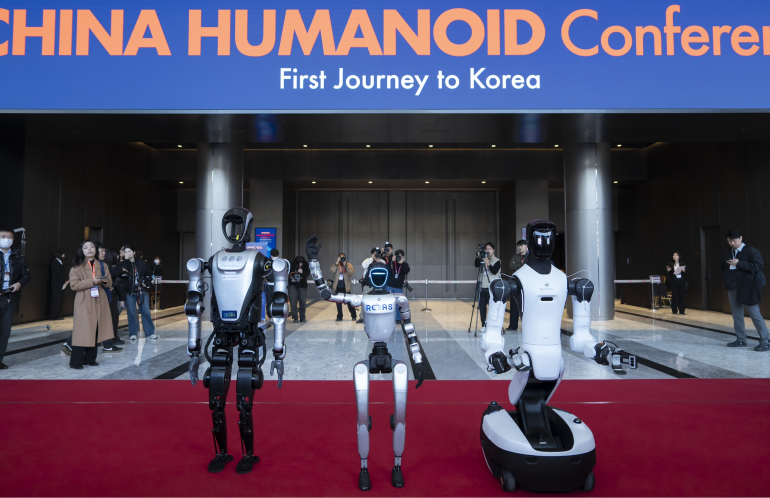
Agibot X2, Unitree G1, and Leju Kuavo 4th Generation Pro humanoid robots make their debuts in South Korea. Credit: AW 2026
SEOUL — Smart Factory & Automation World, or AW 2026, opened yesterday. The event, which occupies the entire Coex venue and features 2,300 booths, is the largest one in AW’s 36-year history, according to the organizers. It was founded as the Manufacturing Innovation Expo.
This year’s theme of “Autonomy: the driver of sustainability” reflects the global shift from factory automation and digitalization to AI and robotics in multiple industries, they said. They added that the goal is production “with greater intelligence, adaptability, and minimal human intervention.”
In his opening keynote, Jo Sang Hyeon, president of Coex, explained how AW‘s expo halls and session tracks were organized around five themes or trends: smart factories, industrial and collaborative robotics, machine vision and sensors, digital twins, and physical AI including humanoid robots.
“AW has grown significantly in both scale and quality, evolving beyond Korea to become one of Asia’s leading exhibitions for manufacturing innovation,” he said. “In particular, this year marks a major shift toward AI and humanoid robots, positioning AW as the Korean version of CES, with representatives from across the industry and more than 100 media outlets visiting the exhibition.”
Physical AI brings self-learning systems to autonomous manufacturing
Many companies and panelists discussed how artificial intelligence is moving from software only to enabling robots to operate with greater flexibility in the physical world.
“Moving beyond software-centric applications, generative and industrial AI are now being embedded directly into robots, production facilities, and assembly lines – bringing intelligence directly into the physical layer of manufacturing,” noted the AW organizers.
“AW 2026 will serve as a platform presenting the direction of the ‘Physical AI era,’ where AI moves beyond software and integrates directly with industrial environments.” stated Sang Hyeon. “Coex will continue strengthening its role as a global industrial platform driving AI-powered manufacturing transformation and the expansion of autonomous production systems.”
In the new AI Factory Pavilion in The Platz at Coex, exhibitors such as POSCO DX, CJ Olivenetworks, and Doosan‘s Digital Innovation business unit demonstrated the integration of vision AI, digital twins, and data-driven process controls.
A separate hall was dedicated to machine vision systems for applications ranging from quality inspection and robot guidance to collecting data for simulation and AI-aided decision making.
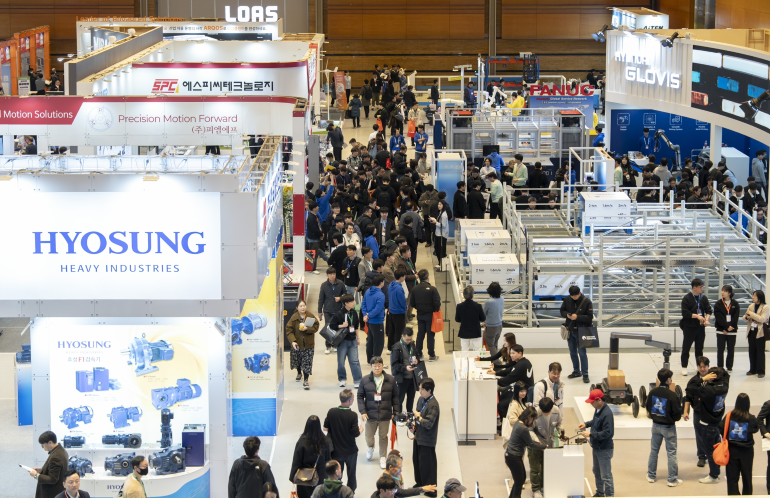
About 30,000 attendees came to Coex in Seoul yesterday, Source: AW 2026
Hyundai demonstrates ‘end-to-end’ logistics
Hyundai Motor Group, which both uses automation as a major automaker and is a supplier of automation, occupied multiple large booths at AW 2026. During the ribbon-cutting ceremony to open the event, its MobED platform brought gloves to the industry and government dignitaries.
Hyundai Robotics Lab‘s MobED had won the Best of Innovation award at CES 2026, and this was its first public appearance in Korea. The robot has some of the maneuverability of a quadruped and can carry a wide range of payloads. Hyundai also announced the MobED Alliance, which including major Korean companies, to help develop applications for it.
Also debuting at AW was the humanoid robot Atlas from Boston Dynamics, although it was not operational. Hyundai said last year that it plans to buy “tens of thousands” of robots from its Boston Dynamics unit.
In addition, Hyundai Glovis demonstrated its integrated AI-based automation and integrated equipment controls with mobile robots from multiple vendors and an automated storage and retrieval system (ASRS) from AutoStore. Hyundai Mobis presented autonomous mobile robots (AMRs).
Other global companies showing logistics and manufacturing prowess included industrial automation leader FANUC, force- and power-limited cobot maker Universal Robots, and autonomous mobile robot (AMR) provider Geekplus Technologies.
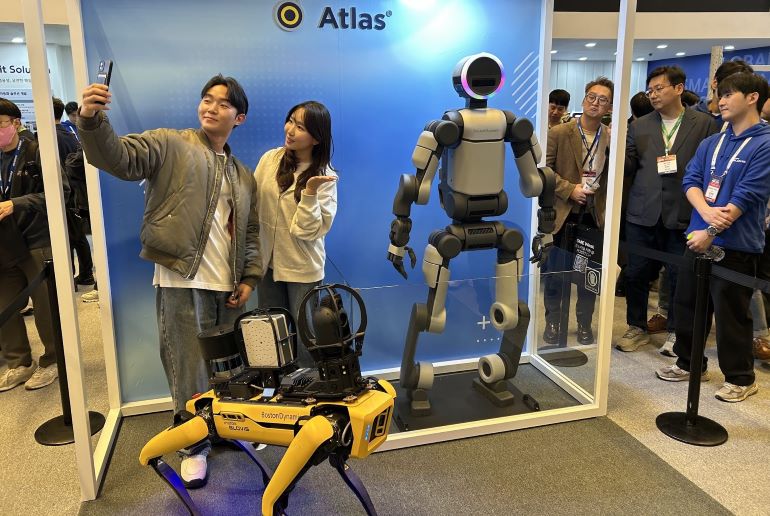
Boston Dynamics’ Atlas made its Korean debut this week. Credit: Eugene Demaitre
Humanoids make their Korean debuts
In addition to Boston Dynamics and Atlas, T-Robotics publicly showed its humanoid robot for the first time in South Korea.
The China Humanoid Robot Conference at AW 2026 addressed commercialization strategies and global industry trends. Daniel He, senior AI architect at Huawei, delivered a keynote addressing the evolution of embodied intelligence and potential applications. Hyung-kwan Shin, CEO of the China Capital Markets Lab, moderated a panel to discuss commercialization strategies, international cooperation, and the future of the humanoid sector.
Chinese humanoid robots on display included the X2 and G2 models from Agibot, which claimed to be the world’s leading humanoid robotics company in terms of global shipments and market share. They are already in commercial use in China, a company representative told The Robot Report.
Unitree‘s G1 performed pre-programmed martial arts moves, while Leju‘s Kuavo 4th Generation Pro walked around. G1 is intended as a research and development platform, and Kuavo, which uses NVIDIA Isaac Sim and Jetson, is in commercial proofs of concept.
Semi-humanoid robots, with a human-like torso and a wheeled base, were more common sights than legged humanoids at AW 2026. DARWIN from Standard Robots was one example.
Several companies such as Gosung Engineering and Mech-Mind showed mobile manipulators for tasks such as palletizing, machine tending, and conveyance of electronics and machine parts.
Korea offers industry leadership, investment opportunities
While 500 companies from 24 countries sprawled across five halls at AW 2026, many were based in South Korea or were from China, Japan, and the West with local divisions. They also reflected evolving service and industrial robotics.
Government representatives discussed legal and financial support to encourage small and midsize manufacturers to acquire robots to be globally competitive. By 2030, the Korean government wants to increase automation in the country‘s factories by 10%. The speakers also cited public-private research and the opportunity for investors.
The Korea International Trade Association hosted a 1:1 business meeting, and a total of 24 buyers from eight companies planned to facilitate meetings with participating Korean companies. AW 2026 also included more than 200 specialized conference sessions around topics such as AI in manufacturing.
AW’s organizers included Coex, the Korea Industry Intelligentization Association, the Korea Smart Manufacturing Office, the Korea Machine Vision Industrial Association, Chomdan Inc., and the Korea International Trade Association.

The post AW 2026 features Korea humanoid debuts as industry seeks digital transformation appeared first on The Robot Report.
View Source


