Mechatronics is a multidisciplinary field of science that includes a combination of: mechanical engineering, electronics, computer engineering, telecommunications engineering, systems engineering and control engineering.
Iván Hernández Dalas: Tesollo and Techman Robot unveil robot for high-mix, low-volume production
Get link
Facebook
X
Pinterest
Email
Other Apps
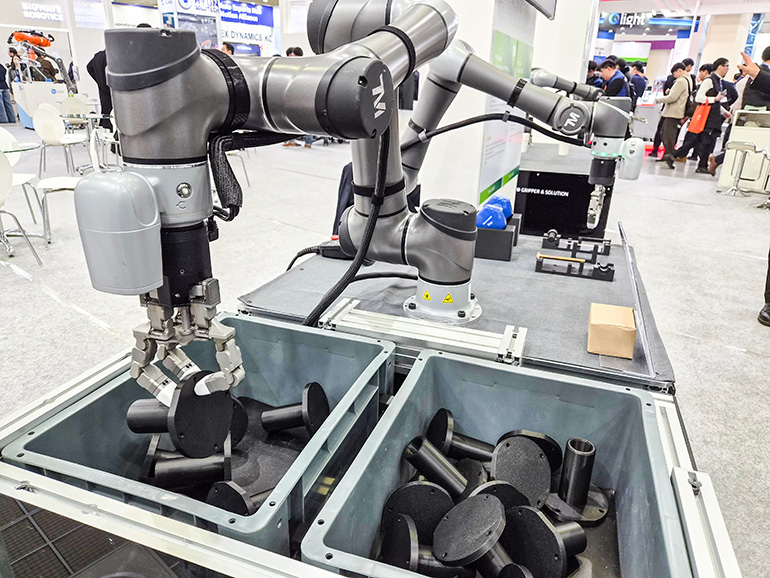
A TM cobot arm with a Tesollo three-finger gripper picks from a bin at AW 2026. Source: Tesollo
SEOUL — Force- and power-limited robots and humanoid robots need good grippers to address a widening range of applications. At the 2026 Smart Factory & Automation Industry Exhibition, also known as Automation World or AW, Techman Robot Korea and Tesollo Inc. presented an articulated, multi-jointed grasping system they said is optimized for high-mix, low-volume production.
“When the industrial reliability of collaborative robots is combined with adaptive grasping technology, it becomes possible to extend processes that are difficult to address with conventional automation,” asserted Techman Robot. “This will be an alternative that can secure both flexibility and scalability in the manufacturing and logistics industries.”
Techman Robot Korea is a subsidiary of Taoyuan, Taiwan-based Techman Robot Inc., and Tesollo is based in Incheon, South Korea. The companies had previously demonstrated teleoperation combining a humanoid robot hand with a TM robot arm. Tesollo last month commercialized its DG-5F-S five-fingered gripper.
“Our Korean customers include Samsung, LG Electronics, and Hyundai, and we have too many U.S. orders to list,” Jaesuk Choi, strategic planning team manager at Tesollo, told The Robot Report. “A camera can be mounted underneath the Delto gripper on the TM arm, and we have a maximum payload of 20 kg [44 lb.]. The fingertips can be equipped with tactile sensors.”
Among the other companies with bi-manual teleoperation demonstrations at AW 2026 were Bigwave Robotics, as well as WeGo Robotics with OnRobot at Universal Robots’ booth.
TM5S, DG-3F-M combo provides reliable grasping, say partners
At AW 2026, Techman and Tesollo showed a process-oriented system that they said can be directly deployed in industrial sites. By combining reliable collaborative robots with adaptive grippers, the collaborators said they offer flexible automation for real production lines.
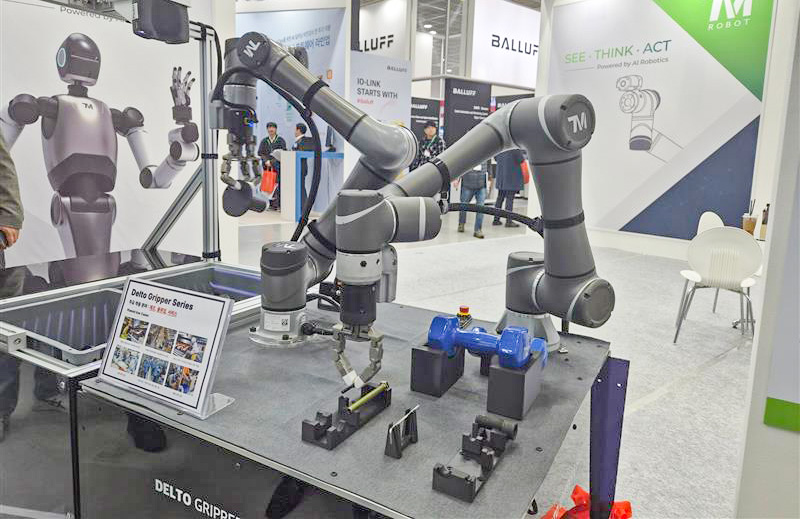
At the center of the partners’ exhibit was an automated workcell integrating the TM5S cobot and the DG-3F-M, Tesollo’s three-finger articulated gripper.
“TM robots provide proven operational stability in industrial environments, featuring high-precision repeatability, an intuitive teaching environment, and built-in vision-based position correction,” claimed Techman. Shin-young Yoon is country manager of Techman Robot Korea.
Tesollo added that the DG-3F-M’s articulated structure enables processes beyond the limitations of conventional automation. The gripper delivers a rated payload of 2.5 kg (to a maximum of 5 kg) in pinching mode and 10 kg (max. 15 kg) in enveloping mode.
Unlike parallel grippers with simple linear open/close motion, The DG-3F-M’s three fingers can actively adapt to the object’s shape and increase the contact area to achieve stable grasping, the company noted. This enables handling of mixed, randomly oriented parts, non-uniform components with inconsistent poses, and heterogeneous parts with diverse geometries.
This gripper can be integrated not only with the TM5S, but also with various payload lineups such as the TM12, TM14, and TM16, broadening its application scope, said Tesollo. “This indicates a platform structure that can be flexibly expanded beyond a single cell configuration according to process scale and load requirements,” it said.
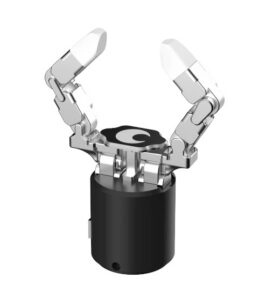
The three-finger DG-3F-M gripper is designed for industrial applications. Source: Tesollo
Tesollo and Techman see application potential
Conventional automation has faced structural constraints where jigs must be replaced or processes must be redesigned whenever part shapes change, observed Tesollo. However, when the TM arm’s stable motion control is combined with the DG-3F-M’s shape-adaptive grasping, the robot can respond more quickly to process changes while maintaining productivity.
Tesollo and Techman said their joint offering is suitable for high-mix, low-volume production. For example, it can be used in processes such as one-kit plate operations that transport multiple parts at once for assembly in the automotiveand electronics manufacturingindustries, which are important in South Korea.
The system is also applicable to automatic picking and aligning of irregular parts in bin-picking logistics, as well as assembly processes that combine parts of different shapes.
A high-mix demo at AW 2026 featuring the DG-3F-M and DG-2F grippers. Source: Tesollo
Two-fingered gripper adds motions
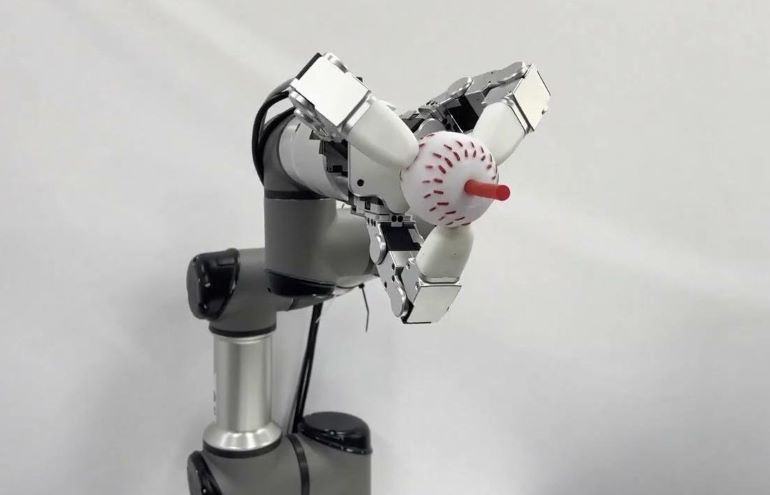
Tesollo also released the DG-2F, a two-finger articulated gripper that it said can overcome the limitations of conventional parallel-jaw styles. While it follows the most commonly used two-finger form factor in industrial settings, the end-of-arm tooling incorporates a multi-axis articulated design internally.
Unlike a standard 1 degree-of-freedom parallel jaw, the DG-2F has a multi-axis articulated design. Source: Tesollo
The company said this enables diverse motions such as vertical grasping, horizontal grasping, and angle-adjusted grasping.
This design allows stable handling of different part geometries without changing jigs, making the DG-2F suitable for general-purpose industrial processes, according to Tesollo.
“Articulated grippers are no longer research equipment—they are now a core robot component directly tied to productivity in high-mix, low-volume production environments,” stated Tesollo CEO Youngjin Kim. “We will continue to expand flexible automation solutions that can be deployed immediately in real processes through integration with collaborative robots.”
Other robotic gripper developers at AW 2026 this week included Robotis and Wonik Robotics.
We’ve had some time to recuperate from the madness of CES, in which more than 150,000 attendees and thousands of exhibitors displayed their latest gadgets, gizmos and yes, even robots, on the CES show floor. Last week’s reporter’s notebook focused on the collection of startups around the Eureka Park area of CES, but several of the same trends were evident on the main South Hall 2 area of the Las Vegas Convention Center, where drones, robotics, AR/VR, and gaming took center stage. While most of our time was spent at CES hosting the Service Robots Arrive in Daily Life event, we did have some time during the week to visit the show floor and record observations. Here’s what we saw on the show floor, as well as some of our own individual meetings: 1. Underwater drones make a big splash On the main floor, there was no busier aerial drone booth than the DJI booth, but that is expected given the company’s dominance in the space. But once you got past that, you noticed a lot more drone co...
Source: EOS Data Analytics Agriculture is becoming the most high-tech industry today. All the top-notch technologies are finding a place in the way we produce, harvest, and distribute our crops. And in all cases, farm automation and robots are not an affordable luxury, but a necessary minimum due to tackling the rising global food demand. Agricultural robots can mitigate labor shortages by automating tasks like planting, harvesting, and weeding, while also supporting sustainable practices. Combined with satellite imagery tools for data-driven farming, these innovations can make precision agriculture more efficient, resilient, and environmentally responsible. According to the United Nations report , by 2050, the world will need 70% more food to feed nearly 9.7 billion people. Considering this demand, farm robots and remote sensing are the cornerstone of the proper work of the supply chain. Smart machines arise for the farm Farm robots are no longer experimental concepts — they ...
Physical Intelligence, the San Francisco-based startup that has raised more than $400 million , has open-sourced its Pi0 robotic foundation model. Pi0 was introduced a few months ago and can be tuned to a range of tasks, including folding laundry, cleaning a table, scooping coffee beans, and more. Physical Intelligence has released the code and weights for Pi0 as part of its experimental openpi repository on GitHub. It also provides checkpoints for a few “simple tasks” on available platforms such as ALOHA and DROID, example code to run inference on real-world and simulated robot platforms, and the code for fine-tuning the base π0 model for your own tasks and platforms. The company said between 1-20 hours of data was sufficient to tune Pi0 to a variety of tasks in its own experiments. HuggingFace has also prepared a PyTorch port of openpi for those developers who prefer PyTorch over JAX. “We believe that general purpose models that can control any robot to perform any task will b...