Iván Hernández Dalas: Three companies demonstrate global commercialization potential at AW 2026
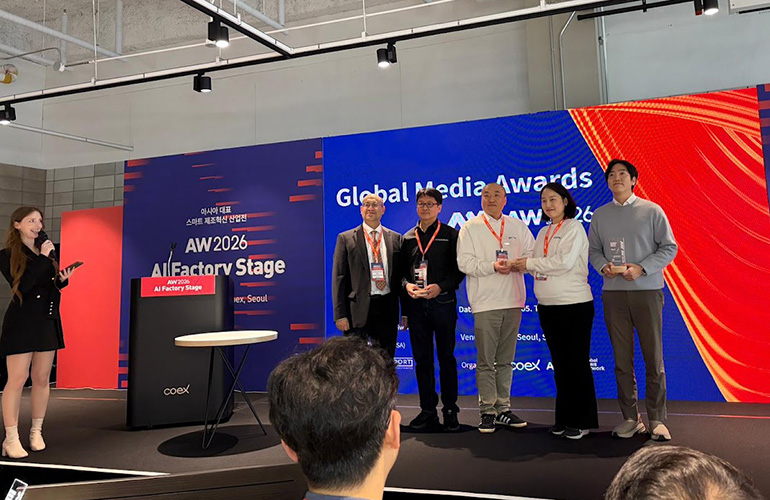
The Robot Report recognized Hypergram, Epson, and Polaris3D at AW 2026. Credit: Sewong Chloe Park
SEOUL — Among the highlights at last week’s Smart Manufacturing and Automation World, or AW 2026, were the 500 exhibitors. The event’s organizers asked me and other international reporters to select three of the most promising candidates for its Global Media Awards.
The criteria included their strength in marketing, potential for market growth, opportunity for investment, and competitiveness. In addition, the finalists had a significant presence in South Korea as the country intends to parlay its expertise in service and industrial automation to be a bigger player in the global robotics ecosystem.
AW 2026 showcased cutting-edge technologies in smart factories, robotics, and innovations in AI-driven manufacturing. The event‘s organizers included Coex, the Korea Industry Intelligentization Association, the Korea Smart Manufacturing Office, the Korea Machine Vision Industrial Association, Chomdan Inc., and the Korea International Trade Association.

Epson Korea, Hypergram, and Polaris 3D stand out
Epson is the global leader in SCARA robots, which are known for their precision, repeatability, and durability. The company’s systems have already found wide use in manufacturing, pharmaceuticals, sortation, and other sectors. Epson Korea also showed force- and power-limited arms at AW 2026.
The company’s dedication to quality, ease of use and maintenance, and support have helped it extend beyond printing. It has continued to innovate with its RC+ software to make robot programming easier.
At AW 2026, Epson Korea showed its four-axis SCARA robot for applying labels, as well as its new LS50-C model, which can handle up to 50 kg (110.2 lb.). The systems have been available in China and are now for sale in Korea, Eun-Jeong Kim, manager of the MS business team at Epson Korea, told The Robot Report.
Hypergram Inc.‘s imaging technology brings machine vision and hyperspectral capabilities to industrial inspection. By using AI and a wider range of wavelengths than many other sensors, it provides deep perception for robotics and quality control.
Hypergram’s technology is particularly applicable to agriculture, food, recycling, and medical imaging and pharmaceuticals, all spaces where safety and sustainability are important. With its roots in the Korea Advanced Institute of Science & Technology (KAIST), this company exemplified Korean innovation and commercial potential.
At AW 2026, Hypergram demonstrated with real and plastic coffee beans how its near-infrared sensing technology enables it to find and classify anomalies in real time. The company is currently working on proofs of concept, explained Min H. Kim, CEO of Hypergram.
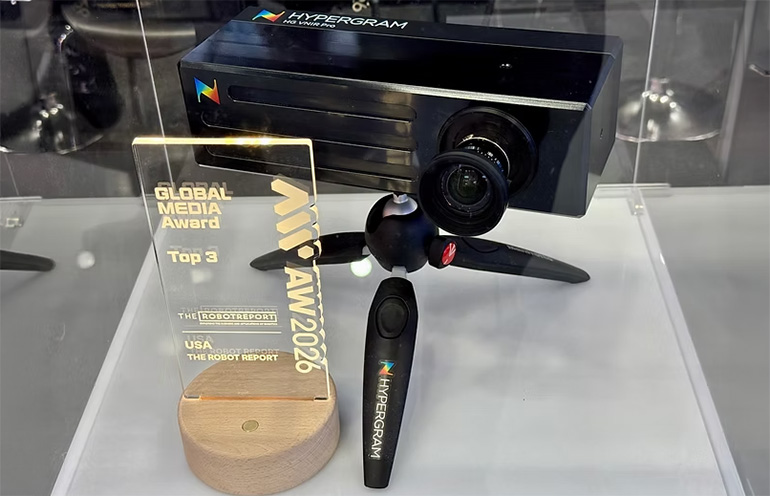
Hypergram earned recognition for its hyperspectral imaging technology. Source: Hypergram
Polaris3D has advanced South Korean expertise in autonomous mobility with its home-grown research, development, and production. The Seoul-based company also offers fleet management and support.
In addition, Polaris3D can apply its technical know-how across use cases, from industrial conveyance to service delivery. The company, which initially focused on service robots, has added supply chains and manufacturing, including demanding Tier 1 automotive suppliers.
“We took the money from service robots and invested in R&D and improving our mobile platforms,” said Shaquille Park, senior manager for global sales and technology at Polaris3D. “We’re now part of the Samsung supply chain and work directly with the Tier 1 providers.”
This pivot was manifest in Polaris3D’s modular Seamless Manufacturing Automation Robot (SMAR) lineup, which the company claimed can improve logistics in factories and warehouses.
Global media covers AW 2026
Selecting nine companies from a total of 60 exhibitors at AW 2026 was no small feat, much like the Robotics Summit & Expo‘s annual RBR50 Robotics Innovation Awards. My host, AVING News Corp.’s Dongkwan Davis Kim, and translator Sewon Chloe Park helped me navigate the event’s many exhibits.
Emily Kuo and Daniel Chiang, reporters at Taiwan’s DigiTimes, recognized companies including Advantech, Asus, and Wonik Robotics. Susan Hong, editor at EE Times, also covered the debuts of Chinese humanoids from Agibot, Leju, and Unitree at AW 2026.
The Robot Report will continue its coverage of South Korean and global robotics.
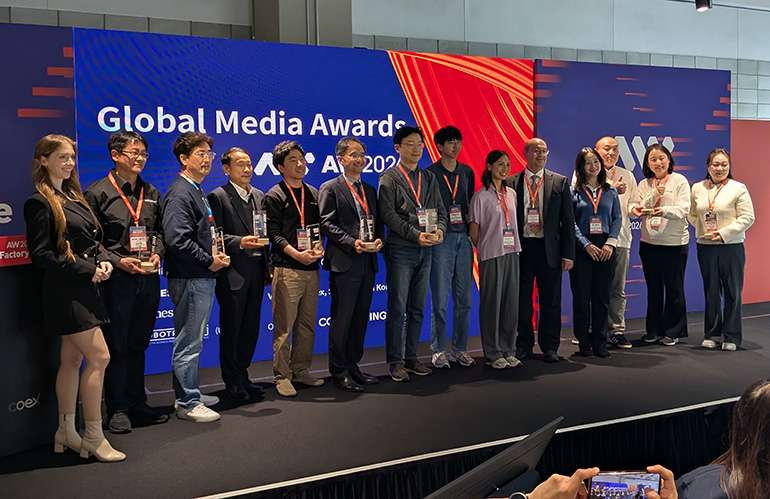
Global media presented awards at AW 2026 in Seoul. Credit: Dongkwan Davis Kim
The post Three companies demonstrate global commercialization potential at AW 2026 appeared first on The Robot Report.
View Source


