Iván Hernández Dalas: Crewline secures $7.1M to automate construction’s most repetitive task
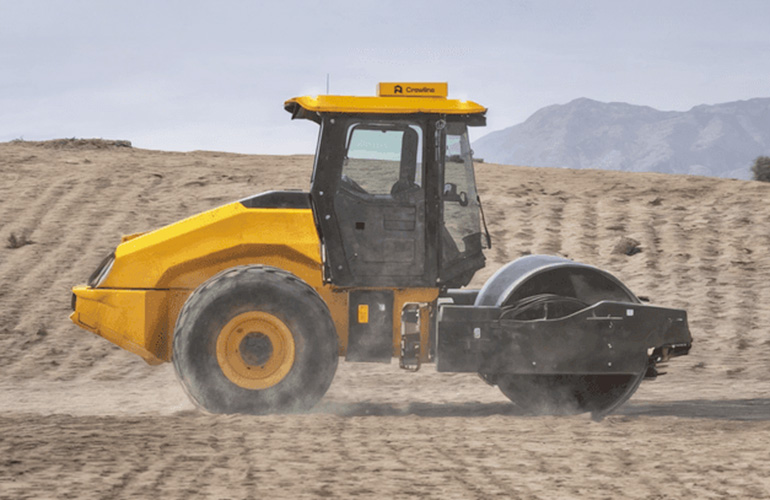
Crewline has developed an autonomy solution for soil compactors that can be installed in an hour, providing a self-driving capability. | Source: Crewline
Addressing a structural labor crisis that forces contractors to cancel nearly two-thirds of their jobs, San Francisco startup Crewline has secured a $7.1 million seed round to deploy an autonomous retrofit kit for construction rollers. By transforming the jobsite’s most repetitive and least-desired task into a self-driving operation, the company is leveraging a “wedge” strategy to tackle a workforce shortage of nearly 500,000 workers. It has already amassed a $26 million waitlist of contractors eager to scale productivity without adding headcount.
CEO and co-founder Frederik Filz-Reiterdank leads a lean four-person team that is developing the new construction automation solution. Already on version six, the company is shipping a new kit revision roughly every 3 weeks.
Filz-Reiterdank told The Robot Report that “labor availability is the #1 constraint on the industry. Ninety-two percent of contractors say they can’t fill open positions (AGC’s 2025 workforce survey). Forty-five percent have delayed projects specifically because of worker shortages. AGC estimates the industry needs ~499,000 net new workers in 2026 and roughly 1.9 million over the next decade. It’s structural, not cyclical – the construction unemployment rate is 3.5%, meaning there’s essentially nobody with experience looking for a job. Contractors already believe automation is part of the answer: 45% expect robotics and AI to positively impact construction jobs, up from 41% in 2024.”
Low-hanging fruit in road construction
Compaction is key to every earth-moving project. Driving a compactor is also the lowest-skilled job. Similar to the tillage workflow in agriculture, compaction is repetitive and pattern-based. There’s nothing to replenish (other than fuel), and nothing to load or unload. Unlike excavation, you can’t hit a utility with a compactor. The key technical problem with compaction is avoiding obstacles like vehicles and crew; otherwise, it’s a basic line-following algorithm.
Crewline’s core principle is that most robotics companies die iterating on hardware and software simultaneously. “We avoided that by retrofitting an existing machine rather than building one. Our kit goes on a standard roller in an hour, no wire cutting, fully reversible,” said Filz-Reiterdank. “Second, soil compaction is the most automatable earthwork task. It’s pattern-based (cover the area N times at a given overlap), forgiving of error, and doesn’t require the sub-centimeter blade control that grading does.”
According to Filz-Reiterdank, “ROI is the core of the economic model. The roller runs fully autonomously. A single human (on a dozer, motor grader, or as a site foreman) sets the roller’s mission from an iPad in under a minute: draws the zone on a map, hits go. The roller then runs on its own for hours with onboard obstacle and crew detection. So one operator who was previously running one machine can now supervise one machine plus one or more rollers. That’s labor multiplication, not labor replacement, which is what makes the ROI work at current wage levels. Watts Services is scaling from one of our rollers to three on that basis.”
A pragmatic approach to autonomy
While compaction is the first construction workflow on its roadmap, Crewline is working on excavation and grading workflows.
The roadmap, as described by Filz-Reiterdank, is straightforward: first, retrofit existing machines instead of designing new ones from scratch. This is a strategy currently used by most heavy equipment automation companies, so it’s well-founded.
Next, the company is deploying immediately on real job sites. Working with partners like Watts Services and DSS, the company has also built a list of 200+ prospects since ConExpo. This has enabled the company to generate revenue from day one while continuously collecting real-world data.
The result is fast iteration and hardening of the solution.
The tech stack
The tech stack employed by Crewline leverages a handful of industry-leading technologies for autonomous vehicles and heavy equipment autonomy.
- Compute: Rugged NVIDIA Jetson onboard.
- Perception: Stereo ZED cameras for 360° coverage, used for crew, vehicle, and obstacle detection.
- Positioning: Dual RTK-GPS for accurate positioning.
- Perception: Crewline went camera-first for two reasons. The first is cost, as stereo is roughly 10 times cheaper, which matters at fleet scale. Next is range. Rollers run at a walking pace, so the stereo’s 20-30m comfortably covers the safe stopping distance. Strategically, cameras put Crewline on the vision-language model curve as foundation models run on image data, not point clouds.
- Connectivity: Starlink for coverage in remote locations.
- Safety: Dedicated safety controller, two wireless e-stops.
- Actuation: Drive-by-wire via integration with the machine’s existing controls. No permanent modifications, reversible in under an hour.

The post Crewline secures $7.1M to automate construction’s most repetitive task appeared first on The Robot Report.
View Source


