Iván Hernández Dalas: Generalist introduces GEN-1 general-purpose model for physical AI
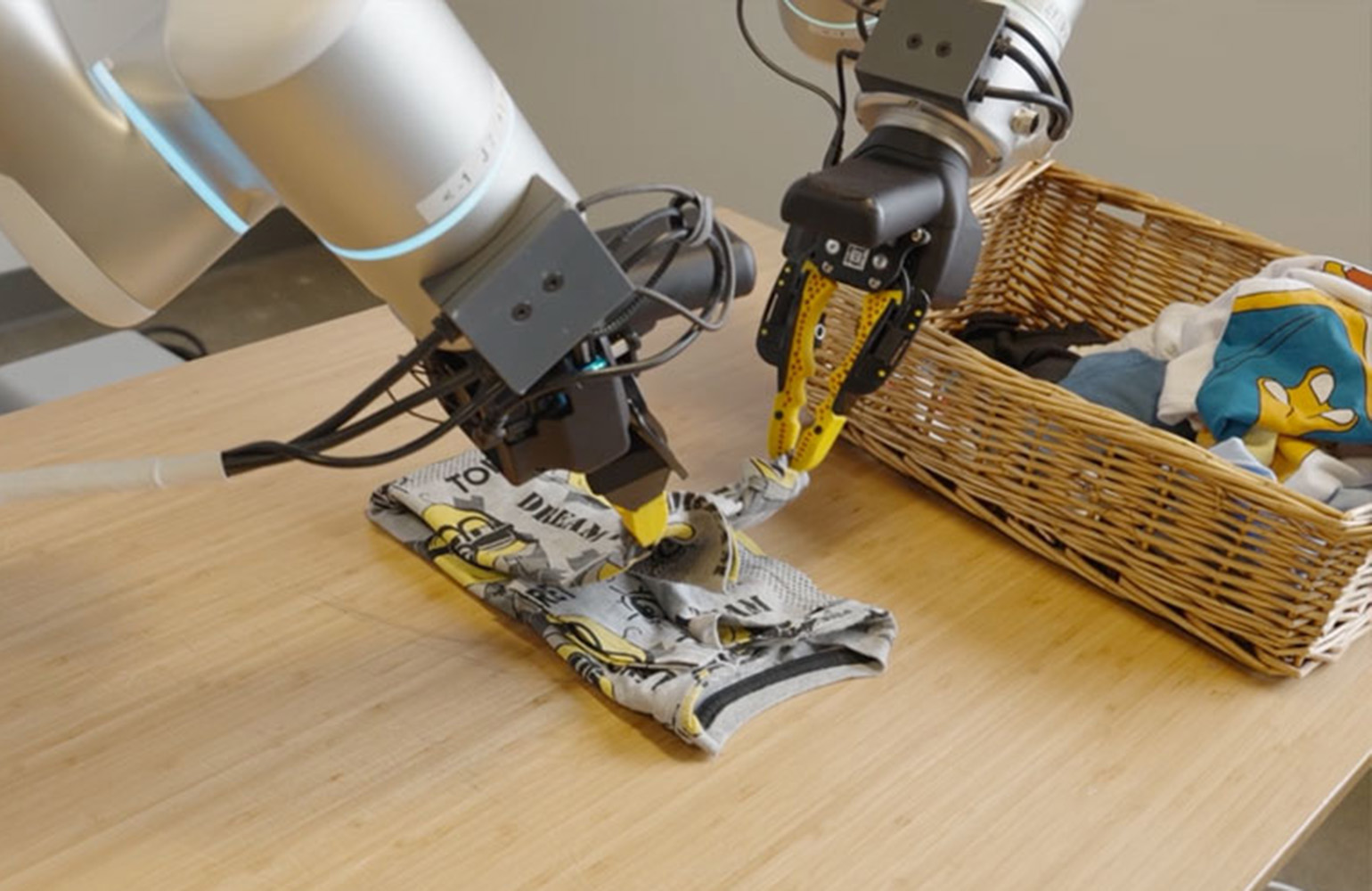
To create GEN-1, Generalist said it improved training stability, built custom kernels, invented new forms of paged attention to enable real-time inference, honed post-training techniques, and hardened controls to be even smoother and more precise. | Source: Generalist AI
Generalist AI Inc. yesterday announced its GEN-1 general-purpose AI model for robotics. The company said the system improves average success rates to 99% on tasks where previous models achieved 64%. The model also completes tasks roughly three times faster than current approaches, and it requires only one hour of robot data for each of these results, Generalist claimed.
Founded in 2024, the company is building embodied foundation models for general-purpose robots. San Mateo, Calif.-based Generalist asserted that GEN-1 “unlocks commercial viability across a broad range of applications.” This latest release came just five months after the company released its GEN-0 model, which it said demonstrated that scaling laws exist in robotics.
While Generalist was optimistic about the AI model’s progress, it noted that GEN-1 can’t solve all tasks. The startup added that some tasks would require higher than 99% success rates to be useful in real settings.
Editor’s note: At the 2026 Robotics Summit & Expo on May 27 and 28 in Boston, there will be sessions on embodied and physical AI development. Registration is now open.

GEN-1 trains on real-world data, scales up from GEN-0
GEN-1 further scales GEN-0’s foundation and uses algorithmic advances to start mastering simple tasks, explained Generalist AI. The company trained the model from scratch on its dataset of half a million hours of real-world data.
With GEN-0, Generalist said it proved that it was possible to scale up robot learning in a generalized way, much like predictable progress in language models. The company said that every zero-shot task it tracked improved simultaneously. However, it acknowledged that the model’s performance “was not sufficient to be used in commercial settings.”
GEN-1 is built on further scaling of data and compute and accelerated by algorithmic advances, said Generalist. It reported that it is starting to see some tasks cross the level of performance needed to be deployed in economically useful settings.
Previous general models in robotics that surpass 90% success have depended on enormous teleoperation datasets that are expensive and difficult to scale, noted the company. Instead, for GEN-0 and GEN-1, the base foundation model is trained without any robot data.
Instead, the model uses data from low-cost wearable devices on humans doing millions of activities, Generalist said it has proved that this pretraining can lead to high levels of mastery without requiring large teleoperation or simulation datasets.
Generalist uses advances across a range of technologies
GEN-1 includes pre-training innovations, which improved compute efficiency, according to Generalist AI. Advances in post-training techniques, learning from experience (RL), multimodal human guidance, and new inference-time techniques also contributed to higher performance for any given task, it said.
In addition to these advances, the company said GEN-1 has scaled significantly in terms of compute since its previous model. “It demonstrated the ability to quickly learn new tasks, adapt to new environments, and display moments of physical common sense,” noted Generalist.
GEN-1 is a data-efficient learner, claimed the company. In some tests, it said the model can achieve comparable performance to GEN-0 with 10 times less task-specific data and fine-tuning steps.
Since the pretraining dataset contains no robot data, when GEN-1 adapts to a new task, it is simultaneously adapting to that robot embodiment and to that task for the first time, said Generalist.
GEN-1 improves reliability and improvisational intelligence
“Embodied foundation models should be reliable, fast, and able to recover from unexpected scenarios,” said Generalist. When it comes to reliability, the company said GEN-1 can perform several tasks at high levels of reliability over long durations without intervention.
The company showed GEN-1 working across six tasks: kitting auto parts for more than an hour, folding T-shirts 86 times in a row, servicing robot vacuums over 200 times in a row, packing blocks more than 1,800 times in a row, folding boxes over 200 times in a row, and packing phones over 100 times in a row.
Without pretraining, tasks trained from scratch exhibited poor performance, with an average 19% success rate. GEN-0 models fine-tuned on these tasks to achieve 64% success rates. Generalist said GEN-1 crossed into production-level success rates, with an average 99%.
Generalist said these models can respond creatively to unexpected scenarios. In the automotive kitting example, if a washer was bumped so that it was no longer held properly, the robot could set it back down to regrasp it, or it could partially insert the washer into the slit to use extrinsic dexterity for regrasping. It could even decide to use its other hand to enable bi-manual in-hand regrasping.
If large deformable objects like T-shirts ended up in unexpected configurations, the model could figure out how to recover, said Generalist. “These behaviors are well outside the training distribution and directly contribute to recovering from unexpected long-tail events,” it said.
Generalist model accelerates task completion
Generalist AI said that GEN-1 enables task completion roughly three times faster than the state of the art (SOTA) for demonstrations. The model can react to new object physics accordingly.
For example, GEN-1 can assemble a box in 12.1 seconds. Generalist said this is 2.8x faster than prior SOTA — GEN-0 and π0 both took about 34 seconds on identical boxes. GEN-1 can also pack a phone into a case in 15.5 seconds, at 2.8x the speed of GEN-0.
Several components enabled these speed levels, said Generalist. The models learn from experience and represent an evolution in inference with Harmonic Reasoning, it said.
The company also credited its data-collection devices for providing its models access to a wide array of pretraining data of completing various other tasks at high speeds, transferring knowledge from general exposure to the dynamics involved. Generalist contrasted this with traditional teleoperation systems that naturally produce slower, less-fluid data because of a lack of force feedback, latency, and visibility challenges.
“Building GEN-1 was not easy — we redesigned our distributed training infrastructure to support petabytes of physical interaction data as a first-class citizen,” said Generalist AI. The company said that early-access partners can now gain access to the model.
The post Generalist introduces GEN-1 general-purpose model for physical AI appeared first on The Robot Report.
View Source


