Iván Hernández Dalas: Ouster releases Stereolabs ZED X Nano wrist-mounted camera
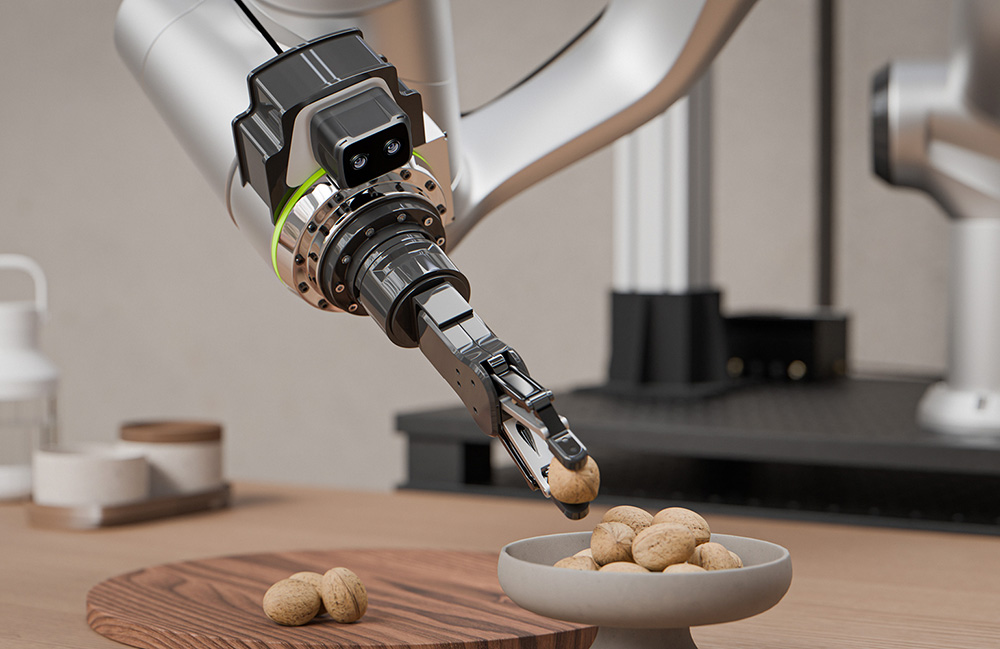
Ouster provides digital lidar, cameras, AI compute, sensor fusion and perception software, and AI models. | Source: Ouster
Ouster, Inc. yesterday released Stereolabs ZED X Nano, a compact wrist-mount stereo camera engineered for robotic manipulation, imitation learning, and high-throughput data collection.
“Building on Stereolabs leadership in AI vision and perception solutions, the ZED X Nano allows us to go deeper into the industrial and robotics markets to win new sockets that require smaller form-factor placements,” said Ouster CEO Angus Pacala. “The future of Physical AI depends on massive amounts of high-quality, low-latency image data collected at the edge. With the ZED X Nano, we’re giving roboticists a major upgrade to their vision systems, enabling machines to sense, think, act, and learn with unprecedented precision.”
As robotics teams scale imitation learning and reinforcement learning for manipulation tasks, RGB image quality and end-to-end capture latency have become critical bottlenecks. Legacy cameras rely on USB connectivity, capture low-resolution 720p RGB and depth, and require CPU-mediated pipelines that limit throughput and add latency.
Ouster designed Stereolabs ZED X Nano to solve these problems. It measures 40% smaller in height than comparable solutions, and mounts directly onto robotic wrists and end-of-arm tooling. It leverages the same 1920×1200 global shutter sensor trusted across the flagship ZED X camera line. It can capture high-resolution RGB and depth images at up to 120fps for training data and manipulation.
The ZED X Nano is available for pre-order starting today. Shipping begins May 2026.
ZED X Nano is built for physical AI, with sub-millimeter accuracy
At the heart of the ZED X Nano is an ultra-low-latency capture pipeline with a fully zero-copy path from sensor to GPU, with frames flowing directly into NVIDIA hardware encoders and AI inference pipelines simultaneously.
For data collection teams, this means higher-throughput dataset capture at full resolution. For deployment teams, it means running perception, segmentation, and policy networks in parallel on the same frames with more GPU headroom.
Depth is powered by Stereolabs’ Neural Depth Engine, an AI stereo depth system with sub-millimeter accuracy in the Z-axis. The depth engine delivers significantly better lateral (XY) positioning than traditional structured-light or time-of-flight cameras, Ouster said. It provides critical advantages for grasp pose estimation, fine placement, and assembly tasks where lateral error directly translates to manipulation failure. With a minimal depth-sensing range of 3 cm, the camera can also sense objects closer than comparable solutions on the market.
Ouster built the ZED X Nano with durability in mind. Sporting an onboard vibration-proof IMU, the camera is powered by a ruggedized GMSL2 connection and next-generation cabling engineered for the repeated motion and cable stress of robotic arms. This replaces a fragile USB-C with an industrial-grade link that carries video up to 15 meters with EMI resistance and locking connectors.
ZED X Nano is the latest Stereolabs product to offer first-class native integration with NVIDIA Isaac Sim and Isaac Lab for sim-to-real transfer, as well as native ROS and ROS 2 support. Teams building imitation learning or reinforcement learning pipelines can capture high-fidelity demonstrations, train in simulation with matched camera models, and deploy to hardware, all on the same sensor and software stack.

The post Ouster releases Stereolabs ZED X Nano wrist-mounted camera appeared first on The Robot Report.
View Source


