Iván Hernández Dalas: Report finds that while 500k+ robots were installed last year, partner layer is still hard to map
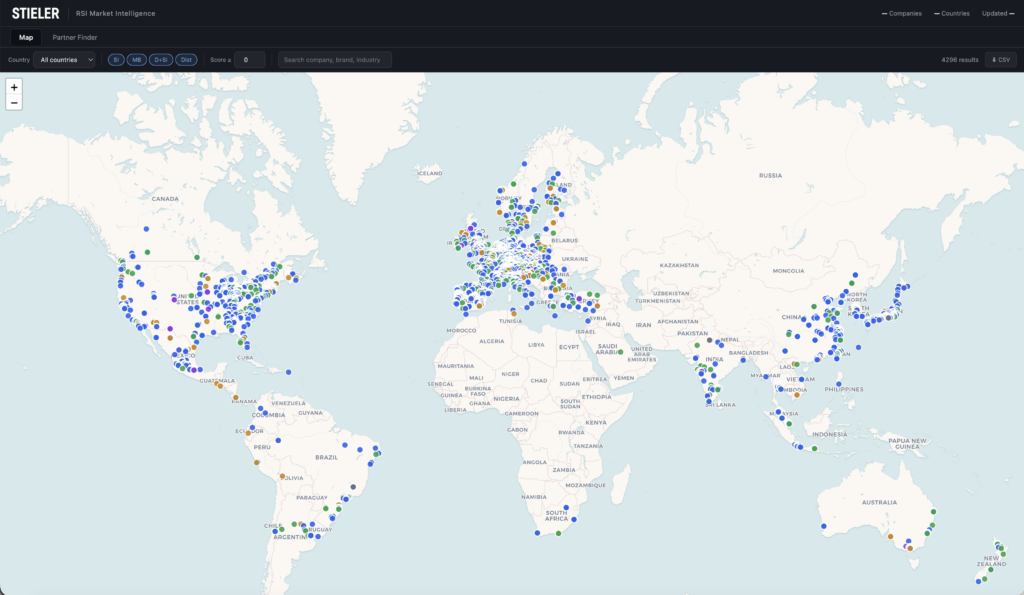
A recent study examined the relationship between robot vendors and integrators worldwide. Click here to enlarge. Source: STIELER Technology & Market Advisors, RSI Market Intelligence
The real bottleneck: You can build the most advanced AI robot in the world, but it will not deploy itself. The promise that cobots would make the system integrator obsolete has proven to be a myth.
Even supposedly simple robots require application expertise, peripheral integration, risk assessments, and process-specific know-how. The system integrator is not a downstream service layer but the true enabler. Without one, even the best technology stalls in the showroom.
A database makes the ecosystem visible
More than half a million industrial robots are installed worldwide every year. But the ecosystem that actually deploys them — the system integrators, machine builders, and distributors that turn hardware into working applications — remains largely unmapped. There is no consolidated, cross-border view of who these companies are, what they specialize in, where they operate, and how they compare.
Over the past year, we set out to build one. The result is a structured database of 4,296 company profiles across 64 countries. What follows are some of the patterns we found.
The analysis is based on a structured dataset built from OEM partner directories, company websites, registries, industry associations, major trade-show exhibitor screening, and analyst review. Coverage varies by country and web visibility, but the structural patterns are clear.
A large ecosystem, dominated by small firms
Of the roughly 3,400 companies for which we have employee data, 54% employ fewer than 50 people. Only 5% have more than 1,000. The top 5% of firms by headcount account for 84% of total employment in the dataset — a classic long-tail structure. The robotics ecosystem includes a few large groups and thousands of small specialists.
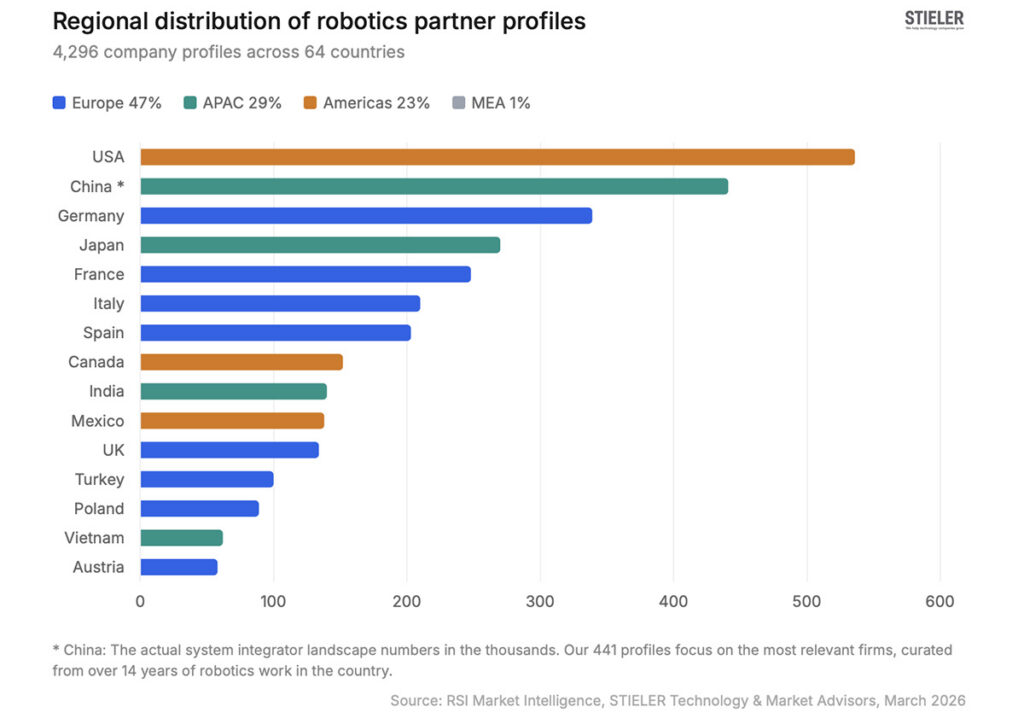
By region, Europe accounts for 47% of all profiles, APAC 29%, the Americas 23%. The top five countries — the U.S. (536), China (441), Germany (339), Japan (270), and France (248) — represent 43% of the total.
China is a special case. The actual systems integrator (SI) landscape numbers in the thousands, but many smaller firms lack a web presence, and the market is consolidating fast. Our 441 Chinese profiles are curated from over 14 years of project work in the country — the ecosystem is significantly larger than what any structured database can capture.
A large share of the channel sits outside the partner label
The post Report finds that while 500k+ robots were installed last year, partner layer is still hard to map appeared first on The Robot Report.
View Source


