Iván Hernández Dalas: SCSP launches National Security Commission on Robotics for Advanced Manufacturing
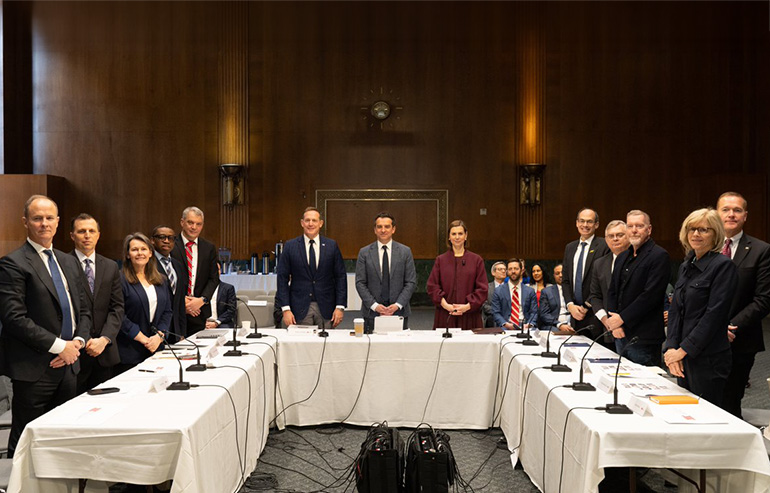
A plenary session of the new National Security Commission on Robotics for Advanced Manufacturing convened on Capitol Hill. Source: SCSP, via X
Robotics and AI are increasingly viewed as not just important for U.S. economic competitiveness, but also key to the future of national security. The Special Competitive Studies Project, or SCSP, this week announced the National Security Commission on Robotics for Advanced Manufacturing.
The organization said the new group is intended “to restore American industrial preeminence by mastering the convergence of physical AI and automation, ensuring that U.S. manufacturing capacity becomes a durable national security asset against our adversaries.” SCSP President Ylli Bajraktari, Sen. Ted Budd (R-N.C.), and Sen. Elissa Slotkin (D-Mich.) are co-chairing the year-long commission.
“We are at a hinge point in history where ‘physical AI’ — powered by robotics — will determine the next era of geopolitical and economic power,” stated Bajraktari. “The commission is not just about making things more efficiently; it is about ensuring the United States commands the robotics-enabled industrial base required to defend our interests. We are bringing together the best minds to ensure America wins the race for the future of production.”
The Special Competitive Studies Project is an Arlington, Va.-based non-profit, non-partisan initiative whose stated mission is to make recommendations to strengthen America’s long-term competitiveness as artificial intelligence and other emerging technologies reshape national security, economy, and society.
SCSP takes the lead on a national robotics strategy
The SCSP said the commission will be the primary architect of a national strategy to scale next-generation robotics as the global production shifts toward autonomous systems. It had sent an open letter to the incoming administration a year ago. By unifying public and private efforts, the commission said it aims to bridge the gap between laboratory innovation and shop-floor execution.
“Improving America’s physical AI can help power a new manufacturing renaissance, and the deployment of robotics will create smarter systems and scalable solutions,” said Sen. Budd. “Enhancing technology for workers will unlock new careers, reduce our reliance on adversaries, and ensure the advanced manufacturing capabilities that will define the future are built in America.”
“To win the future, you need a plan. And with advanced manufacturing and AI rapidly evolving, it’s critical to have organizations like the Special Competitive Studies Project working to stay ahead so we don’t fall behind to adversaries like China,” said Sen. Slotkin. “This commission will work across government, academia and industry to strengthen our national security, protect workers, and boost advanced and robotics manufacturing in Michigan and across the nation.”
A bill introduced in Congress in February would establish an advisory commission much like that of the SCSP but has not yet passed. Another bill introduced that month would would prohibit the federal government from acquiring humanoid robots with integrated AI from foreign entities, particularly China.

Commission plans to work with the robotics ecosystem
Martijn Rasser, vice president of technology leadership at SCSP, replied to the following questions from The Robot Report:
How will this national commission work with the Congressional Robotics Caucus, the Association for Advancing Automation (A3), and other organizations such as regional robotics clusters?
Rasser: We are in regular contact with the staff of the Congressional Robotics Caucus co-chairs. We briefed them on the commission details and provided readouts of our convenings. The staff also have standing invitations to observe the commission’s proceedings.
Similarly, we engaged the senior leadership of A3, the ARM Institute, and AUVSI, and have consulted regional hubs such as NYC Robotics.
What sorts of policies is it looking to promote? Is the commission looking for federal funding or coordination among agencies?
Rasser: The purpose of the commission is to ensure the United States—not our competitors—controls the frontier of next-generation robotics and advanced manufacturing to prevail in this era of intensified competition. Specific policy recommendations will center on four pillars:
- Unifying public and private efforts into a single strategy to scale autonomous manufacturing
- Upskilling the workforce and expanding the pipeline of technicians and engineers for advanced robotics
- Establishing measurable goals for robotic integration to boost competitiveness and modernize supply chains
- Driving policies and investments to ensure U.S. leadership in the robotics supply chain, hardware, and software
What sorts of changes would academia and industry have to make to “secure the talent pipeline,” when many tech companies are laying people off?
Rasser: Much of the talent shortfall in advanced manufacturing is in a workforce that knows how to operate, maintain, and work alongside industrial robotics.
In many cases, those skills need not be taught in four-year institutions, but can effectively be learned in vocational schools, community colleges, and through apprenticeships. This is part of the broader shift away from the college-for-all model.
Employers should move away from degree requirements for new hires and create pathways for laid off employees to return to different roles in the organization. Four-year institutions should become more flexible in their structure and approach, such as by offering stackable certifications that, when combined with relevant work experience, lead to degrees and treat internships and co-ops as core requirements, not a summer “extra.”
By treating the current tech layoffs as a talent surplus for the automation sector, we can turn a short-term labor crisis into a long-term industrial advantage.
How does the commission view the relationship between robotics hardware and AI and where they’re produced?
Supply chain resilience and boosting U.S. robotics hardware capabilities will be major areas of focus.
Does it have milestones between now and March 2027? Is it submitting the report to a specific government body?
Rasser: The commission will produce an interim report in late 2026 and a final report in March 2027.
The National Security Commission on Robotics for Advanced Manufacturing is led and solely funded by the Special Competitive Studies Project. The reports will be available to the general public and briefed to stakeholders in government, industry, and academia.
Members represent leading stakeholders
The commissioners will include representatives from technology, industry, and academia. Several of the companies involved have announced plans to invest in U.S.-based manufacturing.
- Peter Barrett, founder and general partner, Playground Global
- Heather Carroll, chief revenue officer, Path Robotics
- Michael Cicco, president and CEO, FANUC America
- Dr. Ayanna Howard, dean of The Ohio State University College of Engineering
- Dr. Torsten Kroeger, chief science officer, Intrinsic
- Rev Lebaredian, vice president of Omniverse and simulation technology, NVIDIA
- Anne Neuberger, senior advisor, a16z; distinguished fellow, Stanford University; former deputy national security advisor
- Dr. Chinedum Okwudire, professor, University of Michigan
- Dr. Elisabeth Reynolds, principal research scientist and executive director, MIT Industrial Performance Center
- Brendan Schulman, vice president of policy and government relations, Boston Dynamics
- Keith Strier, senior vice president, global AI markets, AMD
- Josh Tavel, senior vice president of R&D, manufacturing, and product engineering, General Motors
- Chris Walti, founder and CEO, Mytra
- Dr. David Van Wie, director, Johns Hopkins Applied Physics Laboratory
Editor’s note: Leaders from several of these organizations will speak about robotics and AI development at the Robotics Summit & Expo next month in Boston. Registration is now open.

The post SCSP launches National Security Commission on Robotics for Advanced Manufacturing appeared first on The Robot Report.
View Source


