Iván Hernández Dalas: FANUC partners with Google to advance physical AI in its robots
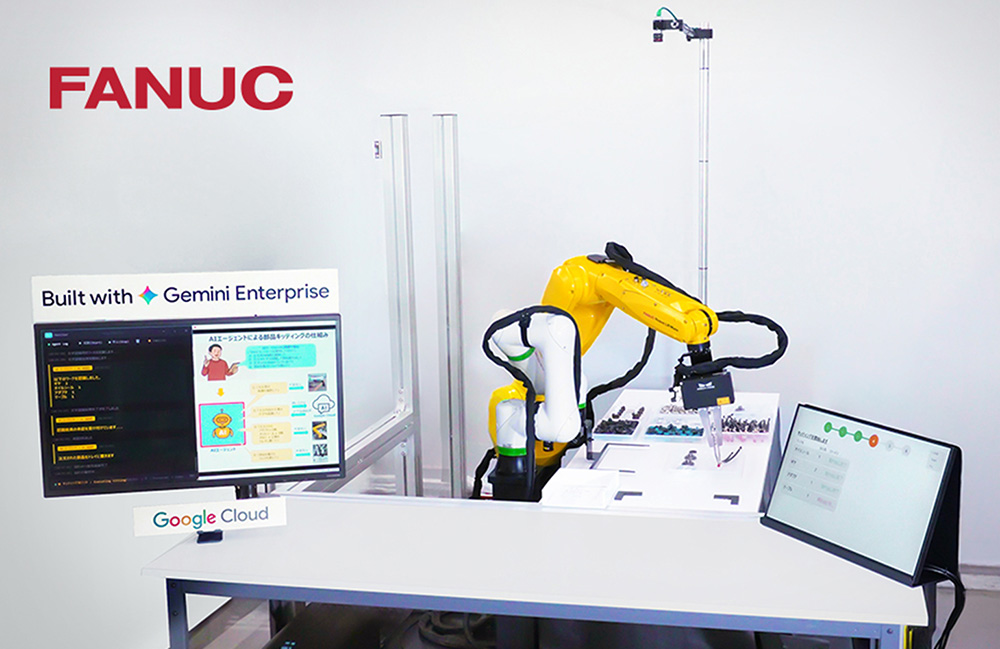
By working with Google, FANUC plans to deliver smarter, more adaptive robots for modern manufacturing environments. | Source: FANUC
FANUC Corp. this week announced a strategic collaboration with Google to advance physical AI in its robots using Google’s state-of-the-art technologies. As part of this initiative, the company said it is applying the latest developments in artificial intelligence across its product lineup.
“Manufacturers are moving beyond the question of whether to use AI and focusing on how to apply it where it matters most—on the factory floor,” said Mike Cicco, president and CEO of FANUC America. “By combining FANUC’s industrial-grade robotics with Google’s advanced AI, we’re enabling customers to take on more complex, variable production while maintaining the reliability and performance that production environments demand.”
Physical AI – the integration of cognitive intelligence with physical action – has drawn global attention with recent advancements in AI, particularly large language models (LLMs). This includes robots that perceive their environment through sensors, make autonomous decisions, and execute tasks accordingly, said the company.
Editor’s note: FANUC is a 2026 RBR50 Robotics Innovation Award winner for helping Wilson Bohannan increase U.S.-based production. See the RBR50 honorees on the show floor and at the ticketed RBR50 gala dinner at the Robotics Summit & Expo in Boston next week. Register now to attend.

FANUC says ROS capabilities make physical AI easier
FANUC said its robots support the Robot Operating System (ROS) industry-standard platform for robot control through its open-source ROS drivers.
The company also offers broad compatibility with widely used technologies, including the Python programming language for AI development, high-speed communication interfaces for external robot control, and interfaces that enable easy operation from PLCs. Google is a prominent contributor and maintainer of ROS through its Intrinsic robotics AI unit.
FANUC asserted that these open platform capabilities allow manufacturers to easily deploy the latest physical AI for actual, reliable production. They include its lineup from small robots with a 3 kg (6.6 lb.) payload to large robots with a 2.3-ton (2,300 kg) payload, and the CRX collaborative series.
Customer interest continues to grow
Since FANUC released its physical AI system at the International Robot Exhibition (IREX) in Tokyo last December, customer interest and demand have continued to grow rapidly, said the company. Since then, FANUC said it has already shipped more than 1,000 robots for physical AI-related applications.
FANUC America Corp. said its collaboration with Google is a key step in advancing more flexible, adaptive automation for manufacturers across North America. The company this week also said it has tightened the integration of its ROBOGUIDE simulation software with the NVIDIA Isaac Sim framework.
Rochester Hills, Mich.-based FANUC America is a subsidiary of Japan-based FANUC Corp. It provides CNC systems, robotics, and ROBOMACHINEs and has facilities throughout North and South America.
The post FANUC partners with Google to advance physical AI in its robots appeared first on The Robot Report.
View Source


