Iván Hernández Dalas: Humanoid partners with Bosch, Schaeffler to scale robot production
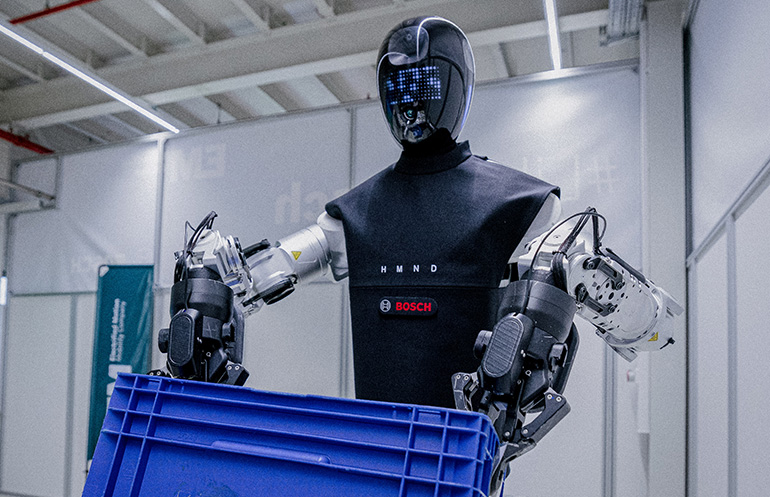
Humanoid and Bosh are collaborating on production and distribution of HMND in Europe. Source: Humanoid
The race to develop commercially viable humanoid robots continues to prompt industry partnerships. London-based Humanoid today said it is working with Robert Bosch GmbH to scale production after the successful completion of a joint proof of concept, or POC, in March 2026.
“For Humanoid, this agreement is a critical step in our roadmap, bridging the gap between POC validation and large-scale deployment,” stated Artem Sokolov, founder and CEO of Humanoid. “Our goal has always been to shorten the path between innovation and real-world integration, and this agreement reflects that approach.”
“Together with Bosch, as a strong strategic manufacturing partner, we are committed to bringing humanoid robots into industrial settings, scaling their deployment, and accelerating adoption across logistics, manufacturing, and beyond,” he added.
Founded in 2024 as SKL Robotics Ltd., Humanoid has designed the HMND platform for industrial environments. The wheeled mobile manipulator has a humanoid torso, head, and two arms and can adapt to a range of tasks in human-centric spaces, said the company.
Editor’s note: The 2026 Robotics Summit & Expo this month in Boston will include a keynote and sessions on humanoid robots. Al Makke, head of humanoid robotics for North America at Schaeffler, will participate in a keynote on “The State of Humanoids.” Register now to attend.

Bosch POC demonstrates diverse box handling
In the POC with Bosch, HMND 01 robots “demonstrated full capability in a complex industrial workflow,” said Humanoid. The systems autonomously transferred boxes from a conveyor to a trolley in a Bosch intralogistics facility in Bühl, Germany.
The POC involved handling five sizes of boxes across multiple footprints, heights, and weights. The project’s goals included developing advanced scanning and handling capabilities, managing inputs from multiple conveyors, and demonstrating adaptability in dynamic environments.
KinetIQ, Humanoid’s proprietary AI framework, orchestrated the POC, which the companies said confirmed both the technical readiness and scalability of the approach.
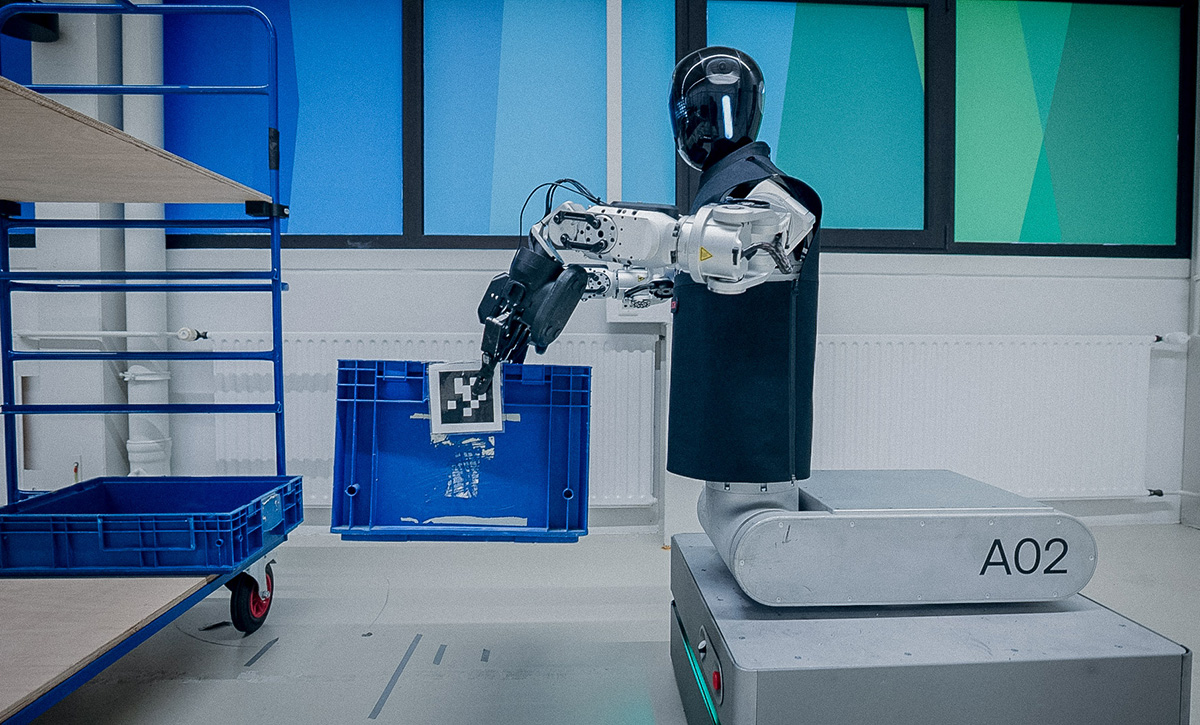
HMND has undergone a successful box-handling proof of concept at Bosch. Source: Humanoid
Partners prepare to produce HMND for European market
Humanoid and Bosch have agreed to manufacture and deploy HMND 01 robots for the European market. Humanoid added that it is investing in “design for excellence” (DfX) — including design for manufacturability, reliability, serviceability, and cost — to deliver long-term performance and economic value for its customers.
Gerlingen, Germany-based Bosch will serve as Humanoid’s contract manufacturing partner. It will provide strategic oversight and technical expertise through a structured DfX framework spanning hardware design, production, supply chain, and cost optimization.
“This partnership is built on the shared belief in the great potential of robotics in industry. Bosch’s goal is to advance the scaling of humanoid robotics and to further develop this field of the future,” said Peter Svejkovsky, head of corporate intellectual property at Bosch. “With our global production infrastructure and deep industrialization expertise, we are the perfect partner to take the step from prototype to volume manufacturing.”
The two companies also plan to explore integrating Bosch components such as actuators, drives, and sensors into future versions of the HMND platform. Humanoid last month said it is working with Siemens.
Humanoid to roll out thousands of robots with Schaeffler
Last week, Humanoid said it has signed a binding, phased agreement with Schaeffler Technologies AG to integrate its robots into live manufacturing operations. The first systems will go live in Germany before the end of 2026.
Humanoid claimed that it is one of the largest humanoid robot rollouts disclosed to date, positioning it as one of the youngest companies to secure such a contract at this scale. The company will also use Schaeffler as a preferred supplier, covering more than 50% of its demand for joint actuators through 2031. This partnership is expected to translate into a seven-digit number of actuators.
Schaeffler and Humanoid first announced their strategic partnership in January 2026 after successful proofs of concept. The initial robot deployments will run from December 2026 through June 2027 at two Schaeffler sites in Germany. In Herzogenaurach, the focus will remain on advancing box handling.
The operations in Schweinfurt will begin with a three-month capability demonstration and integration testing period. After that will come a three-month on-site phase to validate stable, continuous operation approaching full production scale.
Under its robot-as-a-service (RaaS) model, Humanoid will provide systems and services, including connection to fleet management software, maintenance, 24/7 technical support, updates, and ongoing performance management.
Both Humanoid and Schaeffler plan to continue assessing performance and expand to dexterous tasks as assembly and packaging in the future.
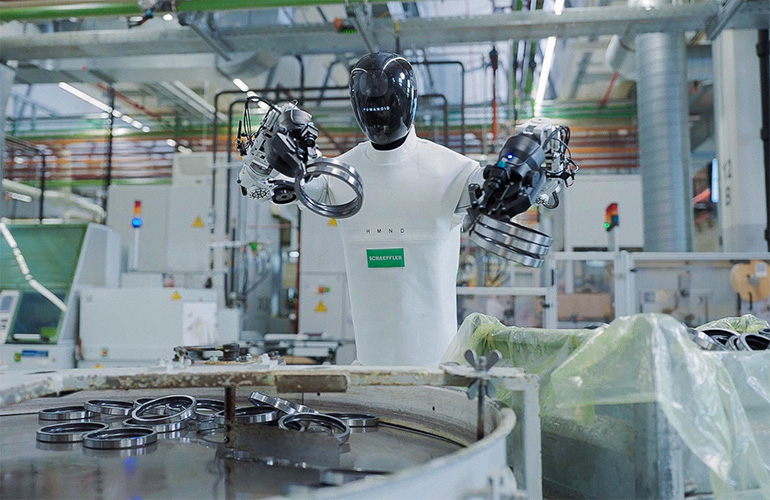
HMND 01 operating at a Schaeffler facility in Germany. Source: Humanoid
Humanoid CEO discusses scaling plans
Sokolov replied to the following questions from The Robot Report about the partnership.
Exactly how many robots do Humanoid and Schaeffler plan to roll out at each stage?
Sokolov: Our agreement targets deployment of a four-digit number of wheeled units across Schaeffler’s global facilities by 2032. The rollout follows the company’s product development and deployment phases, starting with Beta in late 2026, then Gamma in 2027, and the mass-poduction version beginning in 2028.
How extensive is the AI and robot training required for the box-handling applications?
Sokolov: One of the advantages of our simulation-first approach is the ability to significantly reduce the amount of real-world training data required.
For example, for such use cases as box handling or bin picking, we typically require only around one to two working days of real-world data collection. This data is then combined with large-scale simulation training to accelerate deployment.
How autonomous are the systems?
Sokolov: For the first phase, starting in late 2026, we are targeting a 95% autonomous success rate and 99% with the fallback strategy. Our end goal is to increase the autonomy level to 99.5% and beyond for subsequent phases.
Are the partners developing custom manipulators?
Sokolov: For certain industrial use cases, custom manipulators may be developed together with partners depending on operational requirements. However, the default end-effector system for HMND 01 Alpha is the three-finger gripper designed for general-purpose industrial applications.
For HMND 01 Alpha, the target payload is 10 kg [22 lb.] total payload capacity, or 5 kg [11 lb.] per arm. For Beta and beyond, we are targeting 20 kg [44 lb.] total payload capacity, equivalent to 10 kg per arm.
Why did Schaeffler choose Humanoid to partner with out of all the companies developing humanoid robots today? Did it test others?
Sokolov: For Schaeffler, we are a long-term technology partner capable of moving quickly, adapting to real industrial environments, and building for scalable deployment.
What differentiated Humanoid was the combination of execution speed, strong AI and software capabilities, and a very practical approach to deployment. From the beginning, our focus was on solving real industrial use cases and integrating robots into existing workflows.
Can you explain how these wheeled bimanual manipulators serve Schaeffler‘s needs better than cobots or industrial robots?
Sokolov: Wheeled humanoids provide a much more flexible solution for modern industrial environments. They can move between workstations and operate within facilities already designed around human workers.
The world is already built for humans. A humanoid form lets robots operate in existing environments without redesigning infrastructure — like for industrial robots, for example. By staying close to the human form factor, we can use equipment, tools, facilities designed for humans and easily switch between them. Many tasks require human-level dexterity and manipulation for fine-motor movements.
Moreover, human-like shape helps more effective AI training, since most available data is based on humans.
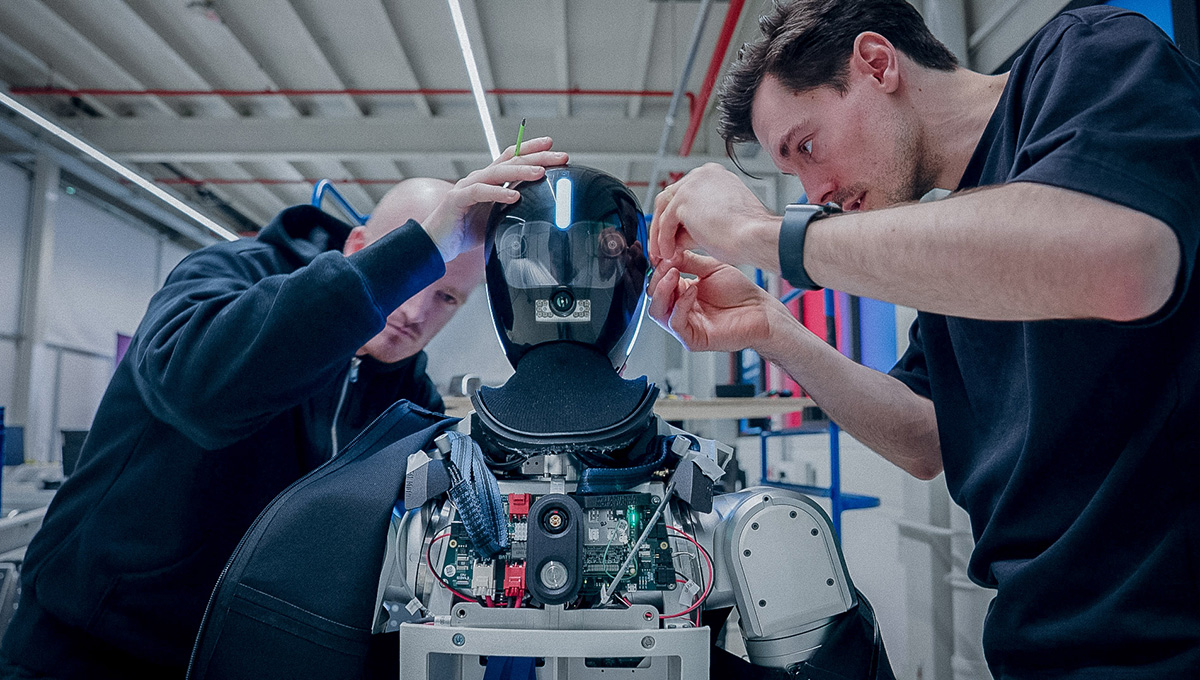
Humanoid and Bosch technicians work on HMND 01. Source: Humanoid
The post Humanoid partners with Bosch, Schaeffler to scale robot production appeared first on The Robot Report.
View Source


