Iván Hernández Dalas: GENISOM AI debuts deployable robotics platforms at ICRA 2026
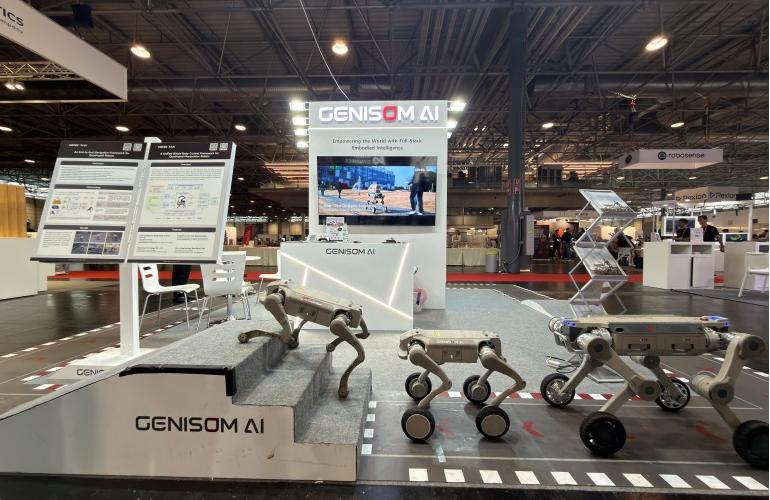
At ICRA 2026, GENISOM AI may have been new to many international attendees — but it is not a concept-stage robotics startup. Founded in December 2023, the company said it has already produced and delivered more than 10,000 units, making it one of the few robotics companies to reach production scale in under three years.
GENISOM AI said that milestone puts it in a different position than many early-stage physical AI companies entering the global market. Like Unitree, GENISOM AI is building around manufacturable platforms designed to move beyond laboratory demonstrations and reach customers at scale.
However, the Beijing-based company said it puts greater emphasis on industry deployment, combining robotics hardware and software, in-house core technologies, and real-world application capabilities.
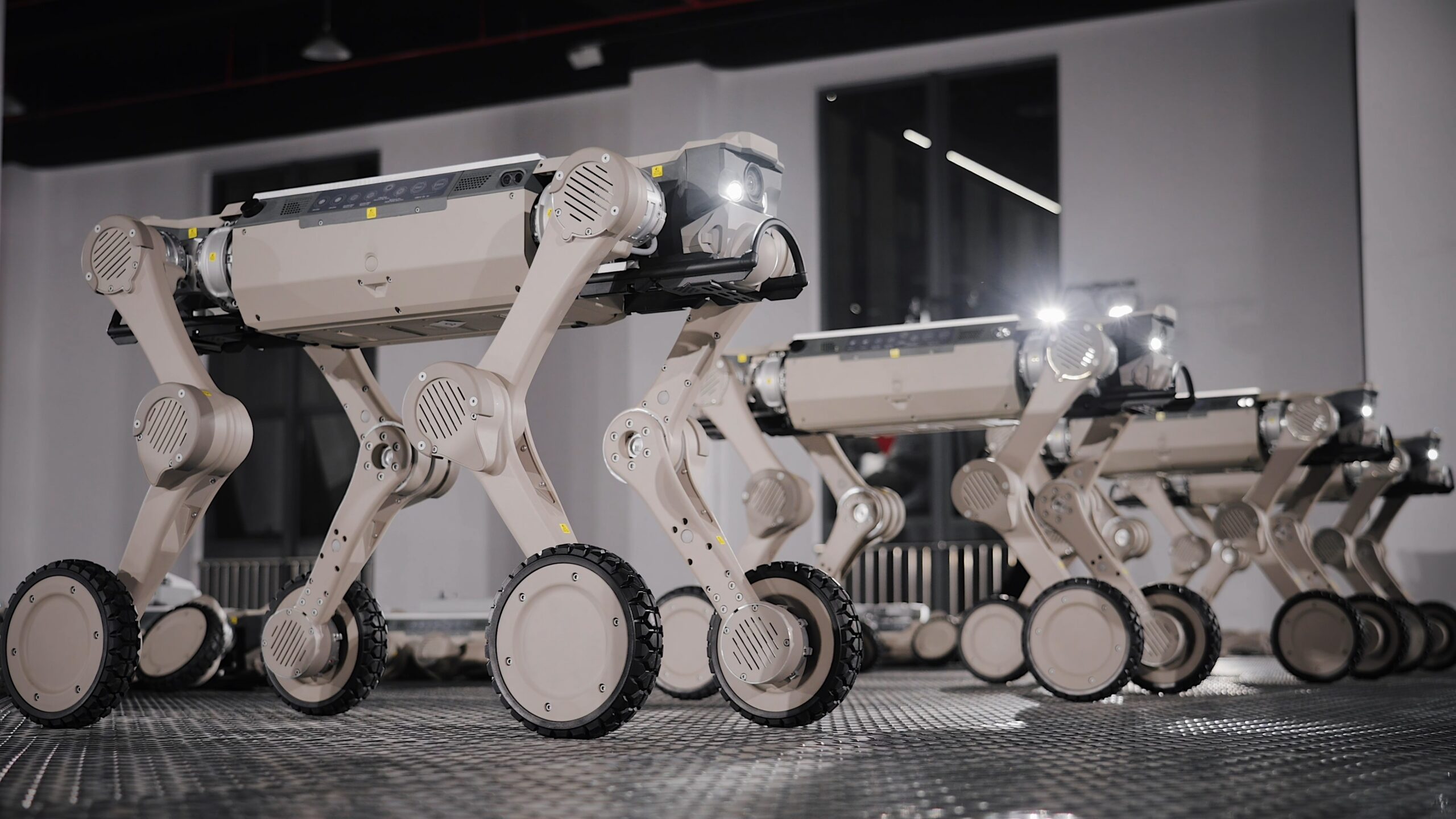
M1, the company’s industrial-grade quadruped robot
GENISOM AI builds platforms for real-world deployment
At ICRA in Vienna last week, GENISOM AI showcased its M1 and L1-series robots as mature, mass-produced systems.
The GENISOM M1 is the company’s industrial-grade quadruped robot, rated for a 30 kg (66.1 lb.) continuous walking payload and a payload-to-weight ratio approaching 1:1. The platform also carries an IP67 protection rating and can support up to five hours of runtime, depending on payload and operating conditions.
That payload capacity is supported in part by GENISOM AI’s in-house P85MAX-S joint actuator module, which delivers up to 180 N·m peak torque in an 86 mm (3.3 in.) diameter form factor weighing approximately 1 kg (2.2. lb.). The company said that developing actuators in-house gives it direct control over a key hardware-software integration point that shapes locomotion performance, payload capacity, and system reliability.
The GENISOM M1 Ultra adds an advanced perception layer to the series. It draws on bird’s eye view (BEV)-based temporal fusion and occupancy-network methods — approaches more commonly associated with autonomous driving perception. This approach supports the Omni-Panorama system for 720° 3D spatial awareness and a more semantic understanding of surrounding structures, obstacles, and spatial relationships.
Beyond the show floor, GENISOM AI said its robot platforms have already moved into real-world applications, including research and education, security patrols, and emergency response, with different platforms serving different needs.
Educational platform wins first place at IROS
On the research and development side, the GENISOM L1 EDU combines NVIDIA Jetson Orin NX computing with Livox Mid-360 lidar, RealSense depth cameras, GNSS, and 5G connectivity. It is designed to support simultaneous localization and mapping (SLAM), 3D reconstruction, autonomous navigation research, and open-source development workflows.
Notably, a University of Manchester team won first place at the IROS 2025 Quadruped Robot Challenge using a GENISOM L1 EDU platform, further validating its mobility and navigation performance.
Full-stack technology enables M1 and L1
Behind the M1 and L1-series platforms is a set of in-house software, simulation, navigation, and control technologies that support them across training, development, and deployment.
MATRiX, GENISOM AI’s open-source simulation platform, combines the MuJoCo physics engine with Unreal Engine 5 rendering to support reinforcement learning training and sensor simulation across RGB, depth, lidar, IMU, and panoramic inputs. The company said it is designed to address a longstanding robotics simulation challenge: combining physical accuracy and visual realism within a single environment.
Working alongside MATRiX is the Real2Sim2Real Data Flywheel, which converts real-world environments captured with consumer-grade cameras into training-ready simulation assets, lowering the cost of policy development and validation.
At the autonomy layer, RoamerX supports mapping, localization, path planning, obstacle avoidance, and cross-floor navigation. The Whole-Body Control framework coordinates legged locomotion and manipulator motion for mobile manipulators.
SomaMind, the company’s Physical AI Agent System, connects high-level task understanding with physical execution modules.
Partners get support across the robotics stack
GENISOM AI said its model extends beyond selling individual robot units. Its capabilities span core components, robot platforms, manufacturing capabilities, software toolchains, and algorithms, allowing partners to work with the company at different layers of the robotics stack.
For system integrators, GENISOM AI provides platforms and support for field applications such as inspection, security patrol, emergency response, and energy operations. Robotics brands and companies developing their own robot products can work with GENISOM AI on ODM (original design manufacturer) customization and production enablement.
Research and secondary-development teams can build on open interfaces, a software development kit (SDK), and RoamerX navigation software resources available on GitHub.
By combining robot hardware, manufacturing capabilities, software tools, and field-application experience, GENISOM AI said it is building a broader robotics business — one that goes beyond individual product sales.
GENISOM AI described its ICRA showcase as more than a first appearance at a major robotics conference. Rather than centering on a single product launch, the showcase positioned GENISOM AI as a robotics platform company focused on production, development, and real-world deployment.
Sponsored content by Genisom AI
The post GENISOM AI debuts deployable robotics platforms at ICRA 2026 appeared first on The Robot Report.
View Source


