Iván Hernández Dalas: Modernizing the global economy with industrial robotics is needed but not inevitable
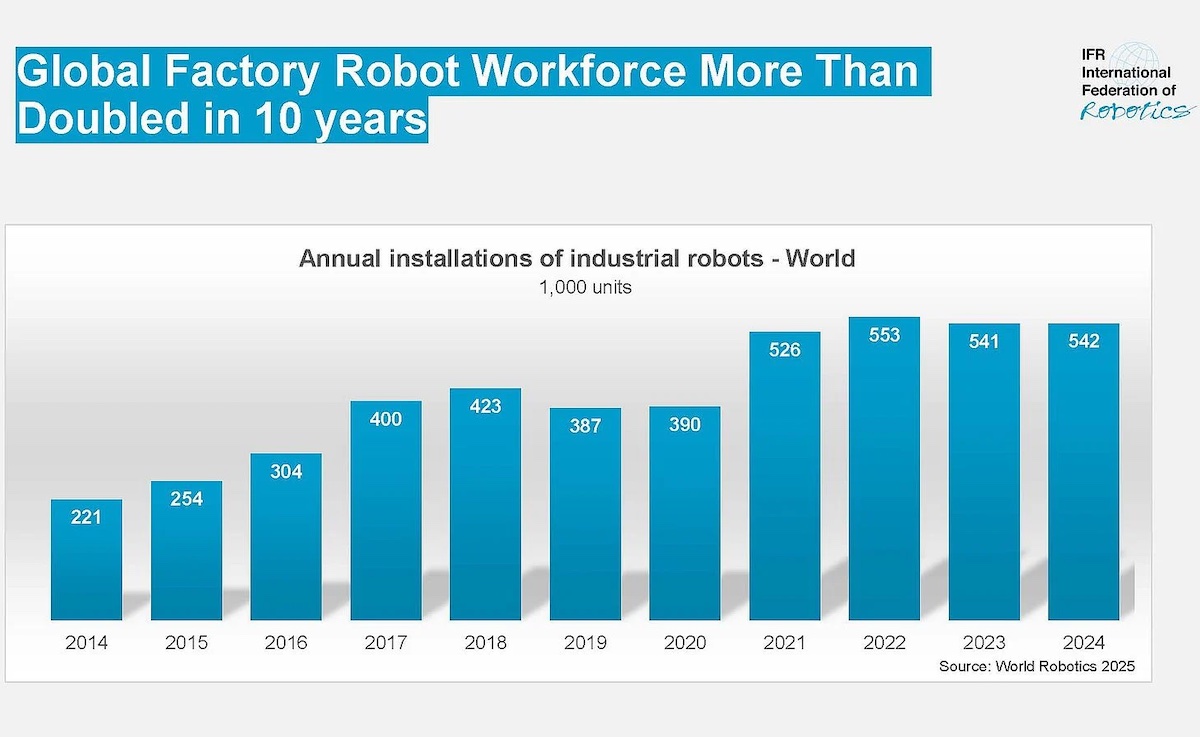
Industrial robot adoption has continued to increase, according to the IFR.
The modern robotics market is divided into several industrial clusters: service and consumer. Both market segments have seen a steady increase in industrial robotics sales, according to the International Federation of Robotics, or IFR.
In 2024, 229,000 robotic systems for industrial use were sold, with 70% of global sales coming from just five countries: Japan, China, the U.S., Germany, and the Republic of Korea, according to the IFR. These countries have a number of government programs aimed at supporting and developing robotics industry strategies, although the U.S. relies more on private capital than federal funding.
Let’s discuss the key economic priorities for the implementation of robotic technologies and how this can transform the economy. More than 343 companies worldwide manufacture industrial robots, and over 347 companies integrate robotic systems into production processes. Also, more than 860 companies produce service robots for professional use, and 204 companies produce service robots for personal use.
A classification of robot types to follow
There are four distinct thematic clusters:
- Basic robotics technologies
- Medical robotics
- Key robotics technologies
- Promising areas of innovative development
These last ones include energy harvesting from the external environment, self-repairing robots, multimodal interfaces, gesture analysis and synthesis, and swarm intelligence in flexible production modules.
Service robots are divided by application into professional and personal. Sales of service robots for professional use accounted for 11.5% of the total, reaching 24,207 robotic units last year. Military and special-purpose robots accounted for 45% of this total (11,000 units). Last year, 4.7 million service robots for personal use were sold. This eloquently demonstrates a total revenue increase of 28%. Sales volumes increased to $2.2 billion.
The IFR predicted significant growth for all market segments of the robotics market. It said it expects industrial robot sales to reach 400,000 units, with service robots for professional use reaching 152,375 units and $19.6 billion. Service robots for personal use are estimated to reach 35 million units and $12.2 billion.
Myria Research projected that the market for robotics, as well as intelligent operating systems with a comprehensive hardware and software system, could reach over $380 billion by 2030. It estimated that the total market for robotics and intelligent operating systems at $63 billion.
As the use of robots of all types becomes more widespread in the coming decade, companies may create an executive position to supervise them, or they could become part of industrial and commercial infrastructure. In addition, a mixed workforce could emerge, with robots, AI, and people closely collaborating.
 Submit your session idea for the 2026 RoboBusiness
Robot industry faces hurdles to growth
After the COVID-19 pandemic, industrial robot sales declined with the slowed growth in e-commerce, the pivot of automakers from electrification, and global trade challenges. The main obstacles to the development of robotics include:
- Weak educational infrastructure
- Lack of qualified robotics specialists
- Outdated training programs;
- Lack of proprietary technological solutions
- Lack of understanding of the international robotics market
- Lack of understanding of the demand for robotics products
Significant priorities to address include the small size of the domestic venture capital market, difficulties in exporting/importing technological products and their components, the lack of a simple and transparent research funding mechanism, and bureaucratic obstacles. The decline in service robot sales was partly due to the increase in the number of companies providing sales data.
Foreign suppliers of industrial robots were able to increase sales volumes to 41,100 units, including robots produced by international manufacturers in China. China is the largest market for industrial robots.
Nearly 29,300 industrial robots were sold in Japan, indicating that sales peaked. Japan has become one of the largest markets by annual sales. At the same time, robot sales in Japan have been declining since 2005, when sales peaked at 44,000 units.
Looking for long-term industrial expansion
Despite its challenges, the global adoption of automation will continue to grow, agreed industrial associations and analysts. For instance, total shipments of industrial robots increased by an average of approximately 50% per year.
The main drivers of growth in global industrial robotics sales have been the automotive and electronics industries. The automotive industry’s share accounted for approximately 43% of total robot sales. Investment in modern industrial capacity in emerging markets, as well as production modernization in automobile-producing countries, increased by 34% to 48,400 units.
Sales in all industrial sectors, excluding automotive and robotics, increased by 21% in 2025. Between 2010 and 2025, the average growth rate was 17%. Automotive sales grew by 27% during this period, while the electrical/electronics industry grew by 11%.
In addition to the core industries for robotics, suppliers have report a significant increase in the number of customers in recent years. However, the number of robots those customers order is still often very small, with the exception of autonomous mobile robot (AMR) fleets in warehouses.
Last year, the IFR and the Association for Advancing Association (A3) noted that the military, automotive, and electronics industries are some of the most promising sectors for industrial robotics.
This indicates that companies are shifting their focus to defense industry rather than the civilian sector. In addition, respondents cited healthcare, autonomous vehicles, and the use of robots for security or safety tasks as the most promising areas for service robotics.
Industrial robot sales are only part of the picture
Remember that these estimates do not include software, peripherals, and engineering systems. However, if these costs are included in the calculations, the actual market size would triple.
Therefore, based on this estimate, the global industrial robotics market is valued at $32 billion in 2025. Many countries exhibit increased potential for industrial robot adoption. To account for differences in the scale of manufacturing industries, the IFR uses robotic density metrics.
This density is expressed as the number of multifunctional robots per 10,000 workers employed in the automotive, manufacturing, or complex automated industries. Estimating the number of industrial robots in operation in various industries allows one to assess the high level of automation development.
The density of robots in service industries such as healthcare and hospitality remains low. On the other hand, countries with developed electronics industries have higher technical indicators. Most Western countries do not have their own electronics manufacturing facilities, prompting calls for reshoring.
The growing demand for electronics around AI has helped Taiwan’s industry increase its robot density in recent years. This places Taiwan fifth on the IFR’s list, with a rate of 138 robots per 10,000 workers.
With lower robot densities, emerging markets such as India show significant potential for growth in robot adoption, as countries grapple with the reallocation of production. Significant investments in robotics can help to mitigate current economic challenges by providing efficiency and flexibility.
 About the author
Elena Krosheva is a freelance journalist, marketing analyst, and SEO specialist. She graduated with honors from the Faculty of Journalism at the Institute of Modern Knowledge in Minsk, Belarus, in 2007.
Krosheva covers topics such as digitalization, IT, the modern economy, and transhumanism. She loves computers and cyberpunk, having graduated from a technical college before graduating from the Faculty of Journalism.
The post Modernizing the global economy with industrial robotics is needed but not inevitable appeared first on The Robot Report.
View Source


