Iván Hernández Dalas: Vention collaborates with FANUC and Universal Robots on software-defined automation
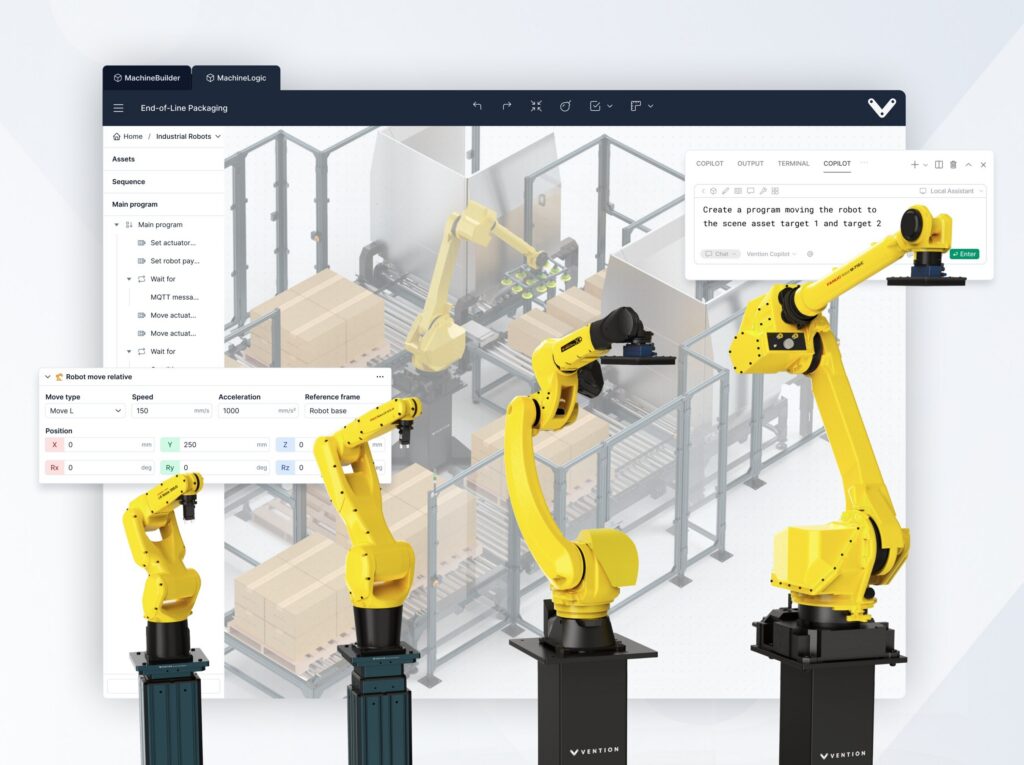
Vention’s AI-powered platform enables FANUC industrial and collaborative robots to autonomously generate collision-free motion paths while providing integrated monitoring and remote support. Source: CNW Group/Vention
At Automate this week in Chicago, Vention Inc. is showcasing partnerships around software-defined automation. The company has expanded support for FANUC America industrial robots, and it has optimized a new digital twin platform for Universal Robots deployments.
“We’re seeing strong demand from manufacturers for automation that’s easier to deploy and faster to bring online, especially as labor challenges continue,” said Dick Motley, director of the Authorized System Integrator Network at FANUC America.
“Many companies want to automate but are looking for solutions that reduce complexity and are easier to implement,” he added. “Vention’s AI-powered platform helps customers deploy FANUC’s industrial and collaborative robots, allowing them to get up and running more quickly while maintaining the performance and reliability they expect from FANUC.”
Founded in 2016, Vention claimed that its “full-stack” platform unifies modular hardware, software, and physical AI. The Montreal, Canada-based company has deployed more than 25,000 machines worldwide at over 4,000 factories and raised $110 million in January. Vention said it enables businesses to design, program, deploy, and operate turnkey or custom automation in just days.
Vention advances goal-driven industrial automation
Vention asserted that its MachineMotion AI and MachineLogic ecosystem provide a new way to program both industrial and collaborative robots.
Rather than manually programming robot paths waypoint by waypoint, operators simply define start and end targets. The system then automatically scans the workspace and computes the optimal collision-free path between the two points.
This goal-driven approach enables manufacturers to deploy more adaptive robotic applications that respond dynamically to changing production conditions, mixed-SKU operations, and evolving factory layouts, said Vention. The platform enables manufacturers to validate robotic motion and automation logic before deployment, accelerating commissioning, it said.
Built on modular hardware and software components, the AI-powered platform enables faster responses to new SKUs, fixtures, and production layouts, according to Vention.
 Submit your session idea for the 2026 RoboBusiness
FANUC focuses on simplifying deployment
Vention said that it and FANUC America are focused on simplifying industrial robot deployment. The combination of FANUC’s robots and Vention’s platform enables manufacturers to design, simulate, deploy, and operate automation from a unified environment, said the companies.
The expanded platform now supports multiple FANUC robot families, including CRX collaborative robots, LR Mate industrial robots, LR-10iA series robots, M-710iD series robots, and M-20iD series robots. By integrating collision-free path planning, no-code, and Python programming capabilities, the partners said they are reducing commissioning complexity and accelerating automation adoption.
Powered by Foundation Stereo, an NVIDIA Isaac open model that helps robots see depth using stereo cameras, the system generates a real-time 3D understanding of the workspace using a zero-shot stereo depth estimation. This enables MachineMotion AI to build a digital twin and automatically compute collision-free robot paths, said Vention.
Unlike traditional systems that require extensive manual programming and custom integration, the combined solution enables users to design automation using pre-validated components that work together, the companies added. Manufacturers can easily generate and validate logic, realistically simulate robotic motion, and test cell interactions before deployment, significantly reducing integration risk and accelerating production ramp-up.
These capabilities now extend across a wide range of applications, from machine tending and pick-and-place operations to palletizing, welding, and high-speed industrial automation.
“By extending Vention’s platform to FANUC industrial robots, enterprise manufacturers in heavy industry can move from automation design to production much faster,” said Étienne Lacroix, founder and CEO of Vention. “Combined with FANUC’s proven reliability and long-standing track record in industrial automation, this partnership gives manufacturers a dependable path to scaling production automation.”
Vention extends MachineBuilder with Teradyne
Vention yesterday also announced a strategic collaboration with Teradyne Robotics to extend MachineBuilder to create a specialized platform for Universal Robots’ force- and power-limited robot arms.
With Vention’s technology, Teradyne can provide its customers a with a ready-to-configure digital environment. This eliminates the traditional trial-and-error phase of automation, allowing users to validate reach and modular framing before a single bolt is tightened, said Vention.
“For our customers, the real breakthrough is moving from concept to a production–ready solution with confidence,” said Justin Brown, chief commercial officer of Teradyne Robotics. “This collaboration enables us to create high–fidelity simulations for our customers that reflect real–world kinematics. That means less trial and error, faster validation, and a shorter path from design to deployment.”
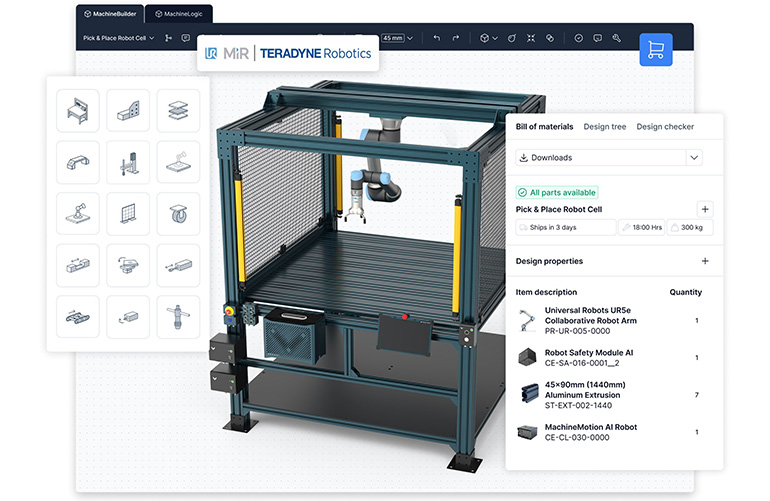
Vention and Teradyne developed an optimized digital twin environment to design, program, and simulate modular UR cells. Source: CNW Group/Vention
Universal Robots deepens the digital experience
Teradyne’s Universal Robots unit and Vention said the next phase of their partnership will move beyond hardware compatibility to deliver an integrated digital experience tailored to the needs of cobot users. It will include:
- UR-optimized design environment: A dedicated interface within Vention’s platform will be pre-loaded with the technical specifications and capabilities of the entire UR cobot line. This ensures that every design is “build-ready” and technically viable.
- Exclusive automation marketplace: Access Vention’s ecosystem of Universal Robots-vetted UR+ components, from end-of-arm tooling (EOAT) to seven-axis systems.
- Empowering customers: Universal Robots said its global teams can now provide customers with high-fidelity, 3D simulations in minutes. This enables closer collaboration during the design phase and a significantly faster path to proof of concept.
- Library of validated templates: Vention’s platform features a suite of pre-configured automation templates for the high-demand applications — including end-of-line solutions, machine tending, pick-and-place, and overhead linear-axis systems–all optimized for UR cobots.
Initially rolling out across North America and Europe, this collaboration gives Universal Robots customers a fully integrated automation foundation that connects robot selection, digital twin design, controls, and modular infrastructure into a single, seamless deployment workflow.
Live demonstrations at Automate 2026
At McCormick Place this week, Vention and its partners will be on display at:
- Booth 1001: A FANUC CRX10iA cobot running Vention’s Click & Customize Machine Tending Solution powered by MachineMotion AI will demonstrate automated CNC machine loading and unloading with configurable EOAT. FANUC will also debut its “Cobot and Go” booth with pre-engineered systems build for rapid deployment.
- Booth 1250: Teradyne will showcase Rapid Operator AI, an NVIDIA-powered bin-picking system developed on the open Isaac platform that enables autonomous decision-making.
- Booth 2848: A FANUC LR Mate industrial robot powered by MachineMotion AI and programmed through MachineLogic will demo collision-free path planning using on-arm vision and autonomous motion generation.
- Booth 2848: Vention will also show a UR12e running AI-driven bin picking and a UR20 on an overhead range extender for advanced, large-scale welding.
The post Vention collaborates with FANUC and Universal Robots on software-defined automation appeared first on The Robot Report.
View Source


