Iván Hernández Dalas: ATDev gives update on its journey building autonomous wheelchairs
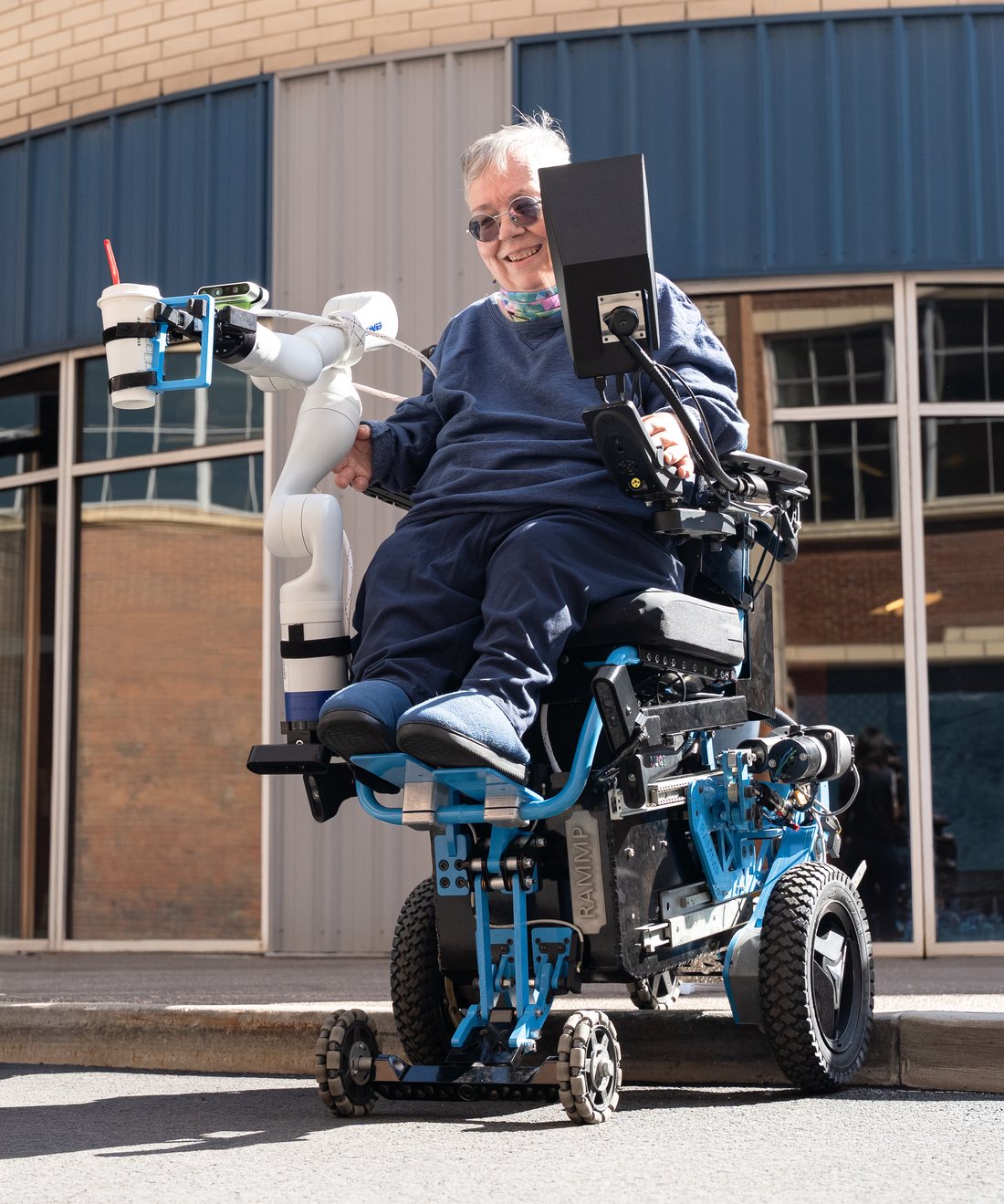
The Robotic Assistive Mobility and Manipulation Platform pairs a modern power wheelchair with a coordinated robotic arm on an open software platform. | Source: ATDev
There are millions of powered wheelchair users in the U.S. today. Assistive Technology Development Inc., or ATDev, aims to use robotics to give these users more independence and freedom in their lives.
“I’ve been a power wheelchair user for over 30 years, my whole life really,” Owen Kent, founder and chief marketing officer at ATDev, told The Robot Report. “I’ve been continually frustrated by seeing technology advance in so many fields except for wheelchair technology and assistive technology. Every phone that you’ve ever had has more computing power than any wheelchair has ever had.”
ATDev part of the Robotic Assistive Mobility and Manipulation Platform (RAMMP). As part of the program, the company is developing a modern power wheelchair with a coordinated robotic arm. The chair can take on reaching and lifting tasks that the user can’t handle on their own.
“We’re aiming to turn the wheelchair into something that can support people during their daytime,” said Kent. “That means helping them with eating and drinking, using the robotic arm on the wheelchair to open doors and turn on lights.”
“Beyond that, we’re also looking at adding some teleoperation features,” he added. “So, if you’re in bed, you can use the chair to go around and get your drink from the refrigerator.”
What is RAMMP?
RAMMP is an Advanced Research Projects Agency for Health (ARPA-H) funded program led by the University of Pittsburgh. It aims to use robotics, AI, and smart mobility to empower people with mobility issues to live more independently.
Orange, Calif.-based ATDev is an industry partner in the RAMMP consortium that’s focusing specifically on creating autonomous wheelchairs.
“This is an extremely stable mobile robotic base with a human in it. You have large wheels planted nice and evenly on the ground, and a sensorized base with a robotic arm,” explained Todd Roberts, co-founder and CEO of ATDev.
“The complex seating side of the current wheelchair industry is impressive modern tech, he said. “It’s making complex molds of people’s backs so you can support them. That has leveled up.”
Other than the seating, however, ATDev plans to redesign the wheelchair from scratch. Currently, most of the medical device wheelchair industry relies on outdated power electronics.
“We’re really starting from the ground and rebuilding a lot of the electronics and software architecture that haven’t allowed for innovation in this space,” Kent said.
Developing robots for vulnerable populations provides challenges
Safety is of paramount importance for developers working with people with partial or full paralysis. Imagine someone who is fully paralyzed in a chair, with a robot bringing a fork towards their face, noted Kent. That user will need to know the robot is safe enough to perform this task.
“One of the biggest challenges is safety when it comes to robotics and working with this population,” Roberts acknowledged. “Robotic manipulation is getting more and more impressive each day, but there’s a huge difference in the level of reliability and repeatability that you need if you’re able to hit an e-stop or move out of the way or if you’re not.”
At the same time, ATDev’s wheelchair doesn’t need the same level of autonomy as an autonomous mobile robot or humanoid robot. For example, a humanoid has to act entirely autonomously, making each choice completely on its own.
“When you have a person in the wheelchair who is participating in shared autonomy with the chair, if the chair starts to make a wrong decision, then they can provide some corrective input,” Roberts said. “There’s not really much desire for wanting to sit in the chair, close my eyes, and go from A to B in the way that you think about an autonomous vehicle.”
Instead, the chair is in charge of micro-adjustments while the user decides the path. “Based on our interviews, people want to decide moment to moment how much autonomy they have, and we’re calling that idea the spectrum of autonomy,” said Kent. “All the way from fully autonomous to individual motor control. We want the end user to be able to decide in real time how much autonomous assistance they want.”
As time goes on, ATDev hopes to build a community of users who can share their knowledge with one another.
“One of the other exciting things that we’re planning is a federated learning approach,” Kent said. “So, our chairs will be able to learn from each other. If someone learns how to do something with their chair, they can then share that basically on an app store with other users of the chair.”
ATDev seeks to get wheelchairs to the people who need them
“ARPA-H and the federal government have really recognized that there’s a huge upcoming need as baby boomers age,” Kent said. “Right now, there’s three and a half million power wheelchair users in the U.S. That means three and half million, basically robotic platforms that are deployed in the home.”
Despite the need, it can still be difficult to gain regulatory approval and insurance reimbursement for new medical devices. This has been a challenge for other robotic systems such as exoskeletons. Roberts said he believes wheelchairs will be a different story.
“There is an existing regulatory roadmap for chairs that exist today for their FDA-regulated products, but there is not an existing regulatory roadmap for self-driving, self-manipulating robotic personal mobility platforms,” said Roberts.
He predicted that ATDev will work with regulators to adjust the requirements for power wheelchairs to work for autonomous ones.
n addition, RAMMP is a federal program, which gives ATDev the opportunity to work directly with ARPA-H on developing technical milestones. That relationship has also facilitated conversations with other federal agencies like the FDA.
What comes next for ATDev?
Right now, ATDev is working with Meta to apply the company’s AI models to ATDev’s chairs.
“Meta has bet on open-source, and we as a company and as a program with RAMMP are betting on open-source more broadly,” said Roberts. “A lot of what we’re developing on the software layer, we’re just outright open-sourcing in an effort to show the world what we’re doing, but also to get more partners to collaborate with us.”
The company is still in the early research and development stage. There are still questions that need to be answered when it comes to making robotic wheelchairs work in the average household. Meta could help ATDev with models that can rapidly segment new environments, which will be crucial in homes.
Right now, ATDev doesn’t have an exact timeline on when it expects to get out an FDA-regulated, insurance-reimbursable chair, but the company‘s founders said they expect to achieve it within the next five years. In the meantime, ATDev will continue to advance its technology, with the end users at the center of the development process.
“Many of the researchers and principal investigators are wheelchair users themselves, so the voice of the ultimate user of the product is very loud within the program, which is amazing,” Kent said. “So often you have these engineering teams, and maybe you do a focus group where you talk to your end users every once in a while. You’ve got to be in the room. Instead of user-centered design, we like to think of it as user-led design.”
 Register now and save on your pass to RoboBusiness 2026
]
The post ATDev gives update on its journey building autonomous wheelchairs appeared first on The Robot Report.
View Source


