Iván Hernández Dalas: Avatar Robotics raises seed round to address industrial labor constraints
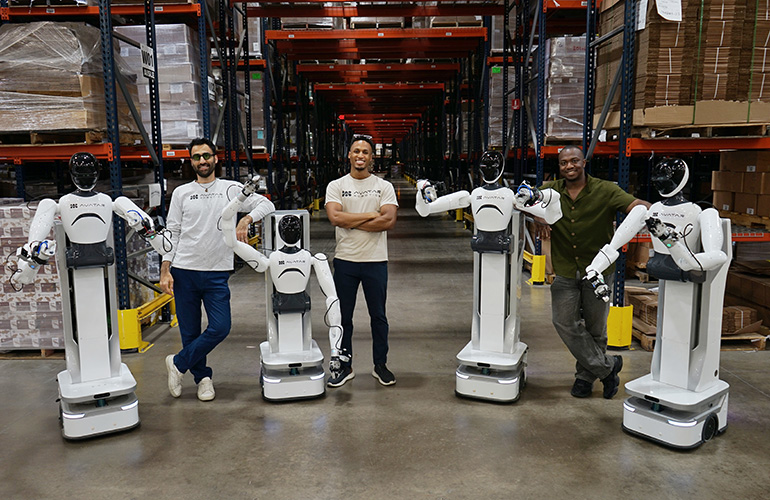
The leadership team at Avatar Robotics: Hamid Farzaneh, founding engineer (l); Colin Webb, founder/CEO (m); and Nenye Anagbogu, chief screwdriver (r). | Credit: Avatar Robotics
Avatar Robotics this week said it has raised $6.5 million in a seed financing round. AlleyCorp led the investment, which followed a pre-seed round led by defy.vc. Additional participants included Headline, Henry Ford III, Refashiond, Paul Vogel, Jack Huffard, and Samuel Udotong.
The funding aims to support the deployment of Avatar Robotics’ semi-humanoid robots across logistics, manufacturing, and warehousing operations. The San Francisco-based startup said it plans to allocate capital toward scaling robot fleets, expanding customer deployments, advancing its autonomy software, and expanding engineering and operations teams.
Founding team has autonomous vehicle experience
Avatar Robotics was founded in 2024 by Colin Webb and Nenye Anagbogu, both graduates of the Massachusetts Institute of Technology (MIT). CEO Webb’s background includes engineering autonomous systems across self-driving cars and AI-powered drones, as well as previously founding an AI startup alongside Anagbogu.
“Colin’s vision for Avatar instantly captivated me,” said Amy Yin, a partner at defy.vc. “The path to full robotic autonomy will require both better hardware and massive amounts of real-world data. Avatar’s approach is incredibly clever: Use remote human operators to bridge the gap today while improving autonomy with every task completed. I believe that model can help Avatar build one of the largest humanoid robot fleets in the world.”
Avatar’s technical team includes engineers and operational personnel with prior experience at institutions and companies such as Cruise, Apple, Tesla, Intuitive Surgical, Unity, and MIT.
 Register now and save on your pass to RoboBusiness 2026
Avatar Robotics uses a human-in-the-loop operational model
Humanoid hardware, remote teleoperation, and machine-learning autonomy comprise Avatar Robotics’ development framework. The company claimed that its approach addresses persistent U.S. labor shortages in sectors experiencing high turnover or hiring difficulty due to repetitive and physically demanding tasks.
Rather than rely purely on fully autonomous software or fixed-site automation, Avatar Robotics said it employs a human-in-the-loop strategy.
- Immediate deployment: Remote human operators control Avatar’s robots to complete tasks such as picking, packing, kitting, sorting, cycle counting, and material handling without extensive facility retrofits.
- Data collection: Operations generate control and task data from real-world environments.
- Autonomy integration: Collected data feeds into robotic foundation models, incrementally transitioning routine tasks to full autonomy over time to allow single operators to manage larger robot fleets.
Startup seeks market traction and operational scale
Since launching, Avatar Robotics reported that its mobile manipulators have processed and assisted in shipping more than 900,000 products within live customer facilities, including operations for a global beauty retailer. The company said it has also initiated a post-pilot expansion phase with a multi-billion-dollar warehouse operator to support sorting and picking workflows.
Investors noted that teleoperation bridges current technical limitations in robotic software while capturing data sets required to train future models.
“Avatar Robotics has built strong partnerships with their initial customers — and is already delivering meaningful value in real workflows — through their human-in-the-loop system, which is performing at a level competitive with skilled human operators,” stated Brannon Jones, principal at AlleyCorp. “In doing so, Avatar Robotics has also generated large datasets of robot control data, which the industry currently lacks and will help to inform foundation models and enable more scalable labor supply.”
Humanoid robots continue to gain funding momentum
The humanoid robot market continues its momentum as young robot companies are funded. Other companies developing wheeled bimanual manipulators include AGIBOT, AI2 Robotics, Autonomique, Genesis AI, Holiday Robotics, and Humanoid.
Other companies using human operators to train AI models for robots include 1X Technologies, Apptronik, BriainCo, NEURA Robotics, Sanctuary AI, and Tutor Intelligence.
Humanoid Funding Table
| Company Name | Date | Funding Round | Round Value | Source |
|---|---|---|---|---|
| Figure AI | Sept. 2025 | Series C | $1.0B+ | Figure funding news |
| 1X Technologies | Jan. 2024 | Series B | $100M | 1X funding news |
| Apptronik | Feb. 2026 | Series A | $520M | Apptronik funding news |
| AI² Robotics | July 2026 | Strategic / Growth | $735M | AI2 funding news |
| Apptronik | March 2025 | Series A | $53M | Apptronik funding news |
| Apptronik | Feb. 2025 | Series A | $350M | Apptronik funding news |
| Agility Robotics | June 2026 | IPO - SPAC | $620M | Agility SPAC news |
| Unitree | March 2026 | IPO | Up to $900M | Unitree IPO news |
| Leju Robotics | Oct. 2025 | Undisclosed | $200M | Leju funding news |
| Unitree | June 2025 | Series C | Undisclosed | Unitree funding news |
| Neura Robotics | June 2026 | Series C | Up to $1.4B | Neura funding news |
| Avatar Robotics | July 2026 | Seed | $6M | |
| Holiday Robotics | July 2026 | Series A | $105M | Holiday Robotics funding news |
The post Avatar Robotics raises seed round to address industrial labor constraints appeared first on The Robot Report.
View Source