Iván Hernández Dalas: Groceryshop 2026 shows that retail robots are ready to scale, use AI
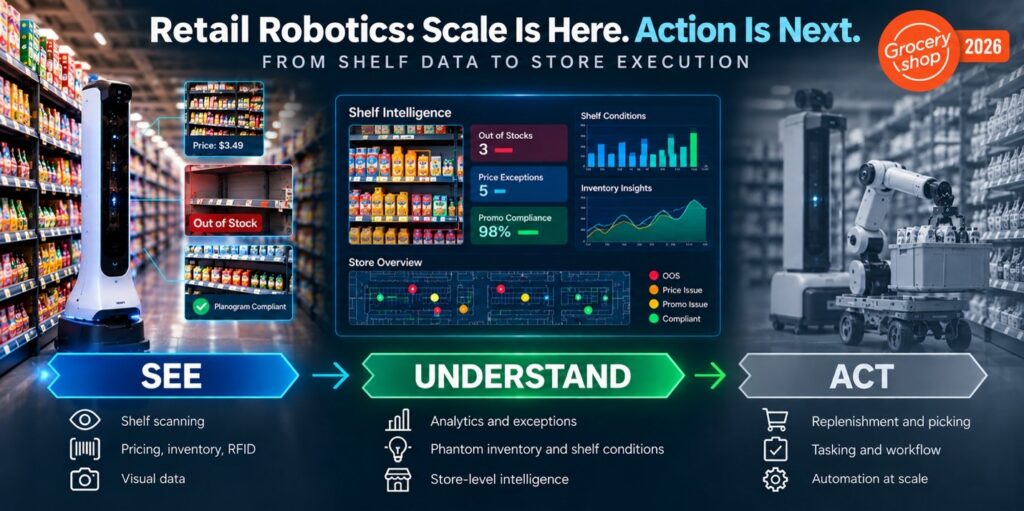
Groceryshop 2026 provided an opportunity to assess the state of retail robotics. Source: Georges Mirza
It has been more than a decade since I first helped to bring robots to live retail center stores. Long gone are retailers’ concerns about robots taking jobs, scaring kids, accidentally bumping into shoppers, or simply disrupting the grocery shopping experience.
It is good to see how much the industry has advanced; we have come a long way. Now that we are seeing scale, we can start using near-real-time shelf insights across more retail solutions. In this AI age of disruption, there is no excuse for not prioritizing and benefiting from these insights.
Is the broader retail solution space ready to advance and make this data actionable? I attended Groceryshop 2026 last month to find out.
Simbe continues to scale with Tally robot
The major announcement came from Simbe Robotics, which has now completed the rollout of 3,000 Tally robots globally across retailers and countries. With an ongoing rollout at a Tier 1 retailer, that number will quickly grow, marking another major accomplishment for robotics in retail.
Simbe has also been proactive in building capabilities to make its data actionable, from analytics dashboards to virtual store tours. That proactive approach will be critical to staying relevant as the retail technology environment continues to evolve.
How far can Simbe go on its own in developing these capabilities before it begins to overlap with established solutions? And how quickly will those established solutions begin consuming this new source of shelf data? A new way of thinking is certainly needed across the industry. It remains to be seen whether this disruption will trigger the change that is needed.

Badger Technologies builds a retail intelligence layer
Badger Technologies appears to be making a similar transition. In my discussion with its newly appointed CEO, John Gehre, at Groceryshop, he described Badger as evolving from a robotics company into a retail intelligence company.
The robot remains the platform for capturing shelf and store data, but the focus is shifting toward making that information actionable, down to how it can improve decisions and execution at the individual store level.
Moving beyond the basics of identifying out-of-stocks and price tags, Badger is exploring whether the continuous data collected as the robot moves through the aisle can be applied to estimate how much product remains on the shelf, when replenishment is needed, and when it will reach peak freshness.
The company continues to stand out with its multifunctional robotic platform, as well as the engineering and manufacturing scale of Jabil behind it. The question is whether it can now leverage those advantages to move faster.

ShelfOptix rethinks the deployment model
ShelfOptix is taking a somewhat different approach to scaling retail robotics. While continuing to strengthen its computer vision and actionable shelf intelligence powered by BrainOS, the more interesting differentiator may be its deployment model.
The company is targeting smaller-format retailers, including drug, convenience, dollar, and regional grocery, with a foldable robot that can travel between stores escorted by a human rather than remain permanently deployed in one location.
That model lowers the hurdle of dedicating a robot to every store and opens the door to recurring audits across a broader footprint. It is a practical approach to matching the economics of robotics to the needs of different retail formats.

Blue Collar Robotics picks up the retail slack
Newcomer Blue Collar Robotics participated in the startup pitch and was selected as a finalist. The company is taking on a harder but potentially more transformative retail use case: physically picking products in the store.
Rather than focusing on shelf scanning, the startup is developing a mobile robot designed to move products between shelves and carts, with initial customer trials planned as it works toward commercialization. The challenge is significant, requiring navigation, vision, picking, controls, and back-end integration to work together reliably.
This is ultimately what I believe will be the long-term role for robots in retail stores: moving from observing retail execution to actually performing it. It is an exponentially more difficult use case that the industry is beginning to pursue, and it will take time to mature before robots can deliver accurately, repeatedly, at scale, and with speed.

MUSE expands modular approach to retail
MUSE, last year’s Shark Reef Startup Pitch winner, was back at Groceryshop continuing to expand the capabilities of its modular robotic platform. The robot moves product through the store, allowing store labor to focus on restocking.
The company has added modules to guide customers to item locations and support in-store promotions. It is also developing additional modules for picking and replenishment, security, and floor cleaning.
With additional funding and a pilot underway with a small U.S. store chain, MUSE is looking to grow and gain a stronger foothold in the U.S. market. It is a very aggressive and wide-ranging approach to expanding the robot’s capabilities.
I will be watching how the company takes what it learns from deployments, along with recent technology advances, to deliver against an equally aggressive roadmap.

The path toward end-to-end shelf automation
As robots become increasingly capable of continuously collecting pricing, inventory, RFID, and visual data, simply delivering another data feed or API is no longer enough. The next competitive battleground will be how effectively that intelligence is translated into actions that improve store execution.
This will accelerate as legacy solutions begin to ingest this data. I still believe many of these decade-old systems will become far more relevant when they start consuming actual shelf conditions instead of relying on plan data, random compliance checks, and point-of-sale data without a true understanding of the retail real estate that generated the sale.
That will be a major step toward end-to-end shelf automation. It will make some existing shelf solutions obsolete – a welcome outcome – and make others far more relevant.
The future is here, more so than ever. What an era to be living through and observing, as innovation begins to deliver accurately, repeatedly, at scale, and with speed – at a velocity still unfamiliar to this industry.

About the author
Georges Mirza has been at the forefront of retail and consumer packaged goods (CPG) innovation, building market-leading category management and retail analytics solutions that achieved majority market share. He pioneered advancements in robotic data collection and image recognition, addressing challenges like out-of-stocks and inventory accuracy.
Today, Mirza advises and collaborates with retail and technology leaders to shape and scale next-generation growth strategies. Follow him on LinkedIn or X.
The post Groceryshop 2026 shows that retail robots are ready to scale, use AI appeared first on The Robot Report.
View Source


